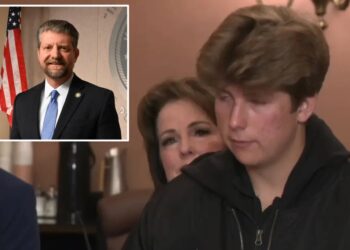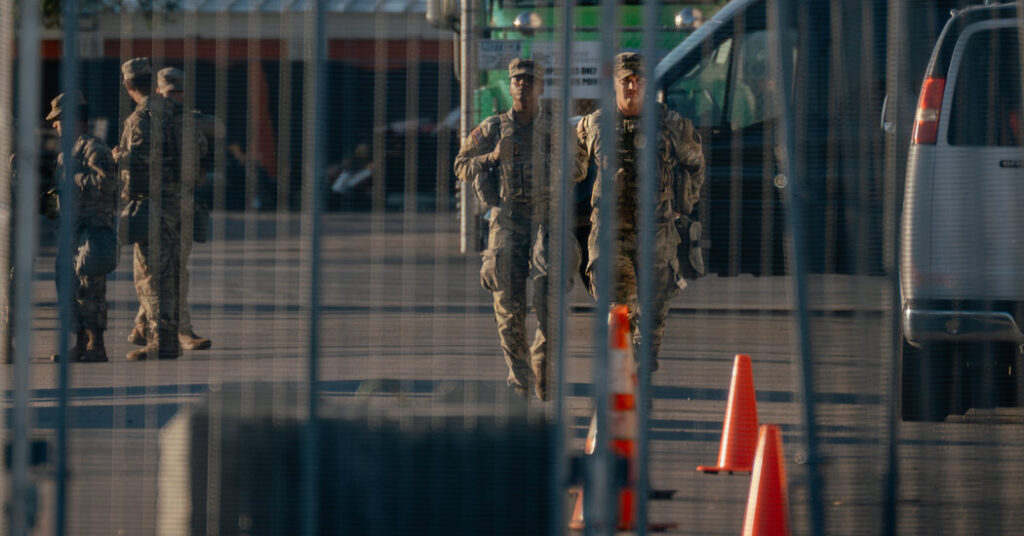
The Supreme Court’s refusal on Tuesday to let the Trump administration deploy National Guard troops in the Chicago area was in large part the result of a friend-of-the-court brief submitted by a Georgetown University law professor named Martin S. Lederman.
The argument Professor Lederman set out, and the court’s embrace of it, could help shape future rulings on any further efforts by President Trump to use the military to carry out his orders inside the United States.
Professor Lederman’s brief said that the government had misunderstood a key phrase in the law it had relied on, which allows deployment of the National Guard if “the president is unable with the regular forces to execute the laws of the United States.”
The administration said “the regular forces” referred to civilian law enforcement like Immigration and Customs Enforcement. Professor Lederman argued that the great weight of historical evidence was to the contrary.
The regular forces, he wrote, was the U.S. military. And, he added, “there is no basis for concluding that the president would be ‘unable’ to enforce such laws with the assistance of those forces if it were legal for him to direct such a deployment.”
Professor Lederman wrote his brief over a weekend. “I hesitate to acknowledge that,” he said on a podcast last month, “but it’s really true that I didn’t have like some great background knowledge in this statute.”
A veteran of the Office of Legal Counsel, the elite Justice Department unit that advises the executive branch on the law, Professor Lederman identified what he called a glaring flaw in the administration’s argument. “None of the parties were paying attention to it,” he said.
But the justices were. A week after Professor Lederman filed his brief, the court ordered the parties to submit additional briefs on the issue he had spotted. They did, and almost two months passed.
In the end, the majority adopted the professor’s argument, over the dissents of the three most conservative justices. It was the Trump administration’s first major loss at the court in many months. During that time, the court granted about 20 emergency requests claiming broad presidential power in all sorts of other settings
The loss in the Illinois case, however, was temporary and provisional, and all but dared the administration to make more extreme arguments. In particular, Mr. Trump could turn to the Insurrection Act, which he has not yet invoked to deploy military forces on domestic soil.
Mr. Trump has long floated the possibility of invoking the act, which gives the president the power under certain circumstances to use military forces to quell widespread public unrest and to support civilian law enforcement agencies. Mr. Trump said in October that he considered the Insurrection Act a possible “way to get around” the opposition to deploying the National Guard to support his deportation campaign. But doing so, he added, had not yet proven necessary.
The loss in the Supreme Court on Tuesday still stung, particularly because it appeared to bar, at least in the short term, similar National Guard deployments in Los Angeles and Portland, Ore.
Two of the dissenting justices criticized the majority for entertaining an argument not presented by a party to the case.
.css-1mxer6r{max-width:600px;width:calc(100% – 40px);margin:1.5rem auto 1.75rem;height:auto;margin-left:auto;margin-right:auto;font-family:nyt-franklin;color:var(–color-content-secondary,#363636);border-top:1px solid var(–color-stroke-quaternary,#DFDFDF);border-bottom:1px solid var(–color-stroke-quaternary,#DFDFDF);padding-top:20px;padding-bottom:20px;}@media only screen and (min-width:1024px){.css-1mxer6r{width:600px;}}.css-1medn6k{font-family:nyt-franklin,helvetica,arial,sans-serif;font-weight:500;font-size:1.0625rem;line-height:1.5rem;}@media only screen and (max-width:480px){.css-1medn6k{font-size:1rem;line-height:1.375rem;}}.css-1f84s5v{font-weight:700;font-size:1.0625rem;}@media only screen and (max-width:480px){.css-1f84s5v{font-size:1rem;}}.css-1f84s5v a{color:var(–color-signal-editorial,#326891);-webkit-text-decoration:underline;text-decoration:underline;}.css-1f84s5v a:hover{-webkit-text-decoration:none;text-decoration:none;}.css-1hvpcve{font-size:17px;font-weight:300;line-height:25px;}.css-1hvpcve em{font-style:italic;}.css-1hvpcve strong{font-weight:bold;}.css-1hvpcve a{font-weight:500;color:var(–color-content-secondary,#363636);}.css-214jt4{margin-top:15px;margin-bottom:9px;}@media only screen and (max-width:480px){.css-214jt4{font-size:14px;margin-top:15px;margin-bottom:10px;}}.css-214jt4 a{color:var(–color-signal-editorial,#326891);-webkit-text-decoration:underline;text-decoration:underline;font-weight:500;font-size:16px;}@media only screen and (max-width:480px){.css-214jt4 a{font-size:13px;}}.css-214jt4 a:hover{-webkit-text-decoration:none;text-decoration:none;}.css-1mxer6r{max-width:600px;width:calc(100% – 40px);margin:1.5rem auto 1.75rem;height:auto;margin-left:auto;margin-right:auto;font-family:nyt-franklin;color:var(–color-content-secondary,#363636);border-top:1px solid var(–color-stroke-quaternary,#DFDFDF);border-bottom:1px solid var(–color-stroke-quaternary,#DFDFDF);padding-top:20px;padding-bottom:20px;}@media only screen and (min-width:1024px){.css-1mxer6r{width:600px;}}.css-1medn6k{font-family:nyt-franklin,helvetica,arial,sans-serif;font-weight:500;font-size:1.0625rem;line-height:1.5rem;}@media only screen and (max-width:480px){.css-1medn6k{font-size:1rem;line-height:1.375rem;}}.css-1f84s5v{font-weight:700;font-size:1.0625rem;}@media only screen and (max-width:480px){.css-1f84s5v{font-size:1rem;}}.css-1f84s5v a{color:var(–color-signal-editorial,#326891);-webkit-text-decoration:underline;text-decoration:underline;}.css-1f84s5v a:hover{-webkit-text-decoration:none;text-decoration:none;}.css-1hvpcve{font-size:17px;font-weight:300;line-height:25px;}.css-1hvpcve em{font-style:italic;}.css-1hvpcve strong{font-weight:bold;}.css-1hvpcve a{font-weight:500;color:var(–color-content-secondary,#363636);}.css-214jt4{margin-top:15px;margin-bottom:9px;}@media only screen and (max-width:480px){.css-214jt4{font-size:14px;margin-top:15px;margin-bottom:10px;}}.css-214jt4 a{color:var(–color-signal-editorial,#326891);-webkit-text-decoration:underline;text-decoration:underline;font-weight:500;font-size:16px;}@media only screen and (max-width:480px){.css-214jt4 a{font-size:13px;}}.css-214jt4 a:hover{-webkit-text-decoration:none;text-decoration:none;}
Got a news tip about the courts? If you have information to share about the Supreme Court or other federal courts, please contact us.
See how to send a secure message at nytimes.com/tips
“If a party passes up what seems to us a promising argument, we do not assume the role of advocate,” Justice Samuel A. Alito Jr. wrote in the first paragraph of his 16-page dissent, which was joined by Justice Clarence Thomas. “Instead, we normally decide the questions that the parties choose to present.”
The third dissenter, Justice Neil M. Gorsuch, also wrote that he was inclined to ignore Professor Lederman’s argument, noting that the parties’ initial briefs assumed that the president could “call up and deploy the National Guard when he is unable to execute federal law with civilian federal law enforcement officials.”
The professor’s argument appealed to some of the court’s other conservative members because it was grounded in textualism, bearing down on the actual words Congress used in the statute.
The law at issue, adopted in 1903 and 1908, said deployments were allowed for three reasons. Everyone involved agreed that the first reason, concerning foreign invasions, did not apply to the events in Illinois.
The second permissible reason for deploying the Guard was if a rebellion was underway or there was danger of one. That is a stretch, and the majority did not cite it, much less discuss it.
The court’s order focused on the third reason: the president’s right to deploy the National Guard if he is unable to execute laws “with regular forces.”
In its order asking for additional briefs, the court asked the parties to address “whether the term ‘regular forces’ refers to the regular forces of the United States military.”
The administration responded that “regular forces” referred to civilian law enforcement personnel. Professor Lederman disagreed.
“Whenever anyone in one of the three branches discussed ‘the regular forces’ in relation to the militia, the National Guard or the volunteer forces,” he wrote, “they were referring to those persons serving within the standing U.S. military, particularly in the Army.”
The majority tentatively agreed. “We conclude that the term ‘regular forces’” in the statute “likely refers to the regular forces of the United States military,” its unsigned opinion said.
The administration had not shown that the regular troops could not do the job, the majority said, adding that it was doubtful that protecting federal personnel and property in Illinois amounted to executing the law.
So far, Mr. Trump has not tried to send the regular military into the streets. But the court’s ruling on Tuesday might encourage him to do so.
Whether he can do that is a complicated question involving two statutes: the Posse Comitatus Act, which prohibits using federal troops for law enforcement unless a federal law expressly authorizes it, and the Insurrection Act, which may provide that authorization in some circumstances.
In a concurring opinion on Tuesday, Justice Brett M. Kavanaugh wrote that “the court’s opinion does not address the president’s authority under the Insurrection Act.” He added that “one apparent ramification of the court’s opinion is that it could cause the president to use the U.S. military more than the National Guard to protect federal personnel and property in the United States.”
Justice Kavanaugh also used his concurring opinion to clarify or revise a concurring opinion he issued in September on immigration stops in the Los Angeles area. He had written that “apparent ethnicity alone cannot furnish reasonable suspicion,” but “under this court’s case law regarding immigration stops, however, it can be a ‘relevant factor’ when considered along with other salient factors.” In a footnote on Tuesday, Justice Kavanaugh wrote that “officers must not make interior immigration stops or arrests based on race or ethnicity.”
In an interview, Professor Lederman said he had little to add to what he had told the court. But he did say one thing.
“I was pleased that, as I suggested in my brief, the court did not opine on the application of the Insurrection Act,” he said, “which raises a whole different set of concerns.”
Adam Liptak covers the Supreme Court and writes Sidebar, a column on legal developments. A graduate of Yale Law School, he practiced law for 14 years before joining The Times in 2002.
The post How a Scholar Nudged the Supreme Court Toward Its Troop Deployment Ruling appeared first on New York Times.