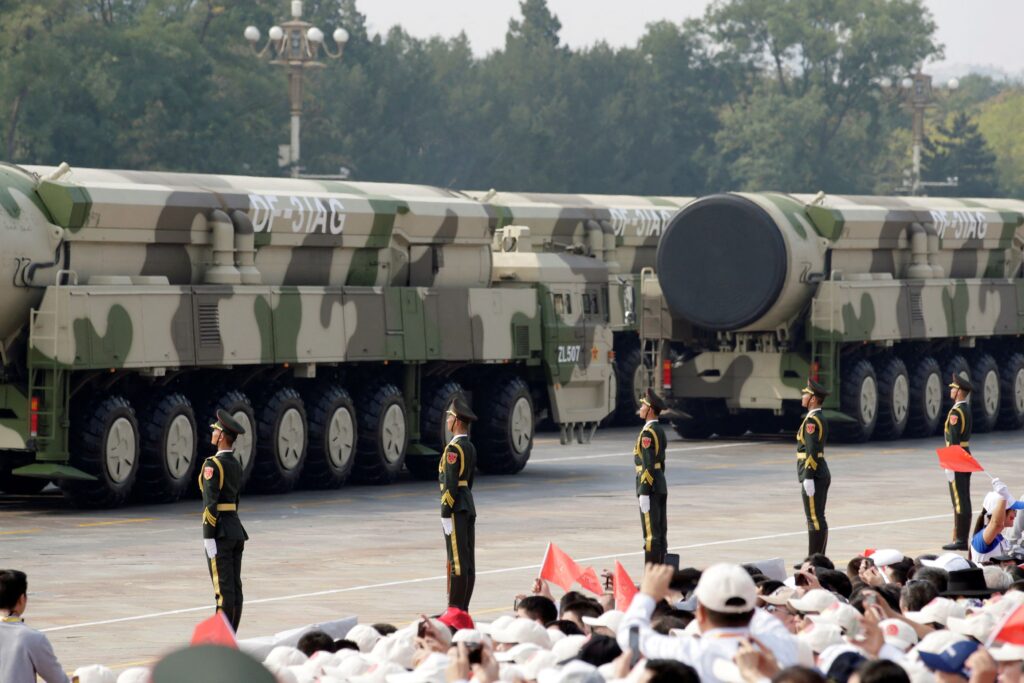
The Pentagon assesses that China’s production of nuclear warheads has slowed after a rapid buildup since 2020, with fewer new weapons added to its arsenal. But China’s program continues to expand, focusing on lower-yield nuclear weapons and early counterstrike capabilities, and remains on track to field 1,000 warheads by the end of the decade.
The China Military Power Report — an annual unclassified Pentagon assessment of Beijing’s capabilities delivered to Congress — departs from the language of recent editions that emphasized the looming challenge of China’s military buildup, instead highlighting President Donald Trump’s efforts to stabilize ties with the world’s fastest-growing military power.
Beijing’s total nuclear warhead arsenal likely remained in the low 600s, the report says, similar to last year’s figures, “reflecting a slower rate of production” — down from the estimated 100 additional warheads a year since 2020. The report notes that the People’s Liberation Army is, however, continuing “its massive nuclear expansion,” and showing “no appetite” for arms control discussions.
The report strikes an overall more conciliatory tone on Beijing’s military ambitions. Where last year’s assessment described Beijing as the “pacing challenge” for the U.S. military — a term also used during Trump’s first administration, this year’s report describes China’s rapidly expanding military as a “logical” result of the country growing more wealthy and powerful.
“President Trump seeks a stable peace, fair trade, and respectful relations with China, and the Department of War will ensure that he is able to achieve these objectives,” it reads.
Despite the shift in tone, the report lays out mounting challenges posed by Beijing’s ambitions to assert control over Taiwan and expand a conventional missile force that is increasingly approaching U.S. capabilities.
Analysts say it highlights the challenges facing the Trump administration in balancing efforts to prioritize U.S. interests in trade while projecting military dominance in the Indo-Pacific.
“There’s an inherent contradiction running through the report: it lays bare the scale of China’s military expansion and Taiwan ambitions while simultaneously suggesting the relationship is stabilizing. Those two stories can’t be reconciled — no matter how hard the administration tries to preserve the trade truce,” said Craig Singleton, senior China fellow at the Foundation for Defense of Democracies think tank.
The annual military assessment comes as Trump prepares to travel to Beijing next year, following a trade détente reached with Chinese leader Xi Jinping in South Korea that eased tensions over Trump’s aggressive tariff program and Beijing’s weaponization of its rare-earth monopoly.
The report comes as the White House is signaling different priorities on China. The recently released National Security Strategy — a document outlining the administration’s defense priorities — frames China’s challenge more in economic terms while shifting the U.S. focus to threats in the Western hemisphere.
Even as tensions have eased since the South Korea meeting, national security frictions continue to flare up between the two countries. On Monday, Beijing reacted angrily to the U.S. seizure of a Venezuelan oil tanker en route to China amid escalating tensions between Washington and Caracas. Chinese officials also strongly condemned the approval of a record $11 billion U.S. weapons package for Taiwan last week.
The Pentagon report notes that Beijing is ramping up efforts to “coerce” Taiwan to unify with China through a campaign of military patrols — including a twofold increase in incursions into Taiwan’s air defense identification zone between 2023 and 2025 — and using increasingly aggressive political rhetoric as part of a campaign to undermine the island’s independent rule.
China’s embassy in Washington, D.C., did not immediately respond to a request for comment.
Despite producing fewer nuclear warheads, China’s broader nuclear program has expanded in other ways, including the development of more versatile low-yield weapons and upgrades to its counterstrike systems, the report notes. China has likely loaded more than 100 intercontinental ballistic missiles into desert silos, advancing capabilities for long-range strikes closer to U.S. territories.
At over 600 nuclear warheads, China’s arsenal remains far smaller than U.S. stockpile of around 3,700, but the report says upgrades in China’s program likely have enhanced its ability to rapidly retaliate. “This reliance on the strategic level of deterrence — likely nuclear weapons, but also cyber and space capabilities — indicates the growing confidence and comfort the PLA has with conventional escalation,” it said.
The significance of China’s expanding arsenal has been thrown into sharper relief amid rising global tensions over nuclear weapons. Russia has stepped up nuclear intimidation since its invasion of Ukraine, while Trump has ordered the United States to resume nuclear testing “immediately,” accusing Moscow and Beijing of skirting a three-decade moratorium.
Analysts said a slow down in the production of nuclear weapons could also point to changes in China’s threat perception. “Beijing may currently perceive a reduced existential threat from the United States and, accordingly, less urgency to pursue nuclear expansion at maximum speed than during the peak of U.S.-China hostility around 2021,” said Tong Zhao, a nuclear specialist and senior fellow at the Carnegie Endowment for International Peace.
He added that China’s 2023 overhaul of the PLA Rocket Force following a corruption scandal could mean the country is working to “prioritize internal reform and more sustainable, effective long-term growth.”
Elsewhere, the Pentagon report notes China’s advance of military programs in artificial intelligence, biotechnology, quantum technology, and advanced semiconductors — partly through acquisitions of U.S. technology. While restrictions on high-end processors have constrained China’s AI industry, illicit smuggling networks have likely allowed companies such as Deepseek and Huawei to obtain U.S. semiconductors for projects with potential military significance.
The Trump administration has sought to balance U.S. security and trade with Beijing — maintaining restrictions on some high-end chips while, earlier this month, lifting controls to allow approved customers in China access to advanced Nvidia H200 semiconductors.
“The Pentagon is warning that China already treats advanced accelerators as a strategic asset — using intermediaries and shell networks to evade controls — so the White House’s desire to reopen the export spigot is strategically backward,” Singleton said. “It turns an enforcement problem into a policy choice that strengthens exactly the capability the report flags as a growing threat.”
The post Pentagon says China’s nuclear warhead growth slows, commits to stabilizing tensions appeared first on Washington Post.