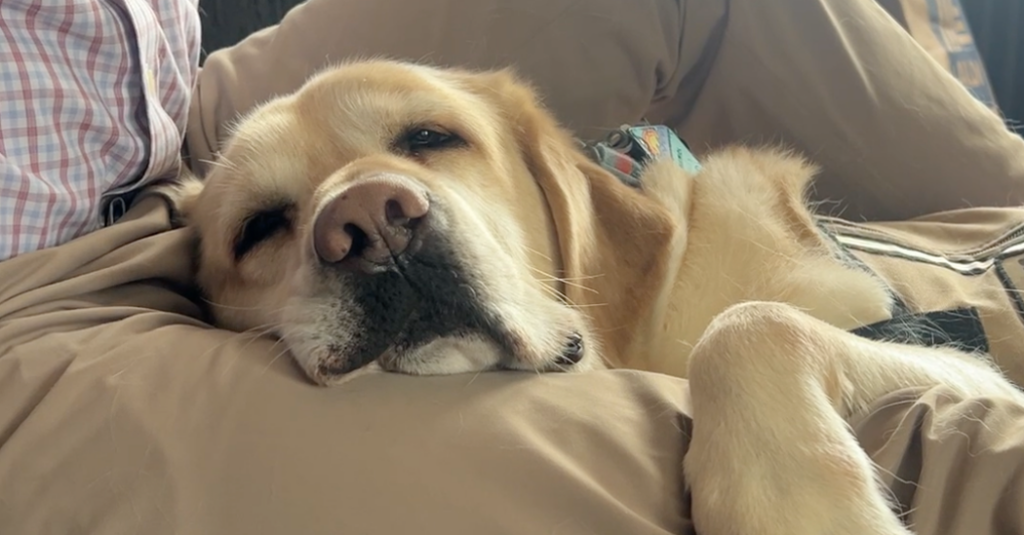
Almost every night, Party, a 65-pound Labrador retriever, intercepts nightmares.
Party jumps onto Marshall Bahr’s chest, rousing him before he wakes up — heart hammering, gasping for air. Dr. Bahr, 40, gives the dog a treat, thanks him and goes back to sleep.
For almost seven years, Dr. Bahr served as a combat medic with the U.S. Army Rangers, deploying five times to Iraq and Afghanistan. Those experiences followed him home, and he was soon diagnosed with post-traumatic stress disorder, a condition that affects almost 10 percent of U.S. military veterans.
At night, Dr. Bahr would get only an hour of sleep, his mind dragging him back to the battlefield. By day, he would be so exhausted that he couldn’t distinguish flashbacks from hallucinations.
He tried white-knuckling it at first, working out constantly and taking pills to sleep. But after years of trying to manage on his own, Dr. Bahr went down to the basement, raised a gun to his head and pulled the trigger. Nothing happened; he had forgotten to load the gun.
He broke down sobbing, ashamed and rattled — but a little relieved. “It was completely dark and then, all of a sudden, a little flicker of hope,” Dr. Bahr said.
Four months later, America’s VetDogs matched him with Party, a “pure bundle of joy” who helped steady his mind.
Dr. Bahr is part of growing cadre of veterans using service dogs for PTSD relief. In a 2024 study, veterans with service dogs were followed for three months and found to have less severe PTSD, depression and anxiety than those on the waiting list.
This research doesn’t say whether service dogs caused these mental health benefits or how long they might last.
Still, many veterans say these dogs make life more manageable. They are trained to catch subtle signs of distress, like thumping legs or a hitch in breathing, said Maggie O’Haire, a human-animal interaction expert at the University of Arizona. But researchers suspect that service dogs can also smell the chemical changes that accompany stress and anxiety.
Labrador retrievers are among the most common breed of service dogs, prized for their steadiness and eagerness to bond.
With a nuzzle or a tug of the leash, these dogs can interrupt the swell of panic in veterans, Dr. O’Haire said. “They know your environment is not filled with danger,” she explained, so they help veterans ground themselves.
Becca Stephens was carefree and idealistic before she enlisted. But when she returned home to Clearwater, Fla., after four years as an Army signal support specialist, Ms. Stephens felt like a specter of herself — distant, short-tempered and lost.
Everything felt too loud and too bright; she couldn’t seem to unclench.
Ms. Stephens, 41, was prescribed opioids for back pain, but she started self-medicating when they ran out. In February 2012, she called a dealer for Percocet. He offered heroin instead. She refused. Then the withdrawal set in — nausea, panic — and she called back.
“That was the first time I had done heroin,” Ms. Stephens said.
She went through detox, rehab and outpatient therapy for years, but she always relapsed. “Every time I tried, I didn’t have a purpose; I didn’t have any hope,” Ms. Stephens said.
On a doctor’s suggestion, she applied for a service dog through K9s for Warriors and, in August 2018, received Bobbi, who was just over a year old.
Bobbi was standoffish and reluctant to show affection at first. But Ms. Stephens saw herself in the yellow Labrador retriever and knew she’d have to earn her trust.
Love took time, but the help was immediate. At an A.T.M. or in a grocery store line, Bobbi watched Ms. Stephens’s back. In a crowd, Bobbi stood tall, creating space around Ms. Stephens so that she didn’t feel hemmed in.
And Bobbi has helped Ms. Stephens stay sober.
Researchers see routines and social support as the scaffolding of recovery. Bobbi gives Ms. Stephens’ days a rhythm and, with those soft brown eyes, provides the reassurance that she deserves a future.
“I have to get out of bed to take care of her,” Ms. Stephens said of Bobbi. “She needs me.”
While service dogs can be helpful, the path to getting one is often steep. Since the Department of Veterans Affairs doesn’t run such programs, nonprofits fill the gap.
Each dog can cost about $50,000 and take 18 months to train, said Erin Hecht, director of the Canine Brains Project at Harvard University. And about half of service dogs that enter training don’t graduate, she added.
While many veterans are left on long waiting lists, others struggle to meet eligibility guidelines. In general, veterans need to be on V.A. disability benefits to qualify, but in 2024, over one-third of veterans’ claims for disability were denied — many rejected because of missing documentation or other bureaucratic hurdles.
Keith Hudson, 55, spent two years waiting, after trying nearly every PTSD treatment available to him. Therapists seemed like they didn’t care; anxiety medications made him feel “like a zombie roaming around,” he said.
Mr. Hudson served for nearly two decades in the Marine Corps. But back home, he felt as if he were stuck on patrol — scanning rooms for threats, never letting his guard down.
He cycled through three marriages and 14 jobs, unable to get out of his own way. A friend from the Marines eventually called him out: “At some point it’s you,” Mr. Hudson recalled his friend saying. “It’s not everybody else’s fault all of the time.
His buddy suggested he check out K9s for Warriors to help him manage his PTSD. Mr. Hudson wasn’t a dog person, but he remembered thinking: What do I have to lose?
Cessna, a yellow Labrador retriever, helps Mr. Hudson keep his peace.
During social interactions, Cessna notices when Mr. Hudson is getting anxious or riled up. She’ll nudge him, so that he focuses on her and calms down.
“Cessna doesn’t stop my anxiety from bubbling up, but she allows me to get through it,” he said.
Service dogs aren’t a panacea, and they’re meant to complement, not replace, other PTSD treatments, said Leanne Nieforth, a human-animal interaction expert at Purdue University.
There’s early evidence that service dogs can help veterans stick with their antidepressant medications. But for many veterans, the companionship and real-time support matter most.
Party, for example, gives Dr. Bahr space to breathe and courage to keep showing up.
“He’s my battle buddy,” Dr. Bahr said, “my constant reminder that I’m not fighting alone.”
Simar Bajaj covers health and wellness.
The post The Service Dogs Helping Veterans With PTSD appeared first on New York Times.