Catholicism is hot right now. The new American pope is popular for speaking his mind on political subjects such as AI and the death penalty. On Instagram and TikTok, Catholic influencers rank local Masses and their favorite Christmas hymns, and priests go viral for DJ’ing raves, while others protest ICE raids. The Catholic Church is at the center of the new Knives Out film, which premiered at No. 1 on Netflix this month. And more and more young people are going to Mass.
Today’s youth aren’t particularly religious. The Pew Research Center reports that 44 percent of 18-to-29-year-olds are unaffiliated with a faith. Yet at the same time, Catholic Gen Z is showing up strong. A new survey from the Catholic Leadership Roundtable found that members of Gen Z are now the most engaged Catholics—attending Mass, confession, and parish functions more frequently than any other generational cohort. (They are followed closely by Millennials.) Young people are also driving a spike in conversions. TheNational Catholic Register reports that many American dioceses are seeing annual increases in conversions of 30 percent, 40 percent, and even higher.
Many converts discover the faith on social media. Catholicism—with its stained glass and embroidered robes—is particularly well suited to a visual medium that sells beautiful imagery. But clergy members are also meeting the moment, evangelizing to young people where they are. Father Mike Schmitz, a handsome priest in the diocese of Duluth, Minnesota, has popular YouTube and Instagram pages and hosted a podcast called The Bible in a Year. Bishop Robert Barron runs Word on Fire, an online ministry that claims to reach “millions of people to draw them into—or back to—the Catholic faith.”
The Catholic Church is almost 2,000 years old. Its origins trace back to the Pentecost of the Upper Room in Jerusalem, and its earliest followers are believed to be the disciples of Jesus himself. About 500 years later, the Church gained strength in the chaos that followed the collapse of Rome, where a weak emperor had led to a power vacuum. The Church offered order. Leadership. Community. Ritual. Beauty. Education. Transcendence. These are the same values that young Catholics today cite as drivers of their devotion. The Church offers an answer to the synthetic remove of AI and digital culture, the isolation of contemporary culture, the disorder of government and institutions.
If more young people turn to the Church, Catholicism may finally see an end to its long decline in America. (Catholicism isn’t alone—the ranks of Christians in general have dwindled since the 1960s.) A 2023–24 Pew survey found that for every person who had converted to Catholicism, 8.4 Catholics had left the faith. Nineteen percent of Americans are Catholic; another 13 percent are former Catholics. The most recent big decline in church attendance began in the 2010s, right around the time that I stopped going to Mass.
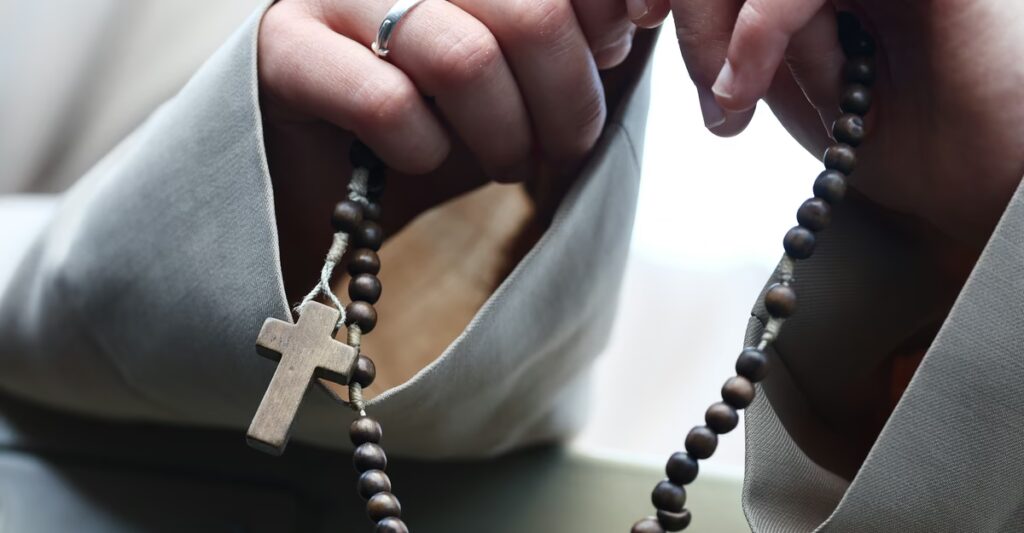
Few experiences in modern life are as wondrous as a really good Christmas Vigil Mass. It’s a full sensory encounter: the sight of the chapel, decked out for the holidays; the smell of the incense; the sound of the choir singing “Adeste Fideles” or “Hark! The Herald Angels Sing”; the taste of the Communion wafer; the heavy feel of the chalice when you sip your Communion wine. The message, every year, is that no matter the state of the world, goodness can be born anew.
I don’t remember the last time that I let myself experience this.
Many Catholics can’t tell where the Church ends and our families begin. The values and customs of the Church are as tied up in our identity as language and nationality. I was raised Catholic, as were my mother and father, and their mother and father before that, going back so long, time ceases to matter. We simply were as we always were: Catholic. Every week, we went to Mass. College threw me for a loop logistically, but I never had a crisis of faith. I was back in the pew in my young adulthood.
My break with the Church began, as it did for many, in 2002, when The Boston Globe published the story of priests preying on children that led to an avalance of heartbreakingly similar stories of sexual abuse and systemic cover-up. I was 25 and repulsed. But it was the Church. And these were a few bad eggs.
I met a nice Catholic boy and we married in a Brooklyn basilica. I even befriended the priest who married us. When he retired, I’d visit him in the old-age home for priests and we’d talk about books. And the stories of abused children kept coming.
In 2008, I got divorced. Committed a sin. And was told that for a $5,000 annulment—a sum I neither had nor wanted to spend—the Church could act like the marriage had never happened. And the stories of abused children kept coming.
I continued to go to Church. My cousin, who is gay, had recently moved to Brooklyn. Week after week, I was told from the pulpit that he shouldn’t have a right to marry. And the stories of abused children kept coming.
I was sitting in Mass as a sinner—a divorcée, unable to receive Communion. My nearest kin was unwelcome because of whom he wanted to love. And a Church whose own sins I was trying so hard to ignore kept telling me how to vote: always for the candidate who would best protect the lives of unborn children. I kept thinking, But who will protect the children from you?
I left Mass and the Church and can count on my fingers the number of times I’ve returned since.
But the Church never left me. I am secular, liberal, upper-middle-class—I’ve tried yoga, transcendental meditation, and other faiths, and nothing reaches me in the same way as those old smells and bells. My brain is wired Catholic. So I reconciled myself to this detached spiritual life—one where, to quote Sojourner Truth, “I talk to God and God talks to me.”
Then, this fall, I was at a book festival where the Italian American author Adriana Trigiani defended her Catholic faith as part of her cultural inheritance—a shaping force in her life as important as being Appalachian and working-class and Italian. I realized that this is what I gave up: communion and Communion; quiet genuflection and ritual; a cultural practice that had been in my family for generations. My grandparents are dead now—I gave up one of the last activities we shared.
Not out of laziness. Not even because of politics. I gave the Church up because, when it betrayed those children, it betrayed us all.
The Church reacted to the revelations at first with denial and hostility, and eventually with payouts and apologies. In 2018, Pope Francis issued a letter expressing remorse to all of the “people of God” who had been hurt by the decades of sexual abuse and cover-up. Still, until 2019, Church leaders in New York State attempted to block the Child Victims Act, which extended the statute of limitations on victims of child abuse so they could come forward (the Church withdrew its opposition after the law was broadened beyond the Church to include victims of abuse by members of public institutions). When, earlier this month, then-Cardinal Timothy Dolan announced that the New York archdiocese would sell off property to help compensate about 1,300 victims, he sounded exhausted by apologizing: “As we have repeatedly acknowledged, the sexual abuse of minors long ago has brought shame upon our church,” he wrote in an email. “I once again ask forgiveness.”
Repetitive apologies are not the same as penance, which many Catholics feel has never happened. I find myself almost envious of these Gen Z Catholics, who were too young to experience the abuse scandal as a betrayal, and who can receive all the goodness and glory of the Church without my ambivalence or resentment.
Anthony Gross is 22, a recent graduate of Washington University, and one of the new Catholic influencers online. He grew up in a suburb of Milwaukee and has been documenting on Instagram his recent move to New York City, including his effort to attend and rank the best Catholic Masses in Manhattan. The videos are charming, and often conclude with Gross tucking himself in at night, just beneath the cross hung over his bed.
Gross is, like me, a multigenerational Catholic. Unlike me, he has recommitted to the faith. When we spoke this month, he told me that he thought, “It’s time to start acting like a man.” He wanted to be more disciplined, more principled, more of a leader, and thought, “God is a big part of that.” (Church is also, he admits, not a bad place to meet like-minded young women.)
Young men are more religious than their female counterparts today. In an article called “How Catholicism Got Cool” in The Free Press, Father Charles Gallagher of Washington, D.C., said that the internet priests of the Church provided an answer to the “false prophets” of the “Manosphere.” The article also quoted a 21-year-old man and recent convert who said that the Catholic Church doesn’t “shame you for being a man,” and that he’s found both a wanted discipline and a brotherhood through the Church.
The priests Gross has encountered online and in real life, he said, have helped show him the kind of man he wants to be. When I point out that this feels ironic because they themselves won’t marry, the statement seemed to perplex him. “Priests are normal human beings,” he said. “It’s tough because there’s so much pressure put on them to be this perfect human being. And I feel a lot of empathy for them because they are human, just like every other person, and they screw up all the time, just like me and you.”
In that moment, I remembered that Anthony Gross hadn’t even been born when the Boston Globe story came out. His relationship with and appreciation of the priests he’s met and what his faith has done for him are not tainted by the pain of broken trust. And I could take that and dismiss it. Or I could remember the Gospel according to Matthew: When the disciples argue over who will be greatest in heaven, Jesus says, “Unless you turn and become like children, you will not enter the kingdom of heaven. Whoever humbles himself like this child is the greatest in the kingdom of heaven.”
Pope Leo XIV has an opportunity to bring Catholics like me back into the fold. He has not softened the Church’s pro-life stance, but has taken pains to make the sentiment more consistent: noting that pro-life relates to immigrants and gun control as much as the unborn. And, in a moment when many American Christian political figures are abandoning empathy, Leo has spoken out against political leaders using Jesus to justify cruelty. Many lapsed Catholics are taking notice.
Still, the Church’s sins keep surfacing. Just this past week, the diocese of Grand Rapids, Michigan, released a “complete accounting” of 51 priests accused of sexual misconduct since 1950. Whatever gesture comes next—whatever buildings get sold or apologies issued—it won’t be enough. Perhaps the Church will never be able to stop apologizing, and the scandals will never stop coming to light.
But also, perhaps the Church is not really the priests or the pope. It’s the people. It’s the young people looking for solace and a place to commune in a reckless, violent time. It’s generations of family members loving one another as they’d like to be loved, offering kindness to strangers, and opening the manger to whoever needs shelter and warmth.
This Christmas, after many years away, I’ve decided that I’m going to go to Mass.
The post What I Lost When I Gave Up My Catholicism appeared first on The Atlantic.