Fight scenes have been a fixture in movies since the dawn of commercial cinema. But every year action directors and stars try to dazzle audiences with a new spin on combat. They’ve made deadly weapons out of objects as innocuous as books, sex toys and carrots. They’ve staged battles in locations as improbable as Mount Rushmore, a carnivorous sand pit and the ceiling. And they’ve pushed the limits of how long a fight scene can last, how many combatants it can include, and the velocity with which blood can spurt. For world-class soldiers, secret agents and superheroes, the human body is an awe-inspiring machine capable of, well, just about anything.
There’s obvious pleasure to be found in the rising tension, balletic motion and physical impossibility of a great fight scene. But this year, the stunning “Mission: Impossible — The Final Reckoning” plane melee notwithstanding, I was more taken with a messier strain of cinematic scuffling. In films like “Friendship,” “The Phoenician Scheme,” “Eddington,” “Lurker,” “Splitsville,” and “Bugonia,” it’s not action heroes doing the fighting; it’s ordinary men. And these ordinary men may be taking cues from your John McClanes and John Wicks, but when push comes to shove what ensues is more awkward than epic.
In these films, the men doing the fighting tend to be siblings, friends or neighbors. And they resort to violence because they don’t know how to communicate with one another. Sometimes, as in the cringe comedy “Friendship” and the cringe psychological drama “Lurker,” the physical violence could be interpreted as an expression of repressed infatuation. Other times, a long-running (and often trivial) feud simmers until it boils over, as in “Eddington” and “The Phoenician Scheme.”
These films arrive amid a noisy resurgence of traditional masculinity. A crop of the most popular podcasters — often lumped together as part of the “manosphere” — have found appeal in their barroom humor, jock demeanor and interest in combat sports. Social media is awash in videos about “testosterone-maxxing” and high-protein diets aimed at bulking up. An increasing number of Gen Z men believe that the United States has become “too soft and feminine,” according to an article in The Guardian. And top tech executives are challenging each other to cage matches and promoting a more macho business culture.
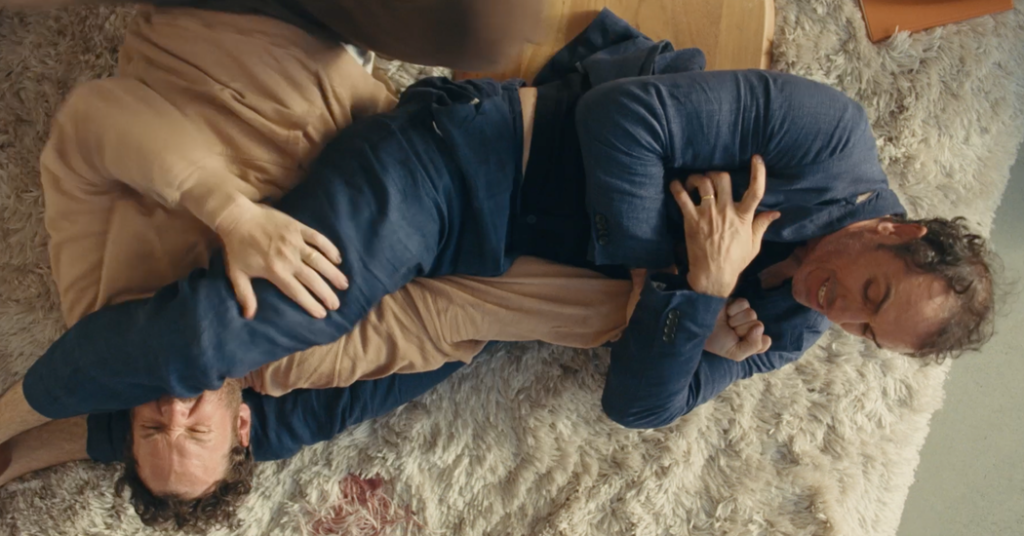
American men may be building stronger bodies, but these films suggest that they are more fragile than ever. The fights in question are rarely premeditated. Instead, insult leads to injury. In “Splitsville,” an absurdist comedy about a pair of couples experimenting with open relationships, Paul (Michael Angelo Covino) claims to be a “self-realized” sexual libertine. But when his best friend, Carey (Kyle Marvin), admits to having slept with Paul’s wife, he immediately slaps him. Paul insists that he isn’t mad, that the slap was “sort of a reflex.” But when Carey offers to talk about what he’s feeling, Paul slaps him again, leading to a six-minute-long fight in which the two men destroy Paul’s immaculate Hamptons lake house.
It’s telling that several of these fights begin with a slap. These men hardly know how to fight, and they are not out to kill, or even physically wound, each other. The slap is a reflexive gesture meant to put the other man in his place. It’s an assertion of dominance and a means of embarrassing a rival. Of course, the slapped can’t merely turn the other cheek, though. Rather than serving as the final word, a slap acts as a taunt. Fight back, or look weak.
The most extreme response to a slap comes in Ari Aster’s Covid-era neo-western comedy, “Eddington.” Pedro Pascal’s smarmy liberal mayor Ted Garcia reaches his breaking point in his clash with the town’s crank conservative sheriff, Joe Cross (Joaquin Phoenix), when Cross intrudes upon a party Garcia is hosting and commits the ultimate party foul — turning the volume down on Katy Perry’s “Firework.” Garcia slaps Cross in front of all his guests, and the shame brought on by the slap is compounded by the powerlessness Cross is feeling in his personal and professional life. He walks out of Garcia’s house with his tail between his legs. And then he snaps, leaving several dead bodies in his wake.
“Eddington” takes place in the sort of small desert town where American popular culture has traditionally celebrated cowboy hat-wearing, gun-toting men like Cross for their vigilantism. Cross likely imagines himself in the lineage of Clint Eastwood and John Wayne gunslingers. But the crux of his own crusade amounts to little more than the right to buy groceries unmasked in the middle of a pandemic. So what gives?
In Aster’s framing, the internet is the root of Cross’s undoing. He and Garcia have each been riled up by their online echo chambers, which have cast the other as less than human, in effect making violence permissible. Yorgos Lanthimos’s zany paranoid thriller, “Bugonia,” takes the dehumanizing effect of our current digital world a step further. Teddy (Jesse Plemons), a reclusive factory worker who’s spent too much time online, kidnaps a big pharma chief executive (Emma Stone) because he’s convinced she is an alien out to destroy the planet. When things don’t go as planned and she gets under his skin, he loses control, gallops across the dinner table, and attacks her.
But the internet is also acting on many of these men in more subtle ways. It’s common for them to be lonely and isolated, lacking friends and often having just lost a romantic partner. When they do try to engage with other people in the real world, they get weird. In “Lurker,” a loner named Matthew (Théodore Pellerin) adores a budding pop star named Oliver (Archie Madekwe). But in an intimate moment — the two men in Matthew’s bed, their faces inches apart — Matthew breaks the tension by saying, “Let’s wrestle,” and begins grappling and giggling hysterically. And in “Friendship,” Tim Robinson’s Craig ruins a nascent camaraderie with his cool weatherman neighbor, Austin (Paul Rudd), by hitting him with a cheap shot in a friendly boxing match. When Austin and his group of middle-aged friends get upset with Craig, he makes matters worse by sticking a bar of soap in his mouth as a self-punishment, saying, “I’m such a bad boy. I’m sowwy.”
Don’t get me wrong: It’s not as though grown men getting in silly fights, either onscreen or off, is an entirely new phenomenon. “The Phoenician Scheme,” which is set in the mid-20th century, interrupts a climactic fistfight between Zsa-zsa Korda (Benicio Del Toro) and his half brother, Nubar (Benedict Cumberbatch), to ask what their feud is even about. In Nubar’s telling, it all comes down to “who can lick whom.” There’s a degree to which that competitive drive may be eternal. And yet, it’s hard to recall a time when so many of the most powerful men in the world embraced anger and impatience so openly.
Which is what’s made these films’ anti-climactic clashes so impactful. Where a typical action movie fight scene produces a jolt, the fights in these films suck the air out of the room. If it wasn’t already clear that the fighting men should be embarrassed, many of these filmmakers include a shot where we see the perpetrators from the vantage point of a neutral third party. In the eyes of Austin’s friends, in “Friendship,” or Paul’s wife and son, in “Splitsville,” these men look pathetic, like misbehaving children.
The absurdity, of course, is the point. If you’re a secret agent or a soldier, you might have to throw a few punches. For the rest of us, giving in to the masculine fantasy of clobbering our way through conflict belies a very boyish lack of control.
Max Cea is a writer and filmmaker living in Brooklyn.
The post The Year’s Best Fight Scenes Had One Thing in Common appeared first on New York Times.