Alex Stevens is the manager of policy and communications at the Institute for Energy Research, where Samuel Peterson is a research fellow. IER receives contributions from individuals, foundations, and corporations, including oil and gas companies.
Agrowing chorus of news stories warns that artificial intelligence is driving an unprecedented surge in electricity demand, pushing up household bills and straining the grid. The concern is real. U.S. data centers currently consume roughly 4 percent of the nation’s electricity, with projections showing that the figure could climb as high as 12 percent by 2028. It raises the question: If demand is surging and prices are rising, why hasn’t supply kept pace? In an unfettered market, higher prices would trigger a supply response, prompting a rapid increase in investment and construction. Yet, in some states, that isn’t happening.
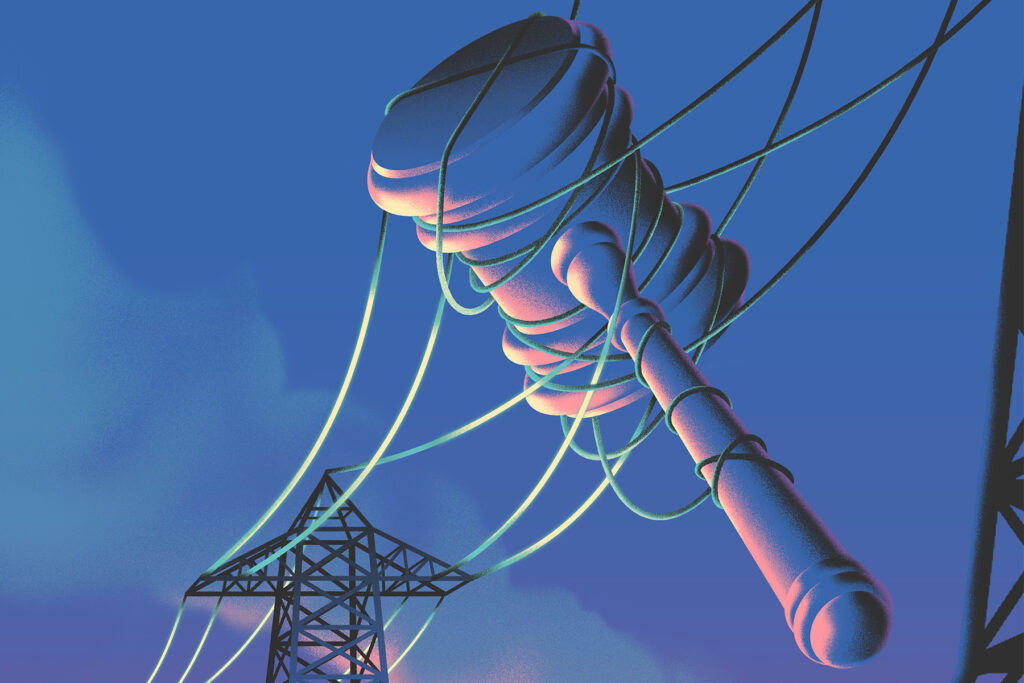
The reason? Building energy infrastructure in the United States today is less an engineering challenge than a bureaucratic endurance test.
Today’s prices are affected by yesterday’s policies. It can take up to five years to bring a new natural gas plant online, but construction accounts for only a small fraction of the time. Natural gas pipelines, which are the primary source of fuel for the U.S. power sector, face the worst delays. Since the 1970s,permitting timelines have steadily lengthened. Rock bottom arrived in the Biden era, when the United States added the smallest amount of interstate natural gas pipeline capacity since the Energy Information Administration began tracking the data in 1995.
Meanwhile, dozens of states have chained themselves to rigid “net-zero” or 100 percent clean energy mandates in an attempt to cut down on emissions and accelerate a transition to renewable energy sources in the name of fighting climate change. Twenty-four states, plus Washington, D.C., have enacted legally binding targets that effectively mandate wind and solar generation, prohibit new coal and natural gas plants and require the retirement of existing ones. But clean energy mandates are economically impractical.
Wind and solar power are variable. This intermittency requires overbuilding capacity and transmission, additional energy storage and backup from “dispatchable” sources such as coal and natural gas to maintain grid stability and prevent blackouts, all of which add costs.
Additionally, the regions with higher prices have closed reliable base load sources; New England shuttered all its coal plants, and New York closed the Indian Point nuclear plant in 2021. Oregon offers another stark example. Electricity prices there are surging — having risen 30 percent for residential consumers between 2020 and 2024. In 2020, Portland General Electric demolished the state’s last remaining coal plant in Boardman. The plant was still economically competitive, but was forced to close 20 years ahead of schedule because of a 2011 settlement pushed by environmental litigants over the plant’s emissions. Two years before the settlement, the Boardman plant produced enough electricity to power 90,000 homes and made up 15 percent of PGE’s total electricity mix.
The same pattern is repeating nationwide. As a direct consequence, the Energy Information Administration now forecasts that operational U.S. coal capacity will plummet from 172 gigawatts today to only 145 gigawatts by 2028, just as electricity demand from data centers surges. Many of these facilities have already recouped their initial capital investments and are able to provide dispatchable power at a low cost. Coal releases more emissions when burned than any other fuel, but forcibly retiring plants early and restricting the development of new facilities could cause power shortfalls to increase and prices to continue to rise.
Reforming onerous and outdated permitting system and eliminating regulatory barriers to building energy infrastructure are key avenues to increasing energy abundance. Arguably, the most important changes would have to come at the state level by removing net-zero mandates and allowing natural gas and coal to remain viable, competitive energy sources.
When voters see higher bills, politicians reflexively reach for the oldest trick in the playbook: price controls. Before anyone starts proposing capping electricity rates, recall President Richard M. Nixon’s 1970s experiment with oil price ceilings. The result was not lower prices but empty gas stations and hours-long lines. Imposing price controls on electricity could be even worse. Power plants would be unlikely to continue investing, risking blackouts, as innovation slowed to a crawl.
The choice is not between AI progress or cheap electricity. The real trade-off is between heavy-handed regulation and market-driven abundance. If policymakers actually want lower bills, the playbook is straightforward: Slash permitting timelines and curb litigation that delays pipelines and power plants for years. Repeal state-level net-zero mandates that shut down dispatchable power sources and prevent new ones from being built. Allow entirely new, private, physically unconnected electric grids to form and compete. Let coal, natural gas, nuclear and renewables compete based on cost and reliability rather than who can gain the most favor in Washington. Finally, drop protectionist tariffs that drive up the price of steel and other materials needed to build energy infrastructure.
Until those barriers come down, every new AI data center will be blamed for price spikes manufactured in statehouses and Washington. The machines aren’t the main problem. The red tape strangling the U.S. grid is. Remove it, and America can have both cutting-edge AI and cheap and abundant electricity.
The post Regulation is strangling America’s electric grid appeared first on Washington Post.