Huddled on the cracked asphalt, their voices soon rose above the thrum of nearby traffic and the wheeze of icy winds.
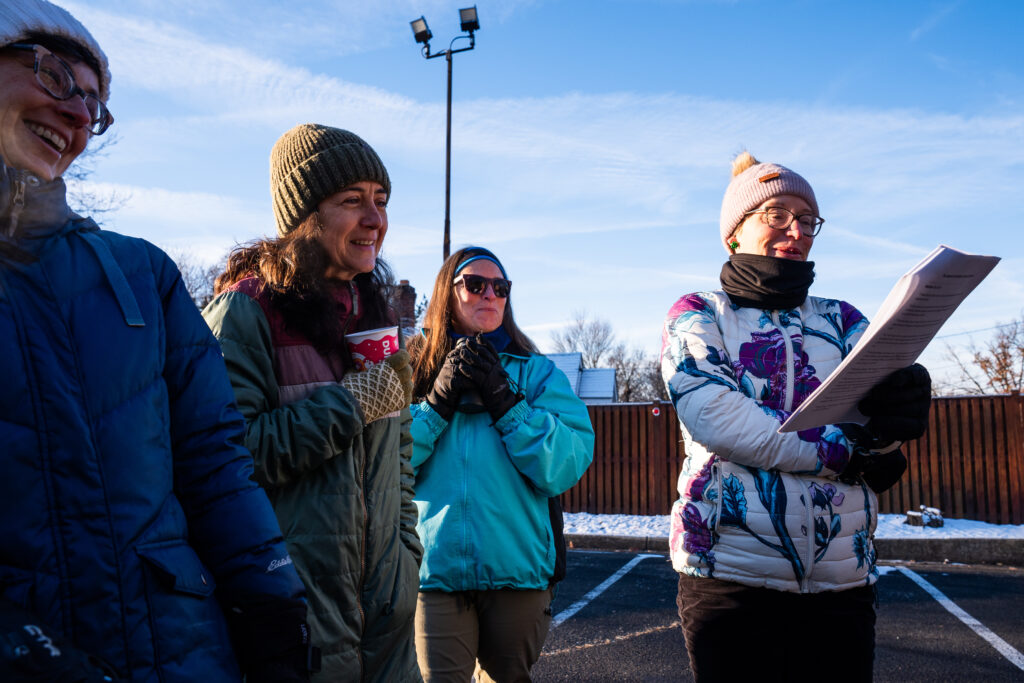
Away in a manger, no crib for a bed, sang the crowd in the parking lot early one morning in mid-December, a few dozen people bundled in hats and scarves. The little Lord Jesus laid down his sweet head.
Wedged behind a squat stretch of shops, this lot in Takoma Park, Maryland, has become both a stage for immigration enforcement in the community — and resistance to it. After months of noticing a cluster of unfamiliar cars they determined belonged to Immigration and Customs Enforcement, residents launched a counterprogramming effort, gathering for two hours each morning in the run-up to Christmas. They were hula hooping one morning, knitting the next. They gathered donations for a holiday drive and decorated cookies.
“A way to bring blessing back to a place that feels very cursed,” said Terry Sabonis-Helf, a 63-year-old professor among those gathered to sing. Away in a manger, she thought, seemed particularly fitting for the occasion — serving as a reminder that Jesus was born into poverty and his parents were traveling in a foreign land.
The stars in the bright sky looked down where he lay. The little Lord Jesus asleep on the hay.
Beyond the parking lot stretched a country ensnared by what President Donald Trump promised would be the “largest mass deportation in history.” Arrests are up in every part of the country compared with the year before, with immigrants plucked from mopeds and vans, collected from construction sites and courthouses, factories and farms. The state of Maryland was catapulted to the center of the deportation debate in March when the administration wrongfully sent Kilmar Abrego García to a notorious megaprison in his native El Salvador. He was handcuffed by federal agents five miles from the Takoma Park lot, on his way home from work with his 5-year-old son in the back seat.
While officials have pledged to target the “worst of the worst,” most immigrants arrested in city crackdowns do not have a criminal record.
Here in Montgomery County, just north of Washington, where more than a third of residents are foreign born, the singers wanted to champion the diversity of their community at a time when it seemed to be under threat. The shops framing the lot exemplified as much — among them, a Guatemalan restaurant, an Ethiopian clothing shop, a jujitsu school.
The parking lot gathering began with a Facebook post.
“Does everyone know by now that ICE is staging right here in Takoma Park?” Ariel Woods, 47, wrote in a neighborhood group earlier this month.
“We are taking back the space and allowing the employees and neighbors to return to their daily routines without harassment and fear,” she continued, encouraging others to join her. “ICE can find themselves a new clubhouse.”
Some thought the idea would be ineffective, that the agents would just idle elsewhere. Indeed, she’d heard agents had been spotted at a nearby Giant and at a park outside a nearby elementary school. Still, she thought, let’s try to bring some joy to the parking lot and maybe make it a tiny bit harder for ICE to operate in her city.
“The more that we can slow them down, that is another family that we help to keep intact,” Montgomery County council member Kristin Mink said at the first parking lot event. Employees and patrons had told her ICE’s presence in the lot made them feel less safe, she said. One employee was getting stress-induced migraines.
Mink was late, she explained, because just that morning a teacher alerted her to a detention in front of her high school and she went to track down the discarded work van, four backpacks sitting on the back seats, their packed lunches still hot.
A couple of days later, they gathered with yarn for a morning of knitting. That same day, Department of Homeland Security Secretary Kristi L. Noem testified on Capitol Hill, praising immigration agents as “doing God’s work.”
She told House lawmakers: “They are honorable men and women who are serving with greatness during a challenging time when activists and radicals attack them and put their lives in danger.”
The next week, on a frigid Monday, dozens clapped and swayed in the lot to Christmas hymns, some clanging cymbals and others ringing bells. A woman dressed as Mrs. Claus — wrapped in a red cloak, curls of white hair stacked high on her head — tapped a bucket around her waist as a drum.
Resting on a folding table near the doughnuts and coffee, a homemade sign: white poster board covered in images of SUVs with out-of-state plates and tinted windows and men wearing masks and tactical vests. “Because you are here … they are not,” it read.
There was also a crowdsourced map of the city scattered with red dots, each marking an incident in which someone was detained. DHS did not respond to a request for comment for this story.
In June, hundreds of students at a nearby high school walked out of class one afternoon in a display of solidarity for a classmate recently deported to Guatemala. In July, Maryland’s congressional delegation staged a sit-in at an immigration enforcement facility in Baltimore.
Woods said the Trump administration’s deportation dragnet arrived on her street one morning in August when federal agents chased two men, who had crashed their pickup truck into her neighbor’s yard. Masked agents yelled that the men were gang members, she said, and the men hid under a deck until they were dragged away.
Her neighbors, seeing commotion and unsure what was happening, hid under desks and in their attics, she said. “It was terrifying.”
In her phone, she saved numbers of nonprofits she’d call when she witnessed detentions. In her car, she kept what she called an “in case I see ICE kit” for when she stumbled upon abandoned vehicles she thought might belong to someone taken into ICE custody. Tape and plastic sheeting to repair smashed windows; leaflets in Spanish and English to tuck into the windshield offering instructions to family members for how to get help.
“We’re flushing them out of their hidey-holes,” Woods told the parking lot crowd, mostly older and White. Since she launched the morning activities, no one had seen ICE station there.
“They’re afraid of sunshine,” called out Sabonis-Helf’s husband, Gavin Helf, an adjunct professor and former United States Institute of Peace employee until he lost his job as part of the Trump administration’s slashing of the federal government.
First with USAID and then at the Institute of Peace, Helf, 63, had committed his career to countering violent extremism and promoting democracy abroad. Now, as he watched what he viewed as authoritarian tactics bloom in his own community, he handed out educational fliers at local businesses and organized “pantry watches” at his church — volunteers keeping an eye on people lining up to retrieve food just in case immigration enforcement showed up.
“I can’t change the Supreme Court. I can’t change the Constitution. I can’t elect a different president,” he said. “I can defend my neighborhood.”
As the gathering neared its close, one woman asked if anyone had a minivan and car seat she could borrow for an afternoon while she helped a family move. Another reminded people to sign up for a “know your rights” training in the new year.
Soon after, the group trickled out, back to homes and jobs and weekday routines. Before long there was little left but the hum of nearby traffic and the promise they’d return for another activity tomorrow.
The post A Maryland parking lot becomes a hub of ICE resistance appeared first on Washington Post.