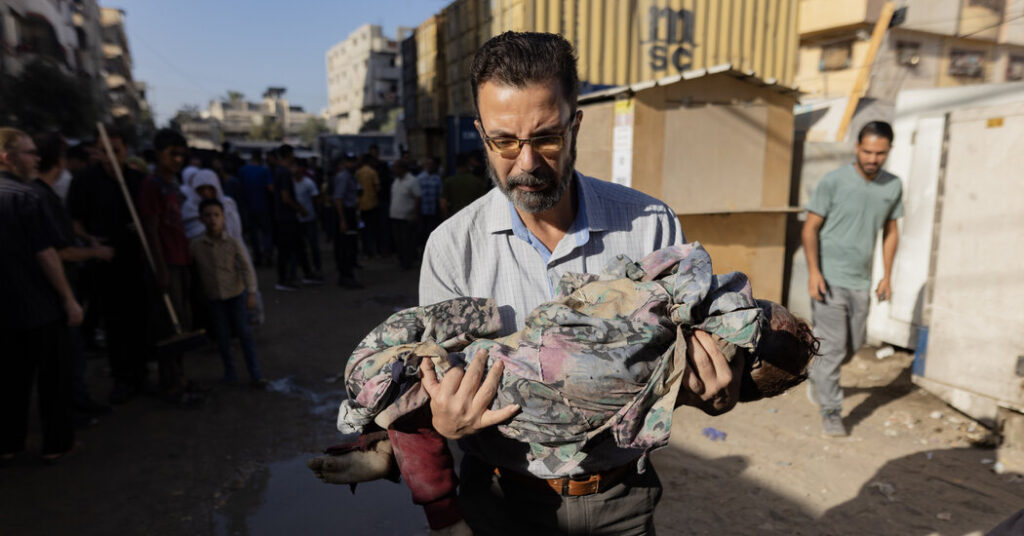
The cease-fire in Gaza is more than two months old. But the killing of Palestinians has not yet stopped for more than a day or two at a time.
Death can come from straying across the Yellow Line, the poorly demarcated border between eastern Gaza, where the Israeli military has entrenched itself, and the western half, where Hamas is seeking to reestablish control over Gaza’s two million-plus residents.
Dozens of times since the truce went into effect on Oct. 10, Palestinians have been killed for crossing east, knowingly or not.
Palestinians say the continued bloodshed shows that Israel does not respect the cease-fire and is cavalier, at best, about the lives of Gazan civilians. The Israeli military says it has opened fire only in response to violations of the cease-fire, and that its rules of engagement permit targeting only people it perceives as threats.
Death can come from being related to the wrong person, as it did for much of the Abu Dalal family in Nuseirat. When Israel targeted two cousins on Oct. 29 — it said they were both local militant commanders — overnight missile strikes destroyed both their homes. One of the men was killed. So were 18 other members of their extended family, including two 3-year-olds.
For Maysaa al-Attar, 30, a pharmacy student, death came from being in the wrong place at the wrong time. She was shot in the abdomen as she slept in her parents’ tent in northwest Gaza on the morning of Nov. 14. Three weeks earlier, they’d set up the tent on the ruins of their family home.
For Ali al-Hashash, 32, death came at about 8 a.m. on Nov. 6 while foraging for firewood east of the Yellow Line to help feed his pregnant wife, whose due date was days away, and their 4-year-old son. There was no cooking gas in the Bureij refugee camp where they lived, according to his father, Hasan al-Hashash.
It’s a risk that many people in Gaza are taking as the cold sets in. On Dec. 18, Mr. al-Hashash’s friend, Saeed al-Awawda, 66, was shot while collecting wood in the same area, Mr. al-Hashash said. “He lost his hand,” he said. “I keep thinking, ‘I wish my son had only lost his hand, too, not his life.’”
Lt. Col. Nadav Shoshani, an Israeli military spokesman, said the army’s procedures were designed to avoid civilian casualties. When Palestinians who are not clearly armed cross over to the Israeli side of the Yellow Line, he said, soldiers are under orders to warn them to turn around and as a last resort to stop them by firing at their lower legs.
He said that Hamas militants in civilian clothes, sometimes with concealed weapons, were probing across the Yellow Line, making almost anyone approaching Israeli positions appear as a potential threat.
“The majority of cases, the violations are by Hamas,” Colonel Shoshani said. “And in the majority of cases where it’s not Hamas, we’re able to warn people, and they turn around.”
The Israeli military was unable to address the death of Ms. al-Attar, of which it said it was unaware.
Palestinian officials say that 406 people have been killed since the cease-fire, including 157 children. That is nothing like the carnage of the previous two years of war, which began with the Hamas-led attack of Oct. 7, 2023, in which 1,200 people were killed, and prompted an Israeli invasion of Gaza in which local health officials say 70,000 people have been killed — an average of hundreds each week.
But the mounting body count highlights the fragility of the truce, with a difficult-to-discern border, bitter enemies in proximity and Palestinian militants sometimes emerging from tunnels on the Israeli-held side and opening fire on Israeli soldiers.
The imbalance in the numbers killed on each side also reflects the continuation, despite the cease-fire, of the Israeli military’s harsh wartime practices of hitting back with punishing force and allowing strikes on militants even when they risk killing large numbers of civilians.
A Family Outing With No Return
On Oct. 17, a week into the cease-fire, a dozen members of the Shaban and Abu Shaban families piled into a van in Gaza City for an outing. Trusting in the relative safety of the truce, they set out from the cramped tent encampment where they were living to visit their two homes in Zeitoun, a largely destroyed neighborhood to the southeast. One was perilously close to the as-yet-unmarked Yellow Line.
Othman Shaban, 14, was along for the ride. He said the family arrived at one of its two houses to see what was left. Then, he recalled, “My father said, ‘Let’s go check our other house.’ We were enjoying our time as we left.”
He said he and his father, who was at the wheel, had collected firewood in the area on foot several times recently, so they believed it was safe.
Othman said their van encountered rubble blocking the road. “I got out of the car and moved the stones off the path,” he said.
That saved him. As his father rolled the van forward to pick him up again, he said, “I suddenly heard an explosion.”
Othman suffered neck and leg wounds. Everyone in the van was killed: his parents, three of his siblings — a sister, Nisma, 16, and brothers Anas, 12, and Karam, 10 — Mr. Abu Shaban’s sister, her husband, their daughter Jumana, 9, and their sons Naser, 12, Ibrahim, 6, and Muhammad, 4.
A relative who stayed behind, Mohammed Abu Shaban, said he believed that Othman’s father may have unwittingly driven toward the Yellow Line. The Israeli military later marked it with yellow-painted concrete blocks.
“Gaza is so devastated that it’s easy to lose your way,” Mr. Abu Shaban said.
The Israeli military said in a statement that its forces had fired warning shots at “a suspicious vehicle” which had crossed the unmarked line, but that the vehicle continued toward them “in a way that caused an imminent threat to them” and that the “troops opened fire to remove the threat.”
Colonel Shoshani added that the distance from the Yellow Line to Israeli territory was only “a two-minute drive” in many places.
But Othman said there had been no warning shots, just the explosion that killed his family.
Othman’s description of the location of the attack — on Salah al-Din Road, a major Gaza artery, hundreds of yards west of the Yellow Line — is also at odds with the Israeli military’s. In his telling, the van was not so close to Israeli-held territory that it could have been perceived as threatening to cross it.
The military says there was no attack at the spot that Othman described.
Civil Defense rescuers waited nearly a day to receive Israeli permission to collect the bodies from the burned vehicle, Mr. Abu Shaban said. They found just nine — or “eight and a half,” he said, to be morbidly precise.
Two Targeted, 18 Others Killed
Despite the truce, militants in Gaza have sporadically opened fire on Israeli soldiers. Each time, Israel has responded with overwhelming force against broad sets of targets far from the attack locations.
On Oct. 28, a sniper killed an Israeli soldier in Rafah — the third Israeli soldier killed since the cease-fire, and, to date, the last of the war. That night, Israel attacked in response, killing at least 100 people across Gaza.
It was midnight in Nuseirat, about 16 miles north of Rafah, when missiles struck the first of two homes belonging to the extended Abu Dalal family.
The following day, the Israeli military said it had targeted 25 terrorists in Gaza, including Yahya Abu Dalal and Nazmi Abu Dalal, who it said were commanders in the militant group Islamic Jihad.
The military said nothing about civilian casualties.
Amr Al-Sabakhi, 20, was in his home across the street when he said two missiles hit the home of his aunt Hala, the wife of Yahya Abu Dalal, 50. He rushed outside to try to help and found his cousin Bayan, 15, dead, his body split in two. Yahya and Hala were both dead. Bayan’s three brothers were also dead, including 11-year-old Mostafa, as were other members of the extended family, including twin 3-year-old boys.
Another neighbor, Muhammad Qasem, 41, said his mother suffered a deep scalp wound from the blast. “I always feared that house would be struck,” he said of the Abu Dalal home, nodding to the prospect that Yahya Abu Dalal could be targeted by Israel. But, he added, “I thought at least there would be a prior warning, so the neighbors wouldn’t be harmed.” There was none, he said.
Colonel Shoshani, the Israeli military spokesman, said that planned airstrikes went through a “rigorous process of approval.” While Israel warns civilians before attacking buildings or other infrastructure, it does not when seeking to eliminate specific enemy targets, lest they escape — and “there’s no army in the world that does,” he said.
He did not say whether Israel was unaware of the presence of so many civilians or determined that the targets justified the risk that so many civilians could be killed.
Other members of the Abu Dalal clan came running to try to help after the airstrike, including Nizar Abu Dalal, 48, who lived around the corner.
He returned home a couple of hours later, according to his wife, Iman Abu Dalal.
Their daughter, Dareen, 23, said she and her mother talked about whether to leave but decided they had nowhere safer to go.
A little after 3:30 a.m., Iman Abu Dalal said, “I heard the whistling sound of a missile,” then felt herself being thrown and rolling violently, before blacking out.
Dareen, two of her siblings, and her toddler daughter, Shatha, all survived the strike. Her father Nizar was killed, as was a 24-year-old brother, Majd, who was set to be married in November. Instead, his body was found days after the strike, crushed between slabs of concrete.
The Israeli military defended the strikes on the homes, saying the two targets, Yahya and Nazmi Abu Dalal, “had for years been involved in directing and leading terrorist activities” against Israel.
Upstairs from Nizar’s home, where Nazmi, his brother, lived, the carnage was far worse.
Nazmi, the target of the second airstrike, was wounded but survived. No one in his immediately family did.
His wife was killed, as were their seven children, who ranged in age from 21-year-old Baraa to 8-year-old Zeinab.
Baraa had painted her nails that afternoon, her cousin Dareen said.
When the results of the Tawjihi, the college-eligibility exam for Palestinian high school seniors, were published a few weeks later, one daughter, 18-year-old Duha, had received a score of 96.7 percent.
Abu Bakr Bashir contributed reporting.
David M. Halbfinger is the Jerusalem bureau chief, leading coverage of Israel, Gaza and the West Bank. He also held that post from 2017 to 2021. He was the Politics editor of The Times from 2021 to 2025.
The post The Truce Is 2 Months Old. So Why Have Hundreds of Gazans Been Killed? appeared first on New York Times.