The Supreme Court said Tuesday it would not allow President Donald Trump to deploy the National Guard in the Chicago area for now, a significant setback for his campaign to push troops into cities across the country over the objections of local and state leaders.
The president’s ability to federalize the National Guard likely only applies in “exceptional” circumstances, the court’s unsigned order said.
Justices Samuel Alito, Clarence Thomas and Neil M. Gorsuch dissented from the court’s unsigned order. Justice Brett M. Kavanaugh filed a separate concurrence.
The Chicago case is the first time the Supreme Court has weighed in on one of Trump’s attempted deployments of National Guard forces. While temporary, the order could have far-reaching effects by repudiating Trump’s claim of virtually unchecked authority to mobilize and deploy troops he says are necessary to fight crime and protect immigration enforcement officers.
The order could affect how lower courts rule in other cases where local and state officials have sued to block Trump’s deployments, such as in Portland, Oregon. It may have less immediate effect on the National Guard deployment in D.C. because of the federal government’s unique role in overseeing the nation’s capital.
It also stands out as a rare example of the Supreme Court blocking the administration’s efforts to move forward with policies that lower courts have temporarily halted.
The high court, which is dominated by a 6-3 conservative majority, has repeatedly approved of Trump’s actions this year, allowing his administration to freeze billions in foreign aid, gut the Education Department, fire senior officials of nominally independent agencies and strip temporary protections from hundreds of thousands of Venezuelan immigrants.
The case came to the Supreme Court after lower courts blocked Trump’s deployment of National Guard forces to the Chicago area. The administration asked the high court to put the lower court ruling on hold. Although the administration told the court that the situation was an emergency, requiring swift action, the justices took weeks to consider it.
The order rejecting the administration’s request means the deployments will remain blocked while litigation continues. Ultimately, the case could return to the high court for a final ruling.
The Trump administration justified putting the National Guard under federal control by invoking a law that allows the president to federalize the Guard if he is unable to execute federal law using “regular forces.” The administration argued that language referred to civilian law enforcement agencies, such as Immigration and Customs Enforcement.
The Justice Department also asserted that courts have little authority to review the president’s decisions about deployments.
“This case falls in the heartland of unreviewable presidential discretion,” administration lawyers told the high court. If Trump’s determination that troops are needed can be reviewed by the courts, the agency said, “such review must be extremely deferential.”
The court’s majority rejected the administration’s argument. The law’s reference to “regular forces” probably refers to the U.S. military, the court said, not to civilian law enforcement. Because of that, the justices said, the president’s authority to federalize the National Guard “likely applies only where the military could legally execute the laws.”
Under a federal law known as the Posse Comitatus Act, the circumstances in which the military can be employed for law enforcement purposes are very strictly limited, the court noted, suggesting that the same would be true for Guard troops.
“At this preliminary stage, the Government has failed to identify a source of authority that would allow the military to execute the laws in Illinois,” the justices wrote.
In his concurrence, Kavanaugh said he agreed with the decision to allow the lower court ruling to stand for now, but would have ruled on narrower grounds. He said he feared the court’s ruling could “lead to potentially significant implications for future crises that we cannot now foresee.”
In his dissent, Alito sharply criticized the majority, saying it had “no basis” for rejecting Trump’s determination that he was “unable to execute the federal immigration laws” using civilian law enforcement officers.
“Whatever one may think about the current administration’s enforcement of the immigration laws or the way ICE has conducted its operations, the protection of federal officers from potentially lethal attacks should not be thwarted,” he wrote.
In response to the Tuesday order, White House spokeswoman Abigail Jackson issued a statement that avoided any criticism of the Supreme Court — a sharp contrast to the administration’s frequent blasts at lower-court judges who rule against them.
Trump activated the National Guard to protect law enforcement in Chicago and “ensure rioters did not destroy federal buildings and property,” Jackson said in an email.
“The President promised the American people he would work tirelessly to enforce our immigration laws and protect federal personnel from violent rioters,” Jackson added. “Nothing in today’s ruling detracts from that core agenda. The Administration will continue working day in and day out to safeguard the American public.”
Illinois Gov. JB Pritzker, a Democrat, said in a statement that the court’s decision “is an important step in curbing the Trump Administration’s consistent abuse of power and slowing Trump’s march toward authoritarianism.”
Trump’s moves to use the National Guard in American cities have generated widespread controversy for months. In addition to Chicago, he has sent or threatened to dispatch troops to cities including Los Angeles, Portland, D.C., San Francisco and Baltimore, sparking several legal challenges.
Many local and state officials across the country have denounced Trump’s attempted deployments, saying the moves inflame tensions and intrude on their sovereignty. They have also disputed that the troops are necessary to protect law enforcement officers.
In the case of Chicago, The Washington Post first reported a plan to send National Guard troops in August, prompting fierce backlash from Pritzker and other state and local officials. Pritzker mounted a public relations and legal offensive in response, telling Trump that military deployments were not warranted or welcome.
In early September, the administration launched an immigration enforcement action in Chicago and surrounding communities that it called “Operation Midway Blitz.” The Department of Homeland Security has boasted that the operation reduced crime and said local officials failed to accomplish this for decades, even though violent crimes — including murders and shootings — were already down significantly before the federal action began.
The immigration enforcement effort fueled intense protests around Chicago, with many demonstrations centering on an ICE facility in Broadview, a suburb west of the city.
The Justice Department said in court papers that the situation in the Chicago area was tantamount to “a rebellion against federal authority,” necessitating the National Guard. DHS officers have had to “operate in a climate of constant fear for their lives and safety, which significantly impedes their enforcement of the law,” the Justice Department said.
Illinois officials, who sued to stop Trump from sending in troops, told the Supreme Court that the Trump administration was mischaracterizing the facts.
In their court filings, Illinois authorities said protests and unrest have not prevented the Trump administration from carrying out federal law. Troops were not needed, they said, because “state and local law enforcement officers have handled isolated protest activities in Illinois, and there is no credible evidence to the contrary.”
Demonstrations in Broadview “never hindered the continued operation of the ICE facility there,” Illinois officials wrote.
The state wrote that it was challenging the deployment “to protect its sovereignty, retain control over local policing, and protect the basic structure of American federalism from unprecedented intrusion.”
The state won the first round of the legal dispute in early October when U.S. District Judge April M. Perry blocked Trump from deploying the National Guard anywhere in Illinois. Perry, who was appointed by President Joe Biden, expressed skepticism of the Trump administration’s credibility and wrote that federal officials’ declarations in the case demonstrated “a troubling trend of … equating protests with riots.”
After the administration appealed, a three-judge panel of the U.S. Court of Appeals for the 7th Circuit allowed Trump to federalize the National Guard within Illinois but left in place Perry’s prohibitionon those troops actually being deployed.
The panel disagreed with the administration’s assertion that the government was facing a rebellion in the Chicago area. Instead, the panel wrote, “spirited, sustained, and occasionally violent actions of demonstrators in protest of the federal government’s immigration policies and actions, without more, does not give rise to a danger of rebellion against the government’s authority.”
The panel’s members were appointed to the circuit court by Presidents George H.W. Bush, Barack Obama and Trump.
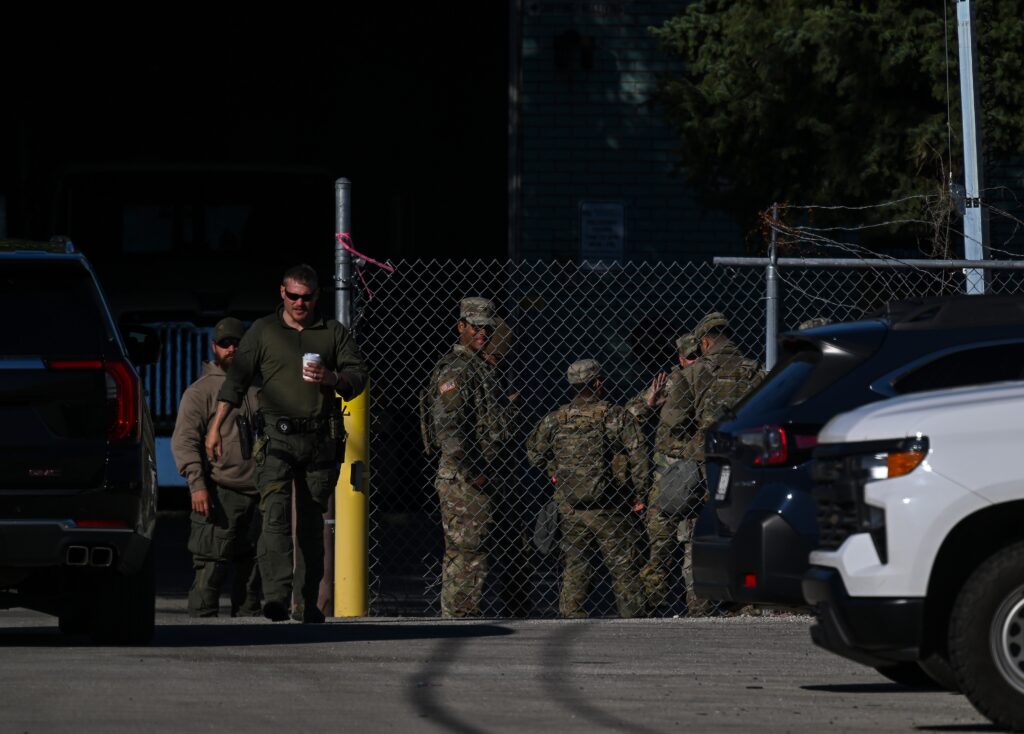
In addition to the Chicago rulings, judges have blocked Trump’s bids to deploy troops in Portland. Some of the troops Trump has deployed to Portland and Chicago have since returned home amid the court battles, while others remained in place, effectively awaiting word on whether they would be deployed on the streets or left idle. In September, a federal judge found that Trump’s deployment of Guard troops to Los Angeles was unlawful.
Dan Lamothe and Isaac Arnsdorf contributed to this report.
The post Supreme Court blocks National Guard deployment to Chicago in defeat for Trump appeared first on Washington Post.