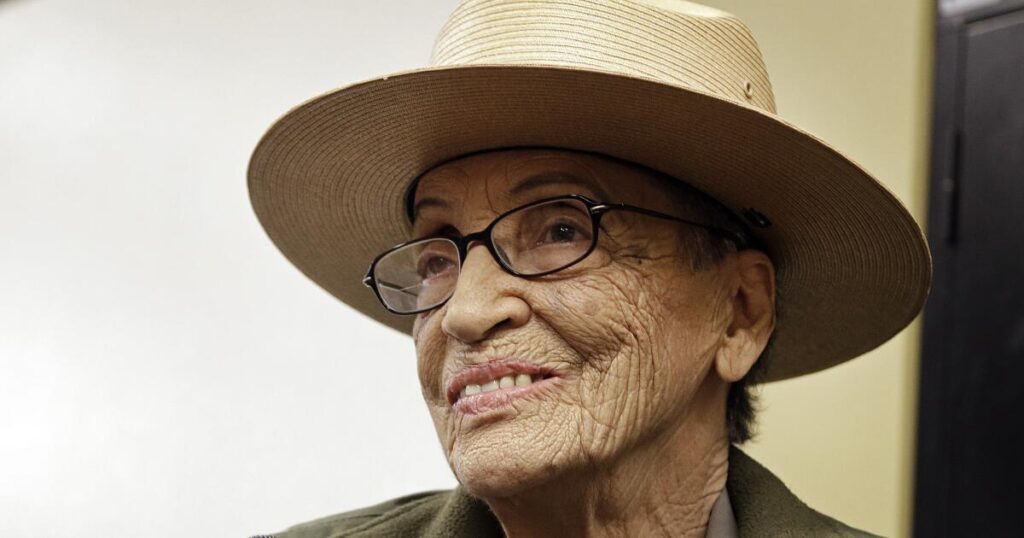
Betty Reid Soskin, who rose to national prominence as the National Park Service’s oldest ranger and shared her experiences of racial segregation working on the World War II home front, has died. She was 104.
Soskin passed away Sunday morning at her home in Richmond, Calif. surrounded by family.
“She led a fully packed life and was ready to leave,” her family wrote in a social media post.
At 85, Soskin was hired as a ranger at the Rosie the Riveter WWII Home Front National Historical Park, where she elevated stories of women from diverse backgrounds who joined the civilian war effort.
By the time she retired in 2022 at 100, she was a national figure, noted for her age and sought out for interviews.
Soskin grew up in a Cajun-Creole African American family that settled in Oakland after a historic flood devastated their home in New Orleans in 1927, according to her Park Service biography. She was 6 when she arrived in East Oakland.
Her parents joined her maternal grandfather, who had resettled in the Bay Area city at the end of World War I.
Her grandfather’s family “followed the pattern set by the black railroad workers who discovered the West Coast while serving as sleeping car porters, waiters and chefs for the Southern Pacific and Santa Fe railroads: They settled at the western end of their run where life might be less impacted by Southern hostility,” the biography reads.
Soskin’s great-grandmother, Leontine Breaux Allen, was born into slavery in Louisiana and freed by the Emancipation Proclamation. (Soskin had a photo of Allen tucked into her breast pocket when she watched President Barack Obama’s 2009 inauguration at the Capitol Mall.)
Amid World War II, Soskin landed work as a file clerk in a boilermaker’s union hall in Richmond. Her position was in the Kaiser Shipyards, where thousands of women helped build more than 700 Liberty and Victory ships, according to the union.
But Soskin’s history diverged from the empowering image of “Rosie the Riveter,” the bicep-flexing symbol for the millions of American women who worked in factories and shipyards during the war. Rosie the Riveter was “a white woman’s story,” she said in a recorded educational talk.
The union hall was segregated, according to Soskin.
The union acknowledged the racial discrimination and presented her with an award decades later.
In the talk, “Of Lost Conversations,” Soskin reflects on her disappointment with a Park Service film made about the wartime effort in Richmond.
The filmmakers, she said, went with “the Hollywood ending,” in which, “[w]e all got together for the sake of democracy and we set our differences aside.”
The reality was harsher. It was about a decade before the labor movement would be racially integrated, and the unions created what were known as auxiliaries, workplaces where Soskin said black workers were “dumped.”
“Jim Crow” — the term for laws and customs that enforced a racial caste system — “was really the other name for auxiliary,” Soskin said.
Yet, she added, “even then” — in 1942 — “that was a step up.”
Working as a clerk “would have been the equivalent of today’s young woman of color being the first in her family to enter college,” she said.
Time marched on. After raising four kids as a “suburban housewife,” Soskin went on to become a field representative for two California legislators — Dion Aroner and Loni Hancock. In that capacity, she helped plan the the national park where she would eventually work.
She also partnered with the Park Service on a grant-funded effort to uncover untold stories of Black men and women who worked on the home front during the war, leading to a temporary position with the agency when she was 84. The permanent position followed a year later.
“Being a primary source in the sharing of that history — my history — and giving shape to a new national park has been exciting and fulfilling,” Soskin said in a statement the year she retired. “It has proven to bring meaning to my final years.”
Soskin’s trailblazing transcended her work at the Park Service.
In 1945, Soskin and her then-husband, Mel Reid, opened one of the first Black-owned music stores in Berkeley, Calif., which remained in business for more than 70 years and served as a hub for gospel music. (Soskin would divorce Reid and go on to marry UC Berkeley professor William Soskin, a union that also dissolved.)
Soskin herself was singer-songwriter, chronicling her journey through the 1960s and 1970s. Her reconnection with music is the subject of an in-progress documentary, “Sign My Name to Freedom.”
It was in 2013 that Soskin reached a national stage, becoming a media darling noted for her age during a government shutdown, according to the Park Service.
Two years later, Soskin was selected by the agency to participate in a Christmas tree-lighting ceremony at the White House, where she introduced President Obama for a PBS special.
She suffered a stroke in 2019, but returned to work in early 2020, before the COVID-19 pandemic hit.
In a social media post announcing her death, the Park Service hailed Soskin as a “trailblazing” employee.
“Betty has made a profound impact on the National Park Service and the way we carry out our mission,” said Charles “Chuck” Sams, former director of the Park Service, when she retired. “Her efforts remind us that we must seek out and give space for all perspectives so that we can tell a more full and inclusive history of our nation.”
Soskin’s survivors include three children, five grand children and a great-grandchild.
To honor her, her family suggests making a donation to the Betty Reid Soskin Middle School and to support the completion of the documentary about her music.
The post Betty Reid Soskin, ‘trailblazing’ oldest national park ranger, dies at 104 appeared first on Los Angeles Times.


