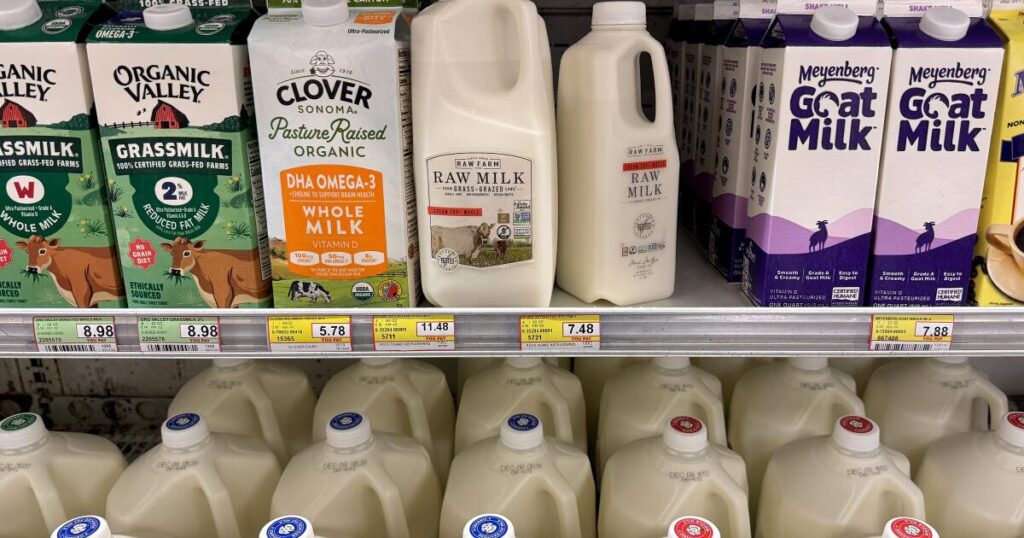
California milk cartons may lose their coveted recycling symbol, the one with the chasing arrows, potentially threatening the existence of the ubiquitous beverage containers.
In a letter Dec. 15, Waste Management, one of the nation’s largest waste companies, told the state the company would no longer sort cartons out of the waste stream for recycling at its Sacramento facility. Instead, it will send the milk- and food-encrusted packaging to the landfill.
Marcus Nettz, Waste Management’s director of recycling for Northern California and Nevada, cited concerns from buyers and overseas regulators that cartons — even in small amounts — could contaminate valuable material, such as paper, leading them to reject the imports.
The company decision means the number of Californians with access to beverage carton recycling falls below the threshold in the state’s “Truth in Recycling” law, or Senate Bill 343.
And according to the law, that means the label has to come off.
The recycling label is critical for product and packaging companies to keep selling cartons in California as the state’s single-use packaging law goes fully into effect. That law, Senate Bill 54, calls for all single-use packaging to be recyclable or compostable by 2032. If it isn’t, it can’t be sold or distributed in the state.
The labels also provide a feel-good marketing symbol suggesting to consumers the cartons won’t end up in a landfill when they’re discarded, or find their way into the ocean where plastic debris is a large and growing problem.
On Tuesday, the state agency in charge of waste, CalRecycle, acknowledged Waste Management’s change.
In updated guidelines for the Truth in Recycling law, recycling rates for carton material have fallen below the state threshold.
It’s a setback for carton manufacturers and their customers, including soup- and juice-makers. Their trade group, the National Carton Council, has been lobbying the state, providing evidence that Waste Management’s Sacramento Recycling and Transfer Station successfully combines cartons with mixed paper and ships it to Malaysia and other Asian countries including Vietnam, proving that there is a market. The Carton Council persuaded CalRecycle to reverse a decision it made earlier this year that beverage cartons did not meet the recycling requirements of the Truth in Recycling law.
Brendon Holland, a spokesman for the trade group, said in an email that his organization is aware of Waste Management’s decision, but its understanding is that the company will now sort the cartons into their own dedicated waste stream “once a local end market is available.”
He added that even with “this temporary local adjustment,” food and beverage cartons are collected and sorted in most of California, and said this is just a “temporary end market adjustment — not a long-term shift away from historical momentum.”
In 2022, Malaysia and Vietnam banned imports of mixed paper bales — which include colored paper, newspapers, magazines and other paper products — from the U.S. because they were so often contaminated with non-paper products and plastic, such as beverage cartons. Waste Management told The Times on Dec. 5 that it has a “Certificate of Approval” by Malaysia’s customs agency to export “sorted paper material.” CalRecycle said it has no regulatory authority on “what materials may or may not be exported.”
Adding the Sacramento facility to the list of waste companies that were recycling cartons meant that the threshold required by the state had been met: More than 60% of the state’s counties had access to carton recycling.
At the time, CalRecycle’s decision to give the recycling stampto beverage cartons was controversial. Many in the environmental, anti-plastic and no-waste sectors saw it as a sign that CalRecycle was doing the bidding of the plastic and packaging industry, as opposed to trying to rid the state of non-recyclable, polluting waste — which is not only required by law, but is something state Atty. Gen. Rob Bonta is investigating.
Others said it was a sign that the Truth in Recycling law was working: Markets were being discovered and in some cases, created, to provide recycling.
“Recyclability isn’t static, it depends on a complicated system of sorting, transportation, processing, and, ultimately, manufacturers buying the recycled material to make a new product,” said Nick Lapis, director of advocacy for Californians Against Waste.
He said this new information, which will likely remove the recycling label from the cartons, also underscores the effectiveness of the law.
“By prohibiting recyclability claims on products that don’t get recycled, SB 343 doesn’t just protect consumers. It forces manufacturers to either use recyclable materials or come to the table to work with recyclers, local governments and policymakers to develop widespread sustainable and resilient markets,” he said.
Beverage and food cartons — despite their papery appearance — are composed of layers of paper, plastic and sometimes aluminum. The sandwiched blend extends product shelf life, making it attractive to food and beverage companies.
But the companies and municipalities that receive cartons as waste say the packaging is problematic. They say recycling markets for the material are few and far between.
California, with its roughly 40 million residents, has some of the strictest waste laws in the nation. In 1989, the state passed legislation requiring cities, towns and municipalities to divert at least 50% of their residential waste away from landfills. The idea was to incentivize recycling and reuse. However an increasing number of products have since entered the commercial market and waste stream — such as single use plastics, polystyrene and beverage cartons — that have limited (if any) recycling potential, can’t be reused, and are growing in number every year.
Fines for municipalities that fail to achieve the required diversion rates can run $10,000 a day.
As a result, garbage haulers often look for creative ways to deal with the waste, including shipping trash products overseas or across the border. For years, China was the primary destination for California’s plastic, contaminated paper and other waste. But in 2018, China closed its doors to foreign garbage, so U.S. exporters began dumping their waste in smaller southeast Asian countries, including Malaysia and Vietnam.
They too have now tried to close the doors to foreign trash as reports of polluted waterways, chokingly toxic air, and illness grows — and as they struggle with inadequate infrastructure to deal with their own domestic waste.
Jan Dell, the founder and CEO of Last Beach Cleanup, released a report with the Basel Action Network, an anti-plastic organization, earlier this month showing that the Sacramento facility and other California waste companies were sending bales of carton-contaminated paper to Malaysia, Vietnam and other Asian nations.
According to export data, public records searches and photographic evidence collected by Dell and her co-authors at the Basel Action Network, more than 117,000 tons or 4,126 shipping containers worth of mixed paper bales were sent by California waste companies to Malaysia between January and July of this year.
Dell said these exports violate international law. A spokesman for Waste Management said the material they were sending was not illegal — and that they had received approval from Malaysia.
However, the Dec. 15 letter suggests they were receiving more pushback from their export markets than they’d previously disclosed.
“While certain end users maintain … that paper mills are able to process and recycle cartons,” some of them “have also shared concerns … that the inclusion of cartons … may result in rejection,” wrote Nettz.
Dell said she was “pleased” that Waste Management “stopped the illegal sortation of cartons into mixed paper bales. Now we ask them and other waste companies to stop illegally exporting mixed paper waste to countries that have banned it.”
The post Why California’s milk cartons may lose their coveted recycling symbol appeared first on Los Angeles Times.