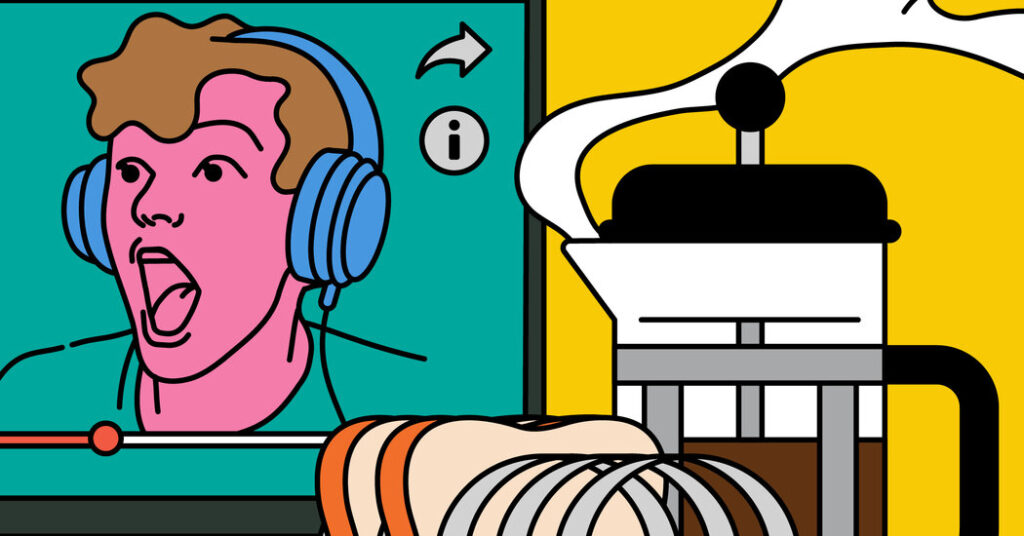
At Nancy Ann Ling’s house in Central Texas, the TV generally goes on around 5 a.m., and Mrs. Ling flips over to the same app each day: YouTube. For many hours after that, the app keeps running.
As she prepares breakfast, Mrs. Ling and her husband stream the previous night’s monologue from Stephen Colbert or Seth Meyers. After her husband heads off to work, she finds comforting background noise for meditating. By the afternoon, she tunes into cycling videos as she exercises, and later turns to the YouTube channels of local news outlets while she cooks.
But when the sun goes down, YouTube goes off. Mrs. Ling, 57, scrolls to an app like Apple TV or BritBox for scripted entertainment.
And Mrs. Ling’s viewing habits mirror those of millions of Americans.
YouTube has been winning the streaming wars for years, generating more TV viewing time in the United States than Netflix, Amazon Prime Video, Disney+ and every other app out there. In November, it accounted for nearly 13 percent of viewing time, compared with 8 percent for Netflix, the next in line, according to Nielsen.
Much of YouTube’s lead, though, comes from its dominance during the daytime, adding a challenge for media and streaming executives who are trying to puzzle through how to close a widening gap.
At 11 a.m., for instance, YouTube had an average audience of 6.3 million viewers in October, Nielsen said. Netflix’s audience is less than half of that (2.8 million). Amazon has about a million viewers at that hour, and some streaming services, like HBO Max, Paramount+ and Peacock, draw fewer than 600,000.
YouTube, which is owned by Google, continues to hold a commanding lead as the day progresses. It is only in prime-time hours that the competition narrows significantly: Netflix’s average audience swells to over 11 million viewers at 9 p.m., only a bit behind YouTube’s audience of 12 million, for example. Other large services, like Amazon, Disney and HBO Max, also close in on YouTube’s lead during prime time — before YouTube’s dominance begins again in the overnight hours and continues into the next day.
“We’ve changed our daytime viewing because of the accessibility that YouTube gives us,” Mrs. Ling said. “It’s the immediacy of it — anything we want is in one place. There’s no more flipping between channels.”
YouTube’s growing dominance in television streaming — and this is just for YouTube, not the YouTube TV subscription service, which features traditional cable networks — has been a conundrum to streaming and entertainment executives who continue to invest tens of billions in scripted and unscripted entertainment to get people to subscribe and watch. YouTube is forcefully encroaching on their turf now, too. The company reached a five-year deal to exclusively stream the Oscars beginning in 2029, ending a run for ABC that began in the 1970s.
Both Netflix and Paramount are locked in a fierce battle over Warner Bros. entertainment properties, with each prepared to spend at least $80 billion to add a trove of movies and TV series that would better position them against YouTube and everyone else.
Netflix and others are also explicitly looking for content that will get people to click on their apps more frequently in the morning or afternoon.
Netflix is bringing at least 34 video podcasts to its service next year, including “The Breakfast Club,” “The Bill Simmons Podcast,” “Pardon My Take” and “My Favorite Murder.” In September, Amazon added Travis and Jason Kelce’s popular “New Heights” podcast to Prime Video.
This is all an intentional strategy. Roughly 75 percent of all podcast listening time happens between 6 a.m. and 6 p.m., according to Edison, a research firm. YouTube said viewers watched 700 million hours of video podcasts on living room devices in October, a 75 percent increase from last year. And YouTube is also the No. 1 platform for podcast listening, with a healthy lead over Spotify and Apple, Edison said.
Sean Downey, a top Google sales executive, said YouTube provided a steady stream of entertainment for viewers, no matter what time they decided to click on.
“That is kind of the power of the platform,” he said. “We haven’t thought about it as a daytime perspective. We’ve thought about it as: We have great content that people can resonate with when they want to. When they turn on their television, they will find exactly what they’re looking for that meets the moment and the need that they have.”
The platform, which is free and shows commercials, does feature a nearly endless supply of content to appeal to any interest, however niche.
Matthew Lawrence, a 69-year-old who lives in Portland, Ore., has been flipping to YouTube almost every day to help guide him on a retirement project: improving his pool game.
Mr. Lawrence found a wide collection of well-produced videos of billiards competitions on YouTube. He said he commits at least an hour or two every day — either in the late morning or the afternoon — watching the competitions on his 65-inch TV screen before heading to a pool hall to practice. His game has improved significantly thanks to the videos, he said.
“My mother would be deeply ashamed of me,” he said, laughing. “I hear this voice inside me: ‘You can’t be watching TV during the day.’ But it’s instructive. I’m learning something.”
Not all viewers are watching as intently.
Over the decades, daytime television’s mix of talk shows, soap operas, cooking series and easy entertainment like “Judge Judy” induced a sort of casual viewing. People could move around the house or tackle chores — folding laundry, paying bills, tidying up — with the TV providing ambient noise as the day passed.
It seems that YouTube is serving a similar role. “Lots of viewing is happening during the day on YouTube, but it’s not very attentive viewing,” said Hollan Wills, a senior analyst at TVision, a research group.
TVision conducts research by deploying a camera, with permission, in 5,000 households to see what people are watching during the day. YouTube’s attention scores are generally much lower than nearly all premium streaming apps, TVision has found, suggesting that music playlists, programming for children and other sorts of background-noise content helps drive its viewership.
Some YouTube creators are committed to dropping new videos during the daytime. “Good Mythical Morning,” a comedic variety show from the YouTube stars Rhett McLaughlin and Link Neal, posts each weekday at 6 a.m.
A recent poll of its viewers showed that the majority of people who tune in prefer to watch it when they are getting ready for school or work; during a lunch break; or to keep them “company while doing other activities.” (Plenty of people also watch or listen to YouTube on devices other than a television screen, which is not included in the Nielsen ranking.)
Mr. Downey, the Google sales executive, said many creators had tapped into something that had existed for decades: People want something entertaining to watch in the morning.
“They’re choosing YouTube, and the creators on it, because that’s the most interesting and entertaining thing for them,” he said. “That’s a consumer-driven shift, and it’s a creator-driven shift.”
Other popular YouTube stars, like MrBeast and Mark Rober, post their videos on Saturday mornings. Michelle Khare, whose popular videos document challenges like training how to be a samurai, said she also posts new videos on Saturday mornings because she believes that the app has effectively replaced a programming bloc that used to be a staple of daytime television.
“A lot of families watch YouTube together on the weekends,” she said. “You might even say that the Saturday morning cartoons from decades ago are now Saturday morning YouTube.”
Jessica Testa contributed reporting.
John Koblin covers the television industry for The Times.
The post YouTube Has a Firm Grip on Daytime TV appeared first on New York Times.