This spring, the presidents of the Federal Reserve’s regional banks gathered behind closed doors in Philadelphia to debate an uncomfortable question. The discussion focused on plans to cut 10 percent of the Fed’s staff, a step aimed at aligning the central bank with a broader White House drive to shrink the federal workforce — and one that drew pushback from some top officials.
Chicago Fed President Austan Goolsbee questioned the move in the meeting, which has not been previously reported, arguing it might invite further White House demands, according to two people familiar with the discussion, including one who spoke directly to a regional president who described the debate as contentious. But Goolsbee’s objections, shared by others in the room, were effectively overruled.
In that meeting, the details of which The Post has confirmed, the Fed’s leadership chose strategic restraint over confrontation with the Trump administration — a strategy that has continued to guide its response to the president’s repeated attacks on the institution.
That debate and others like it offer a preview of how the Fed would handle President Donald Trump’s drive to both remake the central bank and push it to slash interest rates. The meeting also reveals early disagreement among top officials over how to confront the president, even as they quietly adjusted policies and operations to accommodate administration priorities that didn’t directly relate to monetary policy.
In the end, leadership of the venerable 112-year-old institution chose to safeguard its independence to set interest rates by avoiding an open fight with Trump, absorbing some blows and refraining from striking back in public.
“Like a boxer in the ring, the Fed has bobbed and weaved,” said David Wessel, director of the Hutchins Center on Fiscal and Monetary Policy at the Brookings Institution. “And it’s still standing.”
Past administrations have also pressured the central bank, whose independence rests both on federal law and on norms that most recent presidents, wary of rattling financial markets, have been reluctant to test. President Richard M. Nixon pushed then Fed Chair Arthur Burns to cut rates before the 1972 election. Top aides to President George H.W. Bush publicly pushed Fed Chair Alan Greenspan to cut rates before the 1992 election. President Joe Biden met with Fed Chair Jerome H. Powell in the White House in May 2022 to show concern about inflation (though Biden stressed he respected the Fed’s independence).
At the same time, Fed chairs have never been oblivious to politics. Greenspan was a visible and influential figure in Washington, backing President Bill Clinton’s 1993 tax increases and later supporting President George W. Bush’s 2001 tax cuts. In crises, coordination among the Fed, the White House and the Treasury becomes especially tight: Fed Chair Ben S. Bernanke worked in lockstep with the Bush White House and Treasury during the 2008 financial crisis, and Powell coordinated closely with the first Trump administration during the coronavirus pandemic.
Even so, no modern president has gone as far as Trump, who openly mused about firing a Fed chair, repeatedly demanded sharp rate cuts in public and is testing whether he can remove another sitting member of the Fed’s board, Lisa Cook, over unproven allegations of mortgage fraud.
The Supreme Court, which has allowed Cook to remain at the Fed while it considers the matter, is set to hear the case next month. She denies wrongdoing.
The court’s ruling could remake the Fed, which Congress designed to be insulated from political pressure. That insulation protects interest rate decisions from the president and other elected officials, who often favor lower rates to boost near-term growth even at the risk of longer-term inflation.
Powell, who has shied away from directly commenting about Trump, underscored the lie-low strategy this month. When asked about how he hoped the Supreme Court would rule in the case, he demurred. “We’re not legal commentators,” Powell told reporters on Dec. 10. “It’s before the courts and … we don’t think that we help matters by trying to engage as a public discussion of that.”
Powell’s public reticence was mirrored behind closed doors. When the Fed’s 12 regional bank presidents met privately in Philadelphia in April, the group discussed a sensitive question: how the central bank should position itself toward the new administration. They invited at least one external academic to talk about the history of the Fed system and the independent role of the regional banks. The in-person meeting also served as a farewell for a retiring regional Fed president, according to the people familiar with the discussion.
At the time, the Fed was already making concessions to align its nonmonetary policies with the new administration. A top Biden-era official had recently demoted himself from a leadership role on the Fed’s board in Washington, ceding oversight of Wall Street to the new administration to avoid a potentially messy legal fight with the White House. The Fed also abandoned its work on climate and diversity initiatives, froze outside hiring and was moving to require staff to return to the office full-time.
Officials were also working to impose the 10 percent systemwide cut to the staff of roughly 24,000 across the regional Fed banks and the board in Washington. Though the Fed as a whole, as a part of the government, historically “aligns” its policies with new administrations, some regional presidents grumbled about the staffing cuts. Goolsbee, the Chicago Fed chief, balked at the suggested cuts and received some support from Minneapolis Fed President Neel Kashkari and Cleveland Fed President Beth Hammack, according to the people familiar with the meeting. But the officials were in the minority, and the cuts were announced the following month.
A Fed spokeswoman declined to comment, as did representatives for Goolsbee and Hammack. Kashkari, who chairs a group called the Conference of Presidents that convened the Philadelphia meeting, said in a statement: “Regardless of administration, we always examine Presidential executive orders and determine how to align, as appropriate. The reserve bank presidents collaborate to determine the most effective way to implement any potential changes.”
Asked for comment on this story, a White House spokesman said only that inflation is cooling and “the environment is ripe for further rate cuts.”
Peter Conti-Brown, a Fed historian at the University of Pennsylvania, said the Philadelphia meeting lays bare a question the central bank usually keeps to itself: What, exactly, should the Fed keep independent? The back-and-forth showed officials weighing whether to fall in line with a new administration on charged issues like staffing and budgets and reserve their resistance for interest-rate decisions, which Conti-Brown argues is the only topic that truly belongs behind a political fire wall.
In his view, Fed “independence” is a narrow idea about keeping monetary policy away from short-term partisan demands, not a shield for internal policies such as climate work and diversity efforts.
In other instances, the Fed has avoided opportunities to take on the White House. When Trump tried to oust Cook in August, the Fed issued a statement a day later, defending governors’ long tenures and removal protections as important to safeguarding monetary policy decisions. It also said it would abide by whatever a judge decided once Cook challenged her removal in court, as her personal attorney signaled she would. Powell and other Fed officials have mostly declined to comment on the case in the months since.
Some former policymakers worry the Fed may need a more assertive public defense of its independence and say that each concession to the Trump administration establishes a new precedent that can lead to bigger changes to the institution over time. Although the central bank has long relied on behind-the-scenes engagement with lawmakers to protect its autonomy, that strategy is increasingly tested by what has become a more hostile political environment, with fewer allies on Capitol Hill willing to buck the president than during his first term.
The Fed’s reluctance to confront Trump leaves it dangerously exposed, said Graham Steele, a former top Treasury Department official during the Biden administration.
“The old strategy of keeping its head down and trusting that markets or Congress would defend its independence isn’t working in the same way that it used to,” said Steele, who also previously worked at the San Francisco Fed. “There are risks that, even if they win some of the smaller fights through a strategy of concessions and nonconfrontation, their independence will be undermined over the longer term. If the Fed doesn’t mount a spirited defense of its own independence in these moments, who else is going to?”
However, some Fed watchers say that the lying-low strategy has worked to the Fed’s advantage, so far.
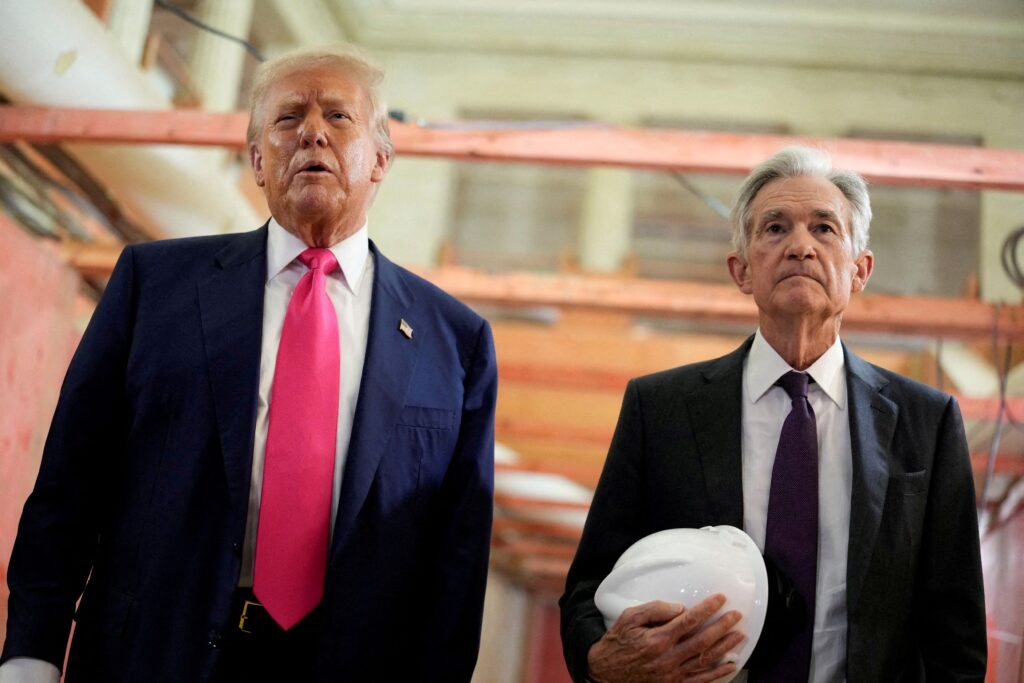
Trump ultimately didn’t try to fire Powell, despite threatening to do so repeatedly, including this summer when he toyed with ousting him over the costs of a massive renovation project for the central bank’s headquarters along the National Mall.
Though Trump made history in August by ordering the removal of Cook, she has so far succeeded in blocking the dismissal in court. The Supreme Court declined the president’s request to remove her from office, while she challenged the firing. Its justices have also repeatedly signaled they are worried about weakening the Fed’s independence in ways that could rattle financial markets — an indication that the president may face an uphill battle when the high court hears oral arguments on Jan. 21.
Indeed, some argue the Fed could be in a far worse position if it had not aligned certain policies or had fought back publicly against the president’s calls to slash rates. Trump could have tried to fire more sitting governors, including Powell.
“Show me another agency that has succeeded when it screamed and shouted at the president,” said Scott Alvarez, a former Fed general counsel. “There’s no tool to do anything other than to act in a normal way and to execute the best they can in terms of monetary policy.”
The post Inside the Fed’s quiet fight to protect its independence appeared first on Washington Post.