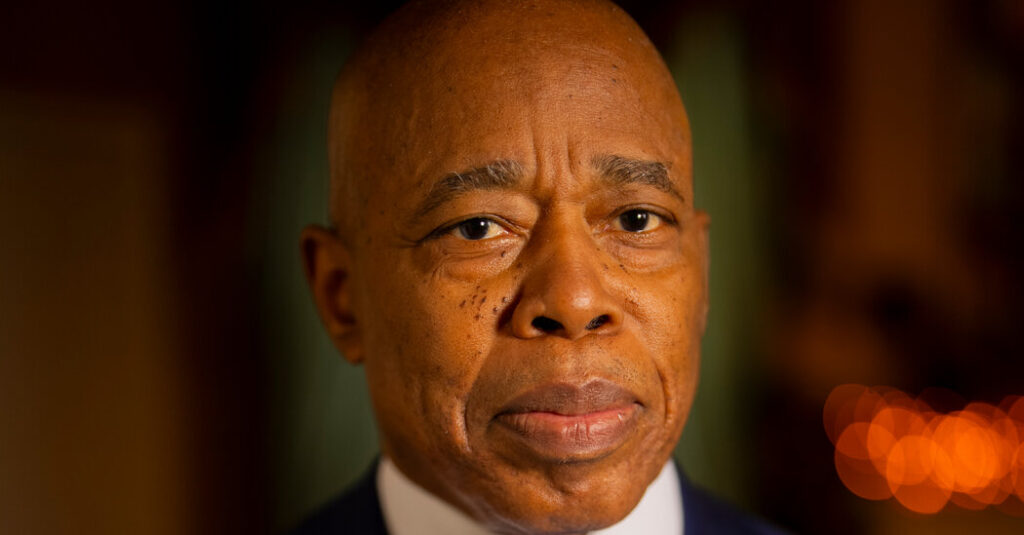
He took office four years ago, vowing to be a “get stuff done” mayor. And in his repeated telling, Mayor Eric Adams has done just that — dropping that catchphrase a half-dozen times or so during a defiant end-of-term speech last week.
There is some evidence to support Mr. Adams’s self-assessment. He ran on a pledge to lower New York City’s crime rates; murders have fallen significantly. He has helped make it easier to build housing, and moved trash from the curb into bins.
But he has also been his own worst enemy, with New Yorkers taking issue with his propensity for stretching the truth, his handling of the city budget and his leadership qualities. By the time he was indicted by federal authorities on corruption charges — a case later dismissed at the Trump administration’s urging — Mr. Adams’s popularity had sunk so far that he ended his bid for re-election.
As he concludes his term, here is a look at how he fared on seven key issues.
— Emma G. Fitzsimmons
Crime fell, but civilian complaints against police officers rose.
Mr. Adams, a former police captain who once spoke out against police brutality, vowed to bring down crime after it rose during the coronavirus pandemic.
He quickly embraced aggressive policies that outraged progressive leaders, but he argued that tougher tactics saved lives.
The number of shooting victims has fallen under Mr. Adams, who appointed Jessica Tisch as police commissioner in late 2024 after two years of chaos and dysfunction in the department’s top ranks. Roughly 838 people have been shot this year, compared with nearly 1,800 in the same period in 2021.
The overall number of felonies, including homicides, also fell during Mr. Adams’s time in office, according to the Mayor’s Management Report. But other crimes, such as rapes and assaults, increased. Officials have said that the number of rapes has gone up, in part, because of changes in the law that expanded the definition of the crime.
Mr. Adams and Commissioner Tisch attributed the declines in crime to policies like putting more officers in known hot spots, though the decreases occurred at the same time that crime fell in other major U.S. cities that had seen spikes in violence during the pandemic.
Misconduct complaints against New York City police officers increased under Mr. Adams; in 2024, they were at their highest level since 2014, according to the mayor’s report. Police officials said that rise occurred at the same time that the city’s police oversight agency received more powers to initiate misconduct complaints.
Stop-and-frisk encounters also rose. In 2024, the most recent year for which data is available, the police made more than 25,000 stops, a 50 percent jump from 2023 and the largest number of stops in 10 years, according to the New York Civil Liberties Union.
Still, stops are lower than their peak in 2011 under Mayor Michael R. Bloomberg, when the police made more than 685,000 stops, according to the New York Civil Liberties Union.
— Maria Cramer
More housing is on the horizon.
The Adams administration made progress on addressing New York City’s housing shortage, even as the city’s deep struggles with affordability persisted.
The administration championed an effort known as “City of Yes,” a set of changes to the zoning code intended to boost residential development. The changes, which included allowing more housing near public transit and removing costly requirements that many new apartment buildings include parking, are expected to make way for 82,000 homes over the next 15 years.
Mr. Adams created a special commission to craft pro-development changes to the City Charter. In November, voters passed all of the commission’s housing measures, diminishing the power of individual members of the City Council to reject housing in their districts.
But the mayor’s self-described “pro-housing” record was damaged this year when he abandoned a contentious push to build housing on the site of the Elizabeth Street Garden in Manhattan, after objections from neighbors.
Mr. Adams was also viewed as an enemy by tenant groups. He supported rent increases by the Rent Guidelines Board, which regulates the city’s more than 900,000 rent-stabilized apartments. The board approved cumulative increases of more than 12 percent on one-year leases during his tenure.
The median rent in New York City grew to around $1,800 in 2024 from around $1,600 in 2021, according to data from the U.S. Census Bureau, with many neighborhoods seeing sharp increases. (The median rent in Manhattan has soared to $4,750.)
The average annual number of affordable homes built or preserved fell during Mr. Adams’s tenure. It declined to around 24,000 during the four fiscal years overlapping with his mayoralty, from 29,000 during a comparable period under his predecessor, Bill de Blasio. That probably reflects, in part, how high interest rates and the pandemic slowed development across the city.
— Mihir Zaveri
Buses still crawl, but pedestrians are safer.
Mr. Adams promised to speed up the city’s bus network, a vital service for lower-income New Yorkers, especially in the boroughs beyond Manhattan. Buses carry 2.6 million riders per weekday.
But at average speeds of about 8 miles per hour, the bus network remains the slowest nationwide.
The mayor does not control the buses — the Metropolitan Transportation Authority, a state agency, does — but the city has the power to improve traffic and street conditions.
Mr. Adams was required to help carry out a plan to create 150 miles of bus lanes with barriers or camera enforcement, and 250 miles of protected bike lanes over five years, after a law passed during the de Blasio administration.
But the Adams administration has fallen short every year. In the last four years, the city installed about 28 miles of bus lanes and 95 miles of protected bike lanes, according to the Transportation Department.
Transit advocates say that a number of projects were stymied by politics or corruption.
In 2023, the city abandoned a plan to create car-free bus lanes on Fordham Road, a congested corridor in the Bronx, the city’s poorest borough. After pushback from local businesses, the city selected a different plan that transit supporters called piecemeal and inadequate.
In August, Ingrid Lewis-Martin, a top aide to Mr. Adams, was accused of participating in a conspiracy to block bike lane changes on McGuinness Boulevard in Brooklyn. Prosecutors said she had accepted $2,500, a role on a television show and other perks from opponents of the plan. She pleaded not guilty.
At the same time, streets have become safer. There were 194 traffic fatalities through Dec. 11 of this year, which is on pace to be the second-safest year since record-keeping began in 1910.
— Stefanos Chen
Students’ test scores are improving.
Mr. Adams entered office with a promise to end the public school system’s “betrayal” of Black and Latino children, often pointing to the city’s steep achievement gaps and dismal reading outcomes as evidence that too many students had been left behind.
His administration took a huge step toward change, overhauling the English curriculum in an effort to root out flawed teaching strategies and follow the science of how students learn to read.
This year, reading scores on state tests climbed seven points, with 56 percent of students in third through eighth grades showing proficiency — a notable increase that Mr. Adams has frequently promoted as a prime accomplishment. Black students made the steepest gains.
It remains largely unclear, though, how much the mayor’s changes are responsible for the rise.
Across the state, reading scores also rose by seven points, recent data shows, and proficiency rates lagged only slightly behind the city’s. And on a federal exam that offers the best measure of reading skills over time, the percentage of students at the lowest performance level actually rose between 2011 and 2024.
New Yorkers could gain a clearer picture in the coming years of how much the administration’s work made a difference: Reading reforms often take time to show success, and results from federal tests — which children will take next winter — will offer better insight.
There also remains much more to accomplish.
By the end of third grade, students who do not read well are at a steep disadvantage. They are much more likely to drop out of high school and live in poverty. Only about 45 percent of Hispanic and 51 percent of Black third graders showed reading proficiency on state tests.
By comparison, about 73 percent of Asian and 75 percent of white test takers were proficient.
And many reading experts say New York can still do much a better job supporting children with disabilities and teenagers who never learned to read well.
— Troy Closson
By many measures, the city has recovered from the pandemic.
When Mr. Adams took office in January 2022, coronavirus cases were high and many office employees were still working from home.
Some storefronts remained empty. Tourism had been cut in half. The unemployment rate, while improving, was among the highest in the country, at nearly 8 percent.
Since then, the New York City economy has rebounded, despite dire predictions. But it has been changed by the pandemic.
A record number of people now work in the city: more than 4.8 million. Many businesses are calling their employees back into the office three to four days a week.
Tourism has roared back to near prepandemic levels, leading hotels in Manhattan to charge more than ever. Broadway attendance is just shy of the 2018-19 season.
The city’s streets also look cleaner, after new rules required trash to be put in bins instead of on the curb.
But it is not all rosy. Most of the job growth in New York City has been in lower-paying positions, while Wall Street bankers have brought in record bonuses. As apartment and food prices have climbed, a quarter of residents now live in poverty.
As Mr. Adams’s term ends, the economic rebound appears to have stalled. Private companies added just 14,000 workers in the first nine months of this year, the lowest positive job growth in the city during that period in 35 years. Major industries like finance and insurance, which pay higher wages, have shed positions.
Business owners say that during this year’s crucial holiday tourism and shopping period, there have been fewer visitors, especially international tourists, who usually spend more at shops and restaurants. The city is expected to welcome fewer tourists this year than in 2024.
— Matthew Haag
The migrant crisis overwhelmed City Hall.
An influx of migrants arriving in New York from the southern border in the spring of 2022 rapidly grew into an emergency that engulfed the Adams administration over more than three years.
The numbers were staggering: Under Mr. Adams, the city spent more than $7.7 billion as it scrambled to feed and house more than 240,000 migrants in more than 200 office buildings, giant tent dormitories and hotels converted into shelters.
Mr. Adams cobbled together the city’s response — which was scrutinized for its logistical missteps and no-bid contracts — with little help or money from the Biden administration, which the mayor accused of abandoning New York.
The crisis became a flashpoint with little political upside for Mr. Adams, who was obligated to shelter migrants under a legal mandate from the 1980s that requires the city to provide a bed to any homeless person who seeks one.
The mayor’s frustration spilled over into his rhetoric, which grew increasingly harsh as he desperately sought help from President Biden, with Mr. Adams at one point saying that the influx of migrants would “destroy” the city.
Mr. Adams traveled to Latin America to personally discourage migrants from flocking to New York and successfully challenged the right-to-shelter mandate in the courts to limit shelter stays for migrants.
The crisis eventually subsided as border crossings plummeted in the final months of Mr. Biden’s tenure and once President Trump took office. The city closed most migrant shelters as the number of migrants arriving in the city slowed to about 100 a week, down from a one-week peak of 4,300 people in May 2023.
But the migrant influx, and the mayor’s efforts to have his federal indictment dismissed, paved the way for a partnership between Mr. Adams and Mr. Trump on some immigration matters that hurt him politically with Democratic leaders and voters in the city.
Mr. Adams expressed support for softening the laws that limit the city’s cooperation with federal immigration authorities, and he met with Tom Homan, the president’s border czar, to try to help federal agents gain access to immigrants detained at the Rikers Island jail complex.
— Luis Ferré-Sadurní
Homelessness has risen.
When he ran for mayor, Mr. Adams said he would succeed in reducing homelessness where others had failed because the issue was personal for him. As a child, he said, he carried a trash bag of clothes to school because he was worried that his family would be evicted.
Four years later, despite the expansion of several effective programs, the homeless population in New York City is up sharply, driven mostly by the influx of migrants. But even apart from the migrant crisis, homelessness has risen under Mr. Adams.
David Giffen, executive director of the Coalition for the Homeless, said the city had “definitely done a better job” of using rent subsidies and vouchers to move people out of shelters or keep them housed.
“But there’s really only one number that matters,” he said. “How many people in New York City are homeless at any given time?”
In September, the nonmigrant population in the city’s main shelter system was about 58,000, up from about 45,000 when Mr. Adams took office, though a bit lower than the prepandemic peak of 61,000. The city’s annual estimate of street and subway homelessness found about 4,500 unsheltered people in January — the most in at least 20 years and an increase of more than 30 percent under Mr. Adams.
The city, to be sure, is moving people out of homelessness faster than it used to. The average stay in the main shelter system is more than 25 percent shorter, for both families and single adults, under Mr. Adams, though it is still over a year.
The number of families with children who moved from shelters to subsidized housing more than doubled, to 9,000, from fiscal year 2022 to fiscal year 2025. To draw homeless people off the streets and subways, the city has increased the supply of “safe haven” and “stabilization” beds — living spaces with more privacy and fewer rules than standard congregate shelters — by more than 40 percent, to 3,500.
Mr. Giffen said the city’s efforts to create affordable housing have been simply unable to keep up with the economic pressures pushing people out of their homes.
Mr. Adams made a particular point of tackling subway homelessness.
But January’s annual estimate found 2,300 people living in the subway, up about 9 percent from 2022 and up about 30 percent from the average of 1,800 during the five years before the coronavirus pandemic.
— Andy Newman
The post Did Mayor Eric Adams ‘Get Stuff Done’? A Look at His Record on 7 Issues. appeared first on New York Times.