In the hours after the massacre at a Hanukkah celebration at Bondi Beach in Sydney last week, it seemed that Australia’s leaders had come together to offer a bipartisan response, as they had done for many past catastrophes.
Prime Minister Anthony Albanese urged unity, describing the assault on the Jewish community as an attack on every Australian. Sussan Ley, the leader of the conservative opposition, offered the government her party’s “full and unconditional” support.
That unity quickly broke down.
Opposition leaders seized on mounting anger in the Jewish community, where many say that Mr. Albanese’s center-left government had not acted enough on their warnings of a dangerous rise in antisemitism over the past two years. Days after the shooting, some of Mr. Albanese’s political opponents blamed him and his government for the mass shooting. Others attacked members of his government for not attending funerals for the 15 people killed and dismissed his move to tighten Australia’s gun laws as a distraction from the issue of antisemitism.
Mr. Albanese fired back, saying that his government had appointed Australia’s first antisemitism envoy and passed legislation to criminalize hate speech. And, he noted that he had condemned the apparent antisemitic motivations behind the attack.
Scenes like this would not be out of place in the charged political landscape of the United States. But the speed at which a horrific event has turned into bitter partisanship has been unusual in Australia, where politics gravitates toward the center, lawmakers typically have little incentive to fan the flames of emotion, and the political class tends toward consensus in moments of crisis.
“I’ve not seen a moment of national tragedy so quickly turned to partisan political advantage as has happened here,” said Mark Kenny, the director of the Australian Studies Institute at the Australian National University.
The massacre and its aftermath fell along existing political fault lines in Australia. Many Australian Jews — less than 1 percent of the country’s 27 million people — saw it as the culmination of a sense of peril they have felt following the Oct. 7, 2023, Hamas-led attacks and Israel’s ensuing war in Gaza, backlash to which conflated anger at the Israeli government with antisemitism.
Even before the Bondi shooting, Mr. Albanese’s government had faced criticism for not quickly addressing a series of recommendations from his antisemitism envoy — which included setting up a national database for antisemitic incidents and allowing the government to withhold funding from universities that fail to act against antisemitism — though some rights groups had described them as overreaching.
The conservative opposition, which aligns more closely with Israel than Mr. Albanese’s center-left Labor Party, had also denounced Australia’s move in September to recognize Palestine as a state. Hours after the Dec. 14 attack, Prime Minister Benjamin Netanyahu of Israel directly linked it to that decision. “You let the disease spread and the result is the horrific attacks on Jews we saw today,” he said.
Although Ms. Ley has not gone as far as Mr. Netanyahu, the opposition leader has accused Mr. Albanese and his government of letting antisemitism fester. On Monday, Ms. Ley accused the government of not engaging enough with those in mourning, and launched a scathing tirade against one minister, who she said she had not seen “shed a single tear.”
For his part, Mr. Albanese has failed to ease the grief and rage in the Jewish community in the immediate aftermath of the attack.
“I think the prime minister, who’s not a gifted communicator, struggled very much to step forward in that moment,” Mr. Kenny said. “To Jewish Australians, it sounded unconvincing.”
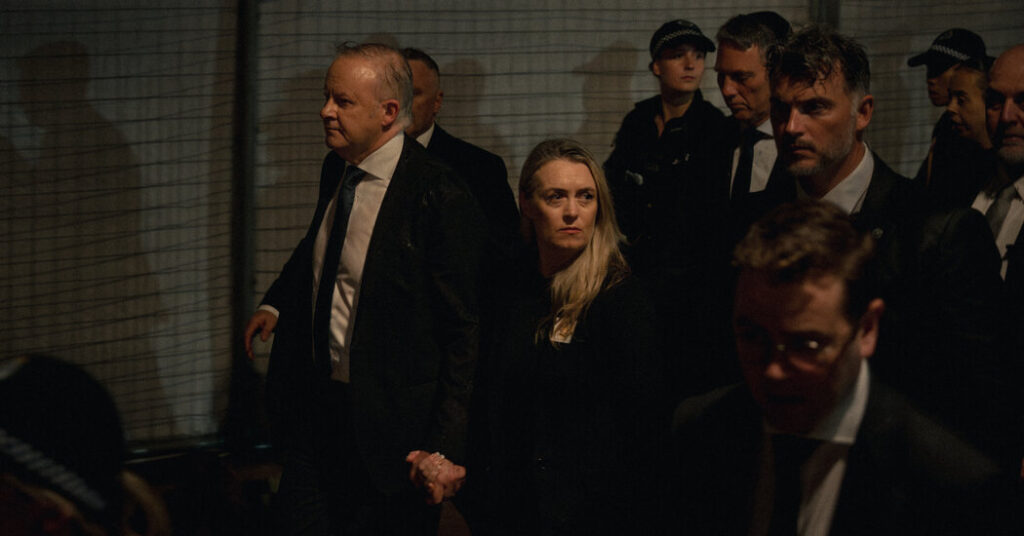
The anger directed at Mr. Albanese has been such that he has not attended the funerals of those killed in the attack, even while other leaders, including Ms. Ley have. On Sunday, when thousands gathered at a memorial at Bondi Beach to mark one week since the attack, some in the crowd booed Mr. Albanese, who did not speak.
It is the biggest political challenge Mr. Albanese has faced since he won re-election in a landslide victory in May. And it has galvanized the conservative side, which has in recent months been wracked by infighting.
The bloodshed at Bondi Beach was the deadliest mass shooting in Australia since 1996, when a gunman killed 35 people in the state of Tasmania. The prime minister at the time, John Howard, a conservative, enjoyed bipartisan support as he quickly enacted strict gun control laws that are celebrated to this day.
But last week, as Mr. Albanese sought to further tighten the laws, Mr. Howard was one of the first to attack the move, saying that the focus on guns was a diversion from the issue of antisemitism.
Other measures announced by Mr. Albanese, like a crackdown on hate speech, have drawn criticisms of too little, too late. So has a review of Australia’s intelligence agency and law enforcement, as questions mount about how the two gunmen, one of whom had come to authorities’ attention as early as 2019 but was deemed not to be a threat, had escaped detection.
The opposition has called for stricter measures including the stripping of citizenship from those who commit terrorism offenses, and to hold a royal commission, Australia’s highest form of inquiry, into the attack. And some far-right politicians have called for a rethink of Australia’s immigration policy. One of the gunmen was Indian; the other, his son, was born in Australia.
One of the strongest attacks on Mr. Albanese has come from Josh Frydenberg, a former Liberal Party politician, who is Jewish. In an impassioned speech at the memorial for the victims last week, he called on Mr. Albanese to “accept personal responsibility for the death of 15 innocent people.”
The trauma, grief and anger in the Jewish community runs deep, said Julianne Schultz, a professor at Griffith University and the author of “The Idea of Australia.” But instead of working toward healing, parts of the conservative opposition have amplified that anger in a way that is “goes beyond something that we’ve seen here in the past,” she said, adding that she saw in it echoes of how President Trump has fostered politics of division in the United States.
Still, there is a danger for Australian politicians to be seen as politicizing the tragedy in a country where residents expect steady governance and stability, said Kos Samaras, a former Labor Party strategist and director of Redbridge Consultancy, a polling firm.
“The Australian public don’t want a political football match here,” he said. ”They want a national response to what they think is a fairly serious event and also what they fear is the collapse of social cohesion.”
The opposition has denied that it is politicizing the tragedy. The Liberal Party was simply “reflecting the views we are hearing of an irate — and deservedly so — Jewish community who feel that they’ve been abandoned,” Julian Leeser, an opposition lawmaker, told the Australian Broadcasting Corp., the country’s public broadcaster.
Ms. Schultz said that the way Australia responds to the attack will test its ability to exist as a pluralistic society where people respect and try to understand different backgrounds, religions and ways of seeing the world..
“If the threat feels existential, pluralism, unless you work really, really hard at it, it breaks down,” she said. “That’s the territory we’re in at the moment — and it’s very difficult to come back from that.”
Yan Zhuang is a Times reporter in Seoul who covers breaking news.
The post After Bondi Massacre, a Moment of Unity. Then, Bitter Partisanship. appeared first on New York Times.