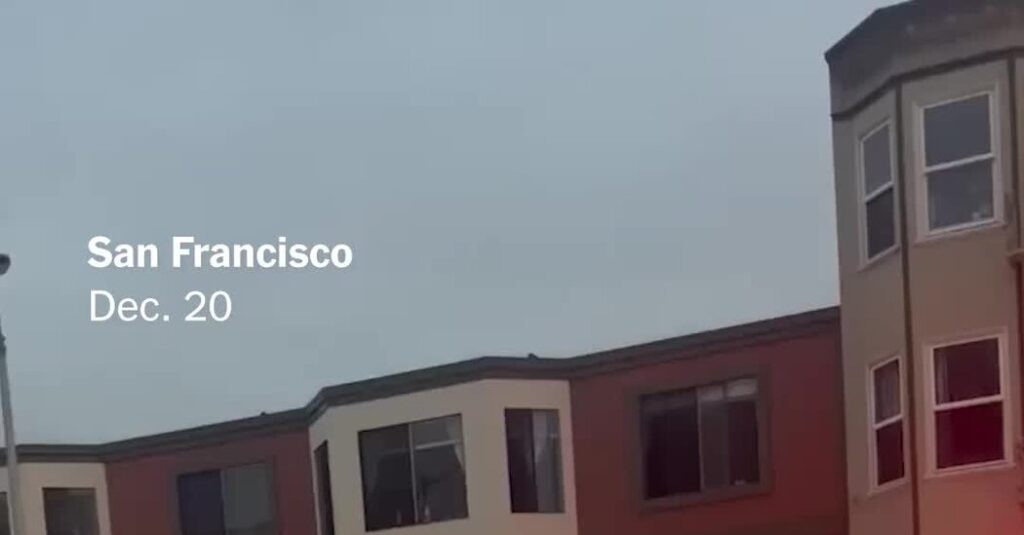
San Francisco officials on Monday called for an investigation into Waymo after its autonomous taxis blocked intersections and snarled traffic during an hourslong power outage over the weekend.
The meltdown, which led Waymo to temporarily shut down its entire fleet in San Francisco, raised alarms about whether the vehicles might impede evacuations or emergency services during a bigger disaster, such as a major earthquake.
“We haven’t seen a situation before where these Waymos have stalled en masse across the city,” said Bilal Mahmood, a San Francisco supervisor who announced he would hold a hearing examining Waymo’s operations during emergencies. “We want to make sure what we saw this weekend doesn’t happen again.”
San Francisco is the nation’s epicenter of driverless cars, and Waymos in particular have become ubiquitous in the past year, with the camera-laden white Jaguars seemingly on every block.
Waymo — which is owned by Alphabet, the parent company of Google — arrived in the tech capital in 2023 and now has around 1,000 vehicles roaming its hills and avenues.
After initial hesitation, San Franciscans have increasingly grown to rely on the cars, which are no longer just a novelty. Some women feel safer in a driverless car than in one driven by a man, and parents have been known to use them for school pickups.
But Waymo has had a rough go of it recently. One of its self-driving cars in San Francisco killed a beloved bodega cat in October, causing an uproar. And this weekend’s events sparked even more outrage and debate, as social media feeds were filled with videos showing a string of Waymos blocking streets with their hazard lights flashing.
It was perhaps the first time Waymo taxis failed on such a wide scale. It was also one of the rare instances, perhaps, where human drivers had a clear advantage over the robots.
Seeing the footage this weekend, many San Franciscans couldn’t help but imagine the Big One, the anticipated and much-feared major temblor. It has been 36 years since the last devastating earthquake knocked out power, toppled buildings and caused gas fires that set homes ablaze in San Francisco.
A fleetwide Waymo failure today could hinder fire trucks, rescue services and other emergency crews, said Jeanine Nicholson, who served as San Francisco’s fire chief for five years until she retired last year.
“They don’t have them programmed for when there’s a power outage, never mind when there’s an earthquake and there’s rubble in the street and all the power is out,” she said. “It is a major, major problem.”
“They’re still building the plane while they’re flying it,” Ms. Nicholson added, “and I think it’s irresponsible.”
Mr. Mahmood, who serves on the San Francisco Board of Supervisors, an elected body akin to a city council, said that stalled Waymo taxis on Saturday had blocked city fire trucks from quickly reaching a burning PG&E substation, which had been one of the causes of the extended power outage in the city. The San Francisco Fire Department declined to comment on whether Waymo vehicles had hindered the emergency response, as did the mayor’s office.
No injuries or accidents were reported from the weekend’s Waymo problems, city officials said. On Saturday, after the power outage began, Mayor Daniel Lurie’s office contacted Waymo about the gridlock its cars were contributing to, and the company agreed to suspend services, according to representatives from the mayor’s office and Waymo. Service resumed by Sunday afternoon.
It remains unknown exactly why the Waymos stalled. Some experts speculated that the vehicles rely on cell service to communicate with remote operators in emergency situations, and that their connections dropped in the outage. Others have said that the company may have purposely shut down the cars because it was too risky to have them navigate through so many dead traffic lights.
It is not clear that self-driving technology itself was to blame. Elon Musk said on X that Tesla Robotaxis, which provide limited ride-share services in San Francisco, had been unaffected this weekend. (The Tesla service is still required to have a human safety monitor on board.)
Waymo said in a statement that while its vehicles are designed to treat nonfunctional signals as four-way stops, “the sheer scale of the outage led to instances where vehicles remained stationary longer than usual to confirm the state of the affected intersections. This contributed to traffic friction during the height of the congestion.”
The company added, “We are focused on rapidly integrating the lessons learned from this event.”
Marcy Fraser, president of the San Francisco Fire Commission, defended Waymo. She finds the automatic vehicles more cautious than human drivers, who she thinks make more mistakes than robot taxis. Even on Saturday, she said, she saw people blasting through intersections where stop lights had gone out.
“That’s less safe, I think, than just stopping,” Ms. Fraser said. “But very disappointing, I’m sure, for the company.”
While Mr. Mahmood called for a hearing, it is not clear what impact the city’s review would have. The state regulates autonomous vehicles in California, not the cities in which they operate. That has sometimes left local officials feeling as though they have little control.
Mayor Lurie has been a prominent supporter of Waymo services. “Waymo is incredibly safe,” he said recently when asked about the cat that was run over by a Waymo taxi. “It’s safer than you or I getting behind a wheel.”
Matthew Wansley, a professor at the Cardozo School of Law who specializes in emerging automotive technologies, said he hoped that state regulators were asking questions about what happened in San Francisco. Terrie Prosper, a spokeswoman for the California Public Utilities Commission, which has oversight authority, said on Monday that the agency was “looking into specifics.”
In general, Mr. Wansley said, self-driving cars are safer than human drivers, but automated taxis come with novel risks that must be considered, particularly as Waymo looks to scale up in cities nationwide. Waymo currently has taxi operations similar to its San Francisco service in Los Angeles and Phoenix and provides rides through an Uber partnership in Atlanta and Austin, Texas.
Regulators must think about how the cars will fare in storms, earthquakes, blackouts and more, Mr. Wansley said.
“This is not the last time this is going to happen,” he said. “Waymo has a promising safety record when it comes to avoiding collisions. But of course, safety is about more than avoiding collisions, as the weekend illustrates really clearly.”
Heather Knight contributed reporting, and Sheelagh McNeill contributed research.
Soumya Karlamangla is a Times reporter who covers California. She is based in the Bay Area.
The post After Power Outage, San Francisco Wonders: Can Robot Taxis Handle a Big Earthquake? appeared first on New York Times.