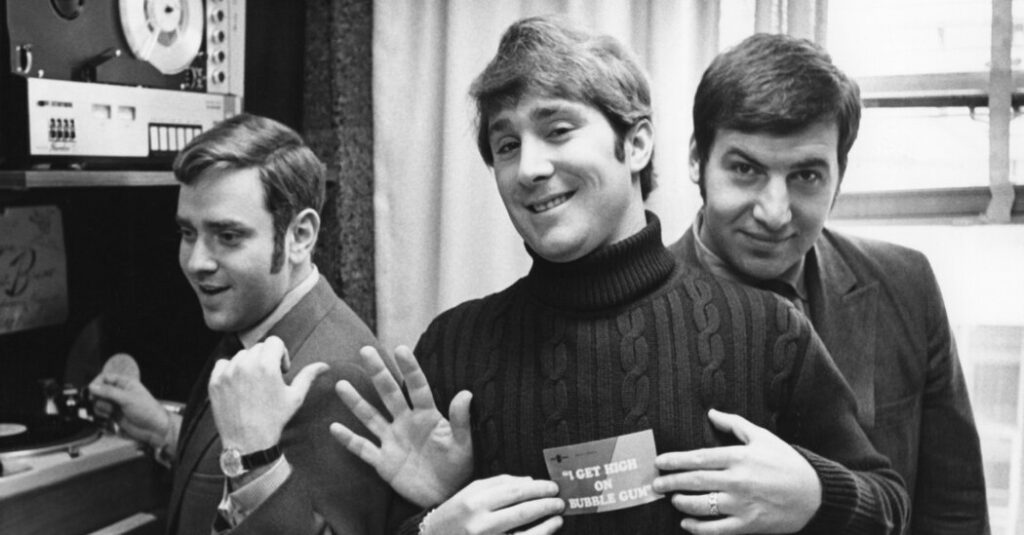
Jerry Kasenetz, a hit-making record producer who, with his business partner, Jeffry Katz, gained a reputation as a “king of bubblegum” by defying rock’s drift toward self-seriousness in the late 1960s, peppering the charts with sugary concoctions like “Yummy Yummy Yummy” and “Little Bit O’ Soul,” died on Dec. 6 in a hospital in Tampa, Fla. He was 82.
The cause was complications from a fall at his home, his son Darren said.
Mr. Kasenetz and Mr. Katz scored their first big hit in 1967 with “Little Bit O’ Soul,” by the Music Explosion, which reached No. 2 on the Billboard Hot 100 chart.
That was a pivotal year for rock ‘n’ roll: The Doors, Jimi Hendrix and the Velvet Underground put out debut albums that seemed to capture the human id on wax, while the Beatles, with “Sgt. Pepper’s Lonely Hearts Club Band,” made the most conspicuous statement yet that rock, long derided as kid stuff, had evolved into an art form.
Kid stuff, however, was A-OK with the partners known as Super K Productions. Given free rein under Neil Bogart at the New York label Buddah Records, also bubblegum royalty, the duo was known within the industry as a “human jukebox” and ran the equivalent of a pop music factory, overseeing a conveyor belt of dessert pastries disguised as 7-inch singles.
Protest anthems? Thinly veiled odes to LSD? They wanted none of it.
“The kids who are digging pop music aren’t involved with the problems in the world that preoccupy older people,” Mr. Katz said in a 1968 interview with the influential British music newspaper Melody Maker. “They want happy music they can dance to.”
Some of Mr. Katz and Mr. Kasenetz’s groups were little more than cover identities for a stable of songwriters and session musicians. Others were small-time bands they reinvented as instant, if disposable, pop stars.
The Super Ks, who virtually defined the form in their heyday, flummoxed critics and rock snobs. They produced records that had all the nutrition, musically speaking, of Twinkies, yet their songs proved addictive to significant swaths of the record-buying public.
During a two-year reign, the 1910 Fruitgum Company — another thoroughbred in the Super K stable — crowded the Hot 100 chart with feel-good tunes like “Simon Says” (No. 4); “1, 2, 3, Red Light” and “Indian Giver” (both No. 5); and “Goody Goody Gumdrops” (No. 37).
Other signature bands included the Ohio Express, who soared to No. 4 with “Yummy Yummy Yummy,” to No. 15 with the cavity-inducing “Chewy Chewy” and to No. 33 with “Down at Lulu’s.” Crazy Elephant got to No. 12 with “Gimme Gimme Good Lovin’,” which called to mind Wilson Pickett channeling the Cowsills.
The producing pair’s zenith arguably was a 1968 concert at Carnegie Hall by the 50-member-strong Kasenetz-Katz Singing Orchestral Circus, which was composed of members of several Super K bands and billed as the first symphony-sized rock group.
“It was sort of a world’s fair of rock,” the critic Robert Shelton wrote in a review in The New York Times, adding that the spectacle included psychedelic lights, smoke pellets and “freaky films” that “gave the stage an aura of interplanetary chaos.”
Seemingly overnight, Mr. Kasenetz and Mr. Katz were millionaires in their mid-20s, and lived accordingly.
“We were more than crazy,” Mr. Kasenetz, known for his high-wattage personality, told Newsday in 1977. “We were off the wall. We were untouchable. Limousines, racehorses, bodyguards. We were zany and we still are.”
Jerrold H. Kasenetz was born on May 5, 1943, in Brooklyn, the eldest of five children of William Kasenetz and Rose (Cohen) Kasenetz, who both worked in real estate development and management.
He grew up in Great Neck, N.Y., on Long Island. After graduating from the Henley School, a private preparatory institution in Queens, in 1960, he enrolled at the University of Arizona, where he met Mr. Katz.
“Jeff was from a poor family in Brooklyn,” Mr. Kasenetz said in a 1977 interview with the rock magazine Circus, “and I was from a wealthy home. I’m the crazy one.”
The duo got its first taste of the music business arranging a campus concert by the Dave Clark Five, and left college before senior year to take a shot at industry success in New York.
They certainly found it, but while they in large part defined the bubblegum sound, Mr. Kasenetz and Mr. Katz were not the only ones to strike gold with less-than-authentic bands. Starting in 1966, the Monkees, the made-for-TV band guided by the music producer Don Kirshner, became a chart sensation. Also under Mr. Kirshner, the Archies, a made-for-TV-cartoon group, scored the No. 1 song of 1969 — the year of Woodstock, no less — with “Sugar, Sugar.”
With the approach of the 1970s, the bubblegum craze began to die down as record buyers sought fresher sounds, a point that was obvious to the Super Ks.
“We made it through an unusual amount of enthusiasm and desire,” Mr. Kasenetz told Circus. “Near the end we began to lose that. It was no longer fun.”
An attempt to spin off their own label brought little success, but they briefly found a second act, signing a production deal with Epic Records and another Top 20 hit in 1977 with “Black Betty,” a scalding rock reinvention of an old song associated with Lead Belly, by a group called Ram Jam.
The duo opened a recording studio in Great Neck in the mid-1970s, and continued to search for new stars into the late 1980s, before Mr. Kasenetz moved to Tampa and retired.
In addition to his son Darren, Mr. Kasenetz is survived by another son, Brett; his brothers, Iver and Bruce; and two grandchildren. His marriage to Jacqueline Schapiro ended in divorce in 1981.
While the Super K team is largely remembered for its helium-light output — the British rock journalist Pete Silverton once deemed the genre “Kleenex music” — no shortage of rock cognoscenti paid tribute over the years.
Pete Townshend of the Who called “Yummy Yummy Yummy” — which fundamentally was straightforward power pop with slyly suggestive lyrics — one of his favorite songs when it was released, according to the liner notes of the 1983 album “The Best of the Ohio Express and Other Bubblegum Smashes” on Rhino Records.
Joey Ramone once said that the Ramones “started off just wanting to be a bubblegum group.” The band covered “Little Bit O’ Soul” on its 1983 album “Subterranean Jungle.” The ever-arty Talking Heads gave their own disjointed spin to “1,2,3, Red Light” while performing in their early years at CBGB, the Bowery club that was a cradle of punk rock.
No less a rock purist than Lester Bangs, the storied gonzo critic, eventually gave bubblegum its due in the 1992 book “The Rolling Stone Illustrated History of Rock & Roll.”
“The basic bubblegum sound could be described as the basic sound of rock ‘n’ roll,” he wrote, “minus the rage, fear, violence and anomie that runs from Johnny Burnette to Sid Vicious.”
Alex Williams is a Times reporter on the Obituaries desk.
The post Jerry Kasenetz, a King of Bubblegum Pop Music, Dies at 82 appeared first on New York Times.