Los Angeles was not looking particularly good in 1995.
The previous few years had been marked by racial tensions, civil unrest, the collapse of both the aerospace industry and the real estate market, an exodus of corporations and a massive earthquake. Much of the world seemed to feel that we were, as that infamous Time magazine cover put it, “going to hell.”
Then on Dec. 15, 1995, the public got its first look at something that would present L.A. in a different light — and a very different darkness.
This month marks the 30th anniversary of “Heat,” the Michael Mann crime drama. Some people love it (me); some people don’t (“Al Pacino is literally chewing up Figueroa Street”). But there is no doubt that the film’s visual style offers an alternative view of L.A. that has influenced a generation of filmmakers. “Heat” broke many of the rules about how art interprets the city, recoloring the metropolis and discovering beauty in many of our most demonized neighborhoods.
Don’t take my word for it.
“It captures Los Angeles, modern Los Angeles, in a way no other film does,” director Christopher Nolan said at an Oscars event a few years ago.“There is no nostalgia to it. It’s a very clear view of modern Los Angeles.”
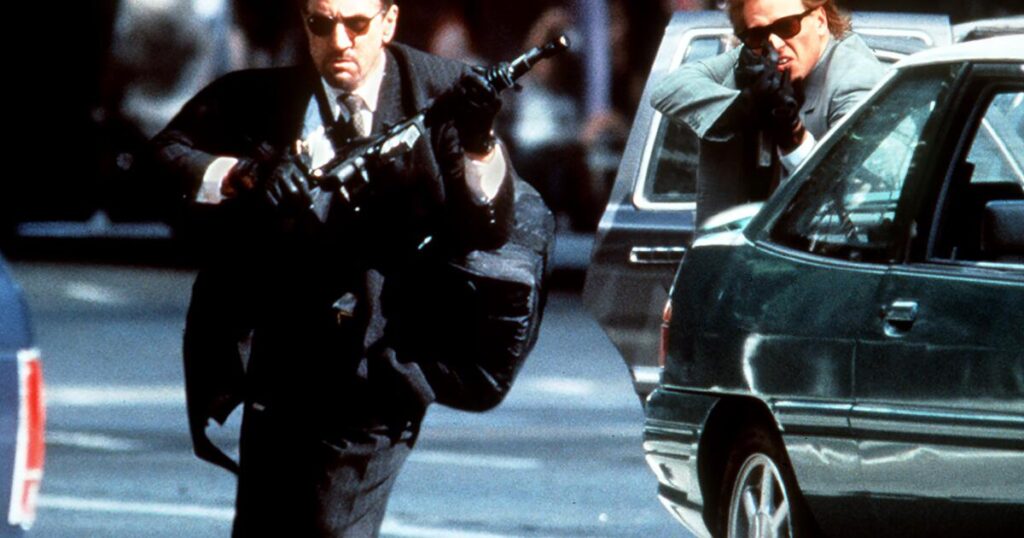
So much has been written about “Heat” that individual scenes have become cottage industries. There’s the choreography of the famous downtown bank robbery and shoot-out. There’s the “diner scene” in which Al Pacino and Robert DeNiro are on screen together for the first time, lecturing each about how “you can’t change me.”
But for me it’s less about the plot and more about how the filmmakers captured Los Angeles. Mann, in conversation with Nolan, said he had livedin L.A. for years but until “Heat” had rarely explored outside its tonier quarters.
Working in Hollywood, he had lived in a “culturally self-imposed ghetto.” When he decided to make “Heat,” he realized: “I don’t know L.A.”
So instead of using his imagination, Mann said he hit the streets. For several months, he spent Friday and Saturday nights with an LAPD commander responding to police calls, “rolling through the city seeing whatever was happening. … The sense of the vibe of Los Angeles at night, that’s where it comes from.” It exposed him to the city that became “Heat’s” protagonist.
In various interviews over the years, Mann described some of his favorite finds — a chop shop in Wilmington, a seedy motel, a stone-encased downtown bank. Mann told one audience he fell in love with the desolate Malibu beach home where De Niro lived, in part because the terrace was covered with bird droppings (to his disappointment, the droppings were cleaned up before filming).
“Heat” was filmed in more than 90 different locations, and it shows. Burrito stands. The concrete jungle under the interchange of the 10 and 110 freeways, a house precariously perched on stilts in City Terrace, a Koreatown mini-mall blindingly illuminated by neon and fluorescent lights, an abandoned drive-in movie theater.
“Heat” is far from the only movie to have great L.A. locations. But film buffs rave about how they are presented here. So many L.A. movies take advantage of the city’s golden light — especially those dramatic orange vistas that transform the landscape at sunset. “Heat” eschews orange in favor of darker blues and greens. There is one scene that takes place at sunset, with two characters taking in a view of downtown L.A. looking west from atop a parking garage. But instead of nuclear orange, the skyline looks dark, with just a taste of citrus disappearing on the horizon.
The secret weapon of “Heat” is not the sun but the city’s own sodium and mercury vapor streetlamps, which gave off green and yellow tints (the lighting scheme is very complex, and the film’s cinematographer breaks it down in detail in this American Cinematographer article).
The 1990s were a high point of L.A. crime movies. “Pulp Fiction,”“Blood In Blood Out,” “Set It Off,” “Reservoir Dogs,” “Jackie Brown,” “L.A. Confidential,” “Devil in a Blue Dress” and so many more. I don’t know if “Heat” is the best.
But simply as a work of L.A. discovery, it is hard to beat.
I’ve lived in L.A. all my life. I brag about how I know all its hidden corners, only to be humbled time and again. A few weeks ago, using a rush-hour shortcut to get from El Segundo to downtown L.A., the city surprised me again. I turned onto 48th Street at Budlong Avenue and was stunned to see a grand public library, a striking mix of Prairie and Italian Revival architecture. It’s the pride of Vermont Square, but I’d never heard of it.
Mann once told an audience something that I believe applies to all of us: “I thought I knew L.A., and I realized that I was just scratching the surface.”
The post 30 years ago, the way we looked at L.A. changed forever appeared first on Los Angeles Times.