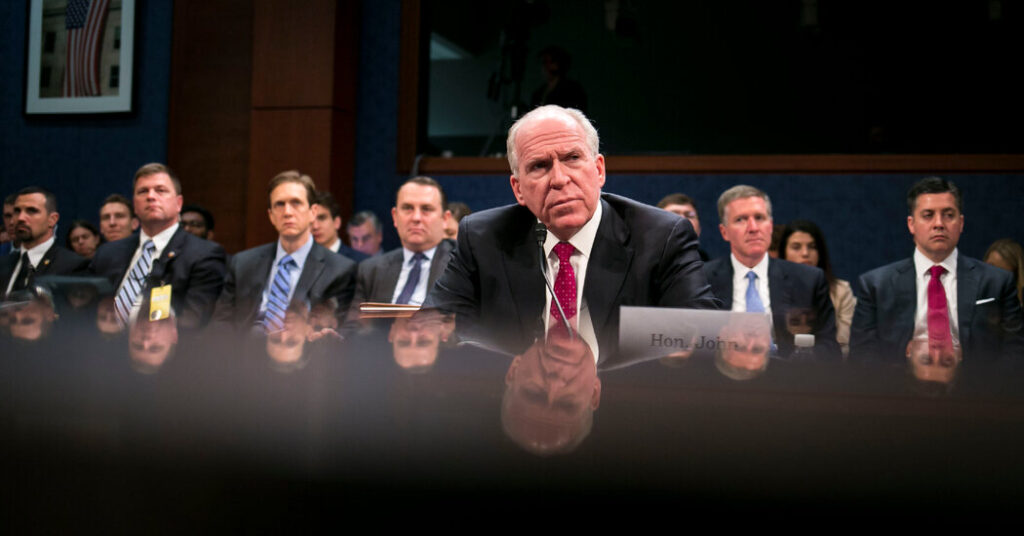
John O. Brennan, the former C.I.A. director, sought on Monday to prevent the Justice Department from steering a sprawling investigation into political adversaries of President Trump to a judge in Florida who issued rulings favorable to Mr. Trump during his classified documents case.
The request, addressed to Chief Judge Cecilia M. Altonaga of the Federal District Court for the Southern District of Florida, was extraordinary. It would be highly unusual for a chief judge to block a colleague from overseeing an investigation. But a lawyer for Mr. Brennan argued that under the circumstances, she had the authority and a duty to do so.
In a 16-page letter, the lawyer, Kenneth L. Wainstein, asserted that the Justice Department, in what he portrayed as a violation of prosecutorial ethics, appeared to be planning to “manipulate grand jury and case assignment procedures” to put the investigation into Mr. Trump’s perceived foes under Judge Aileen M. Cannon.
Citing a pattern of the judge’s rulings in the documents case as indicating bias, Mr. Wainstein wrote, “We urge your honor to exercise your supervisory authority as chief judge to ensure the United States attorney does not steer this matter to the Fort Pierce division and to the courtroom of Judge Aileen Cannon.”
The Justice Department, Judge Altonaga and Judge Cannon did not immediately respond to requests for comment.
The letter by Mr. Wainstein, who served in the administrations of Presidents George W. Bush and Joseph R. Biden Jr., also amounted to a public pushback on what he described as a “concocted case” and “politically motivated and fact-free criminal investigation.”
Mr. Wainstein said he was making his request public “as a means of shedding light on the government’s course of action in this matter.” Prosecutors loyal to Mr. Trump, he wrote, had been “taking advantage of the secrecy around the grand jury process to undertake irregular activity outside of public view.”
The investigation, led by the U.S. attorney in Miami, Jason A. Reding Quiñones, has already involved subpoenas to former officials in a January 2017 intelligence assessment that concluded that Russia was trying to help Mr. Trump win the 2016 election. The focus for now appears to be on Mr. Brennan, who helped oversee the assessment.
But that may just be the start. Mr. Trump’s allies have zealously promoted a “grand conspiracy” investigation aimed at pursuing all former officials involved in scrutinizing the 2016 campaign’s ties to Russia and in bringing charges against Mr. Trump over his efforts to overturn the 2020 election and over his hoarding of classified documents. The idea is to portray the disparate investigations into Mr. Trump as stemming from a single “deep state” conspiracy to violate his constitutional rights.
An inspector general and a special counsel have already scrutinized the Russia investigation, finding no basis for charges against high-level officials. Most of the relevant events took place in and around the District of Columbia, and those that happened more than five years ago would normally be beyond the statute of limitations.
But in his second term, Mr. Trump has openly pushed the Justice Department to leverage its prosecutorial power to settle scores against his adversaries on his behalf. By positing a “grand conspiracy,” the president’s allies have connected his grievances over the Russia investigation to the 2022 F.B.I. search for classified documents at Mar-a-Lago, his home and club in Palm Beach, Fla. That search remains within the statute of limitations and would establish venue in South Florida.
Pursuing the case in Fort Pierce, Fla., would draw jurors from a more conservative area than the District of Columbia and put it under Judge Cannon, who showed Mr. Trump unusual favor during the documents investigation. In particular, Mike Davis, an influential former Republican Senate staff aide and friend of Mr. Reding Quiñones, has pushed the idea of a Fort Pierce grand jury, warning Mr. Trump’s adversaries to “lawyer up.”
Trump Administration: Live Updates
Updated
- Trump halts five wind farms off the East Coast, citing unspecified national security risks.
- Trump appoints a special envoy to Greenland, angering Denmark.
- Here’s what we know about the U.S. interceptions of oil tankers in Venezuela.
Under the rule for the Southern District of Florida, the judge on duty at a courthouse oversees any grand jury that meets there. As the only judge at the federal courthouse in Fort Pierce, Judge Cannon is by default its duty judge. Mr. Reding Quiñones has convened a special extra grand jury to meet in Fort Pierce starting next month, exciting Mr. Trump’s supporters.
Mr. Reding Quiñones has not said why he is putting an extra grand jury in Fort Pierce.
The judge overseeing a grand jury wields particular influence over a contested investigation. She could quash subpoenas on grounds ranging from an expired statute of limitations to claims of privilege, or grant requests by prosecutors to compel recalcitrant witnesses to testify under threat of being jailed for contempt of court.
The letter did not mention that Chief Judge Altonaga tried to intervene with Judge Cannon in 2023, an episode reported by The New York Times.
At the time, Mr. Trump had just been indicted in the documents case, which was randomly assigned to Judge Cannon. The assignment raised eyebrows because of her involvement in the investigation at an earlier stage. After the F.B.I. searched Mar-a-Lago, Mr. Trump had filed a lawsuit that went to her. She had blocked the bureau from working with classified files and appointed a special master to review them for executive privilege — only to be overturned by a sharply critical appeals court panel.
When Judge Cannon was randomly assigned to oversee the indicted case, two of her colleagues, including Chief Judge Altonaga, urged her to decline and let it be reassigned to another judge. But Judge Cannon insisted on keeping it, according to two people briefed on the conversations.
She then moved slowly on pretrial proceedings as Mr. Trump sought to run out the clock to prevent any trial before the 2024 election, only to abruptly dismiss the case. In doing so, she cited what she considered a technicality about the appointment of special counsels that clashed with decades of precedents.
The Justice Department dropped its appeal of that ruling after Mr. Trump won the election because it considers sitting presidents immune from prosecution. Judge Cannon has since blocked the release of a special counsel report about the documents case. An appeals court last month rebuked her for “undue delay” on that issue.
In his letter, Mr. Wainstein argued that for Judge Cannon to have a role in an investigation into Mr. Brennan would be improper because she had a “demonstrated pattern of favoring Donald Trump’s litigating positions” that raised a basis to question her impartiality. Moreover, Mr. Wainstein wrote, if there were a conspiracy case that involved the documents investigation, Judge Cannon could be a potential witness to the government’s conduct.
There would be no reason for Judge Altonaga to intervene, Mr. Wainstein added, if Mr. Reding Quiñones publicly promised that the Brennan matter would never be moved to Fort Pierce. But absent such a statement, he said, the circumstances clearly indicated that Mr. Reding Quiñones was “attempting to steer this matter toward Judge Cannon.”
He urged the chief judge to stop it to protect Mr. Brennan’s rights and the ethics of junior prosecutors ordered to work on the investigation, and “to defend and reinforce the rule of law” at what he called a fragile moment in American history.
The letter cited a decision by a federal judge to dismiss indictments against two other perceived adversaries of Mr. Trump: James B. Comey Jr., the former F.B.I. director, and Letitia James, the New York attorney general.
Mr. Trump had openly pressed Attorney General Pam Bondi to seek charges against them and removed a U.S. attorney who did not think there was sufficient evidence to proceed. A Trump loyalist was installed to secure those indictments, but a judge later threw them out on the grounds that her appointment was illegitimate.
The Trump administration has since tried twice to re-indict Ms. James, only for two grand juries to reject the efforts. Developments like those, Mr. Wainstein asserted, showed that federal prosecutors were no longer entitled to judicial deference and a presumption that their actions were being performed correctly.
“We are no longer in a normal time,” he wrote. “We are now in a time when the Justice Department has surrendered much of its independence and the president is directly commanding his attorney general and her leadership team to use their prosecutorial authorities against his perceived political adversaries.”
Charlie Savage writes about national security and legal policy for The Times.
The post Ex-C.I.A. Chief Asks to Keep Justice Dept. From Steering Case to Favored Judge appeared first on New York Times.