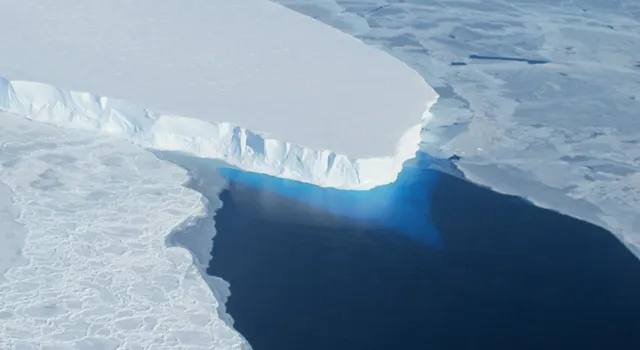
Known as the “Doomsday Glacier,” the Thwaites Glacier in Antarctica is one of the most rapidly changing glaciers on Earth, and its future evolution is one of the biggest unknowns when it comes to predicting global sea level rise.
The eastern ice shelf of the Thwaites Glacier is supported at its northern end by a ridge of the ocean floor. However, over the past two decades, cracks in the upper reaches of the glacier have increased rapidly, weakening its structural stability. A new study by the International Thwaites Glacier Collaboration (ITGC) presents a detailed record of this gradual collapse process.
Researchers at the Centre for Earth Observation and Science at the University of Manitoba, Canada, analyzed observational data from 2002 to 2022 to track the formation and propagation of cracks in the ice shelf shear zone. They discovered that as the cracks grew, the connection between the ice shelf and the mid-ocean ridge weakened, accelerating the upstream flow of ice.
The Crack in the Ice Shelf Widens in Two Stages
The study reveals that the weakening of the ice shelf occurred in four distinct phases, with crack growth occurring in two stages. In the first phase, long cracks appeared along the ice flow, gradually extending eastward. Some exceeded 8 km in length and spanned the entire shelf. In the second phase, numerous short cross-flow cracks, less than 2 km long, emerged, doubling the total length of the fissures.
Analysis of satellite images showed that the total length of the cracks increased from about 165 km in 2002 to approximately 336 km in 2021. Meanwhile, the average length of each crack decreased from 3.2 km to 1.5 km, with a notable increase in small cracks. These changes reflect a significant shift in the stress state of the ice shelf, that is, in the interaction of forces within its structure.
Between 2002 and 2006, the ice shelf accelerated as it was pulled by nearby fast-moving currents, generating compressive stress on the anchorage point, which initially stabilized the shelf. After 2007, the shear zone between the shelf and the Western ice tongue collapsed. The stress concentrated around the anchorage point, leading to the formation of large cracks.
Since 2017, these cracks have completely penetrated the ice shelf, severing the connection to the anchorage. According to researchers, this has accelerated the upstream flow of ice and turned the anchorage into a destabilizing factor.
Feedback Loop Collapse
One of the most significant findings of the study is the existence of a feedback loop: Cracks accelerate the flow of ice, and in turn, this increased speed generates new cracks. This process was clearly recorded by the GPS devices that the team deployed on the ice shelf between 2020 and 2022.
During the winter of 2020, the upward propagation of structural changes in the shear zone was particularly evident. These changes advanced at a rate of approximately 55 kilometers per year within the ice shelf, demonstrating that structural collapse in the shear zone directly impacts upstream ice flow.
Time-series analysis of shear deformation rates, based on satellite data, also showed a sharp increase during that same winter. In parallel, the total length of the cracks and the area of internal mixing grew significantly, confirming a close relationship between structural weakening and the dynamic acceleration of the ice.
The state of tension in the center of the ice shelf also changed significantly. Between 2002 and 2006, the ice was in a state of extensive tension, stretching in the direction of flow. Subsequently, it transitioned to a state of compressive tension, and since 2020, it has returned to an extensive state. Meanwhile, the area just upstream of the anchorage point has shifted from an initial state of compression to one of extension in recent years, reinforcing the idea that the shelf has lost its connection to the anchorage point.
The accumulation of structural damage to the ice shelf creates increasingly concentrated stresses, accelerating the upstream flow of ice and reinforcing the feedback loop that could trigger the complete collapse of the shelf.
A Warning Sign for Other Ice Shelves
The researchers caution that the deterioration patterns observed in this study could apply to other ice shelves undergoing similar weakening processes. A historical example is the Wadi Ice Shelf in the western Antarctic Peninsula, where in the 1970s an ice bulge initially stabilized the shelf, but later became the starting point for the cracks that led to its disintegration.
Because the Thwaites Glacier sits on a reverse-slope bed, where the ocean floor dips inland, once retreat begins, it is likely to progress toward irreversible collapse. The glacier’s total mass is sufficient to raise sea levels by about 65 centimeters, and previous numerical models estimate that the baseline of the ice sheet and shelf will retreat at a rate of nearly 1 kilometer per year over the next 40 years.
These results help us understand the future of other ice shelves in Antarctica and provide key data for validating numerical collapse models. For now, all indications are that the weakening of the Thwaites Glacier ice shelf will continue to accelerate.
This article originally appeared in WIRED Japan and has been translated from Japanese.
The post The Doomsday Glacier Is Getting Closer and Closer to Irreversible Collapse appeared first on Wired.