PINETOP-LAKESIDE, Ariz. — Before Kerri married Mike Abatti in 1992, before she moved to California and raised three children in the Imperial Valley, before she left her husband of 31 years and before she was shot and killed in her 7,000-square-foot Arizona mountain home, she was Kerri Ann Penrod: a talented and beloved member of Arizona’s tight-knit Pinetop-Lakeside community.
“She was one of those people who radiated light,” said her cousin Cathy Penrod. “I don’t know how else to describe her. She was love and she was light.”
Local, state and federal law enforcement are investigating Kerri’s death. Earlier this month, they expanded their investigation from the couple’s 14-acre Pinetop home to their shared properties and businesses in Imperial County. A visit to Pinetop — the town where Kerri was born and which is more than 400 miles from the couple’s primary residence in El Centro — leaves the impression that she came here not only to escape from an unhappy marriage, but to rediscover the familiar joy and comfort this place once provided her.
Kerri “always had a smile and a big wave” when she drove down the short, gravel-dirt road known as Bruin Way and passed by her neighbor Rebecca Lopez, a retired high school administrator. “She even asked her guests to keep their speed down so they wouldn’t cover my cars and house with dust when they drove by. She was just a really nice lady.”
Kerri, who was found dead from a gunshot wound the night of Nov. 20, had returned to her hometown — a place her ancestors found and settled in the 1880s. Her divorce filings say she returned to Pinetop to help her ailing parents, but the hardscrabble town 7,000 feet high in Arizona’s eastern White Mountains is also where she was once considered a rising star, where culture is steeped in tradition and religion, and where familial bonds are staked in blood ties.
According to Cathy Penrod, Kerri said little about her marriage or the divorce when she returned. But “it must have been bad” for her to have walked away and come back to this deeply traditional community built by pioneers and missionaries in the Church of Jesus Christ of Latter-day Saints and still heavily populated by their descendants.
“She must have felt so much shame,” she said, describing her own experience of being a divorced woman in this town — where custom and convention are supreme, and purposeful familial destruction is abhorrent.
“But she also must have known how deep her family’s love was for her. That no matter what, this was her home,” Cathy Penrod said.
While news reports about Kerri’s death have portrayed Pinetop as an exclusive, mountain community crawling with transplants from Southern California, the town — now officially called Pinetop-Lakeside, after it merged with its neighbor in 1984 — is not Sedona, Flagstaff or Prescott. You won’t find a Whole Foods, Sprouts or REI within 100 miles. And although the town’s mayor, Stephanie Irwin, described the area as a draw for outdoor-loving Phoenix-area flatlanders, you’d be hard-pressed — at least in the winter months — to find anyone sporting a label like Patagonia or North Face. It’s an off-brand, pioneer town that has so far resisted any whiff of genteel urbanity.
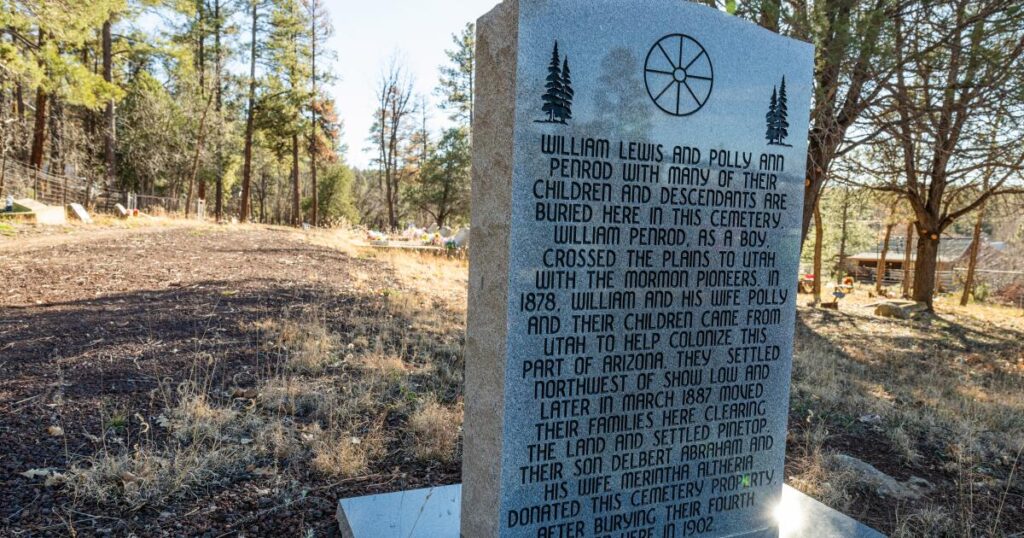
The town was settled by Kerri’s Mormon ancestors, Polly Ann and William Lewis Penrod, who’d been called by Brigham Young to uproot their nine children from Utah and, with hundreds of others, colonize the Little Colorado River Valley — an area that stretches south and east through the White Mountains toward the New Mexico border. After cobbling together carpentry work in the towns of Snowflake and Show Low during the early 1880s, the Penrods decided to strike out on their own and in 1886 settled on a field near a saloon — a place known as Pinetop — where they lived out of their covered wagon until they could build a log cabin of their own.
The geography and environment of Pinetop is harsh. The soil is thin, sandy and gravelly and stands of Ponderosa pine trees are thick — creating a nearly permanent canopy of shade over a carpet of acidic and toxic needles not conducive for growing plants or feeding livestock.
To make a life here, pioneers had to rely on faith, fortitude and family. More than a century after the Penrods first arrived, the name is visible on road signs, a graveyard, and a good number of business cards, phone listings and high school year book entries.
Before she left for California, Kerri Ann Penrod was a stand-out among this hardworking, community-oriented clan.
Blue Ridge High School yearbooks from 1983 and 1984 — her junior and senior years — show a smiling and accomplished young woman, surrounded by friends, taking part in one of her many clubs, receiving honors or performing. She was a member of the school orchestra and the National Honor Society. During her senior year, she was prom queen and student body president, as well as the band’s drum major, and first-place winner of the talent show. She was a Girl Scout, cheerleader and the wrestling team’s scorekeeper. In the orchestra she was first violin, and was a member of the All-State Band and All-State Orchestra. There are nearly three dozen accomplishments listed by her name in the 1984 yearbook.
That same year, she was named Miss Navajo County and received a $1,000 scholarship to the University of Arizona to study music education and studio performance, which she put off for a semester so she could serve her duties representing the county.
Divorce filings show she didn’t graduate from college. However, in 1989, she acquired an Arizona real estate license. She had an EMT firefighting license too, according to the documents.
When and how she met Mike Abatti is not clear. Her family did not respond to requests for comment. Her cousin Cathy — who is 11 years her senior — also did not know the details of their courtship.
According to an April 15, 2024, declaration for spousal support, filed by Kerri in the years following their marriage, she let her real estate and firefighting licenses lapse, but worked as an office manager for a third-party company and as a bookkeeper for the Abatti family’s company, Abatti Farms, LLC.
When her second child was born, she stopped her work as an office manager, but continued doing the family’s bookkeeping. In 1999, she quit both jobs to focus her “time and attention on raising our young family.” She said her husband supported this decision.
Court filings show she was given a $1,000 monthly allowance from Abatti and the pair vacationed around the world — in places such as Italy, Switzerland and Hawaii — with their children, family and friends. They traveled first class, stayed at five-star accommodations, and frequented four- and five-star restaurants. The family also spent money on fishing equipment, camping gear and guns, among other items.
Her children attended private schools, had private tutors and were given new cars — all debt-free.
In the Imperial Valley recently, at least five people who were asked about the Abatti family declined to speak to The Times on the record out of fear of retaliation for themselves or their business.
“Everybody’s afraid to talk,” said one. The Abattis own some of the biggest agriculture operations in the Imperial Valley, and some residents said that if they spoke with reporters, they would be shunned in political or social circles, citing the family’s record of charitable donations and campaign contributions.
Mike Abatti could not be reached for comment. His divorce declarations suggest he was surprised by Kerri’s departure.
What drove Kerri Abatti to leave the marriage is not known. According to declarations submitted by Mike Abatti, she left their California home in August 2023 while he was away on a fishing trip.
Cathy Penrod said in the last two years, her cousin had been spending time at the private Penrod family cemetery in Pinetop, where six generations are buried. Her mother, Sue Penrod, had inherited the role of graveyard upkeep. But Kerri assumed responsibility upon her return — working with dedication to identify the scores of graves scattered throughout the field, figure out all the familial relationships, clean the stones, clear the grass and make sure fresh flowers were laid in remembrance of those who had passed.
Cathy Penrod said in the days before her death, her cousin had placed poinsettias on the graves of William and Polly Penrod’s sixth generation descendants — her generation.
“I realize now that was what she was craving: a bond, a connection to her family. It’s what she needed to do,” Cathy Penrod said. “She came back because this was the center of her universe. It’s where her soul belonged.”
Times staff writer Alex Wigglesworth contributed to this report.
The post Slain wife of Imperial Valley farmer was adored in her hometown; a violinist, friend and beauty queen appeared first on Los Angeles Times.