to Donald Trump, Venezuela was first all about narcotics. Now it is all about narcotics, oil, and the theft of American assets.
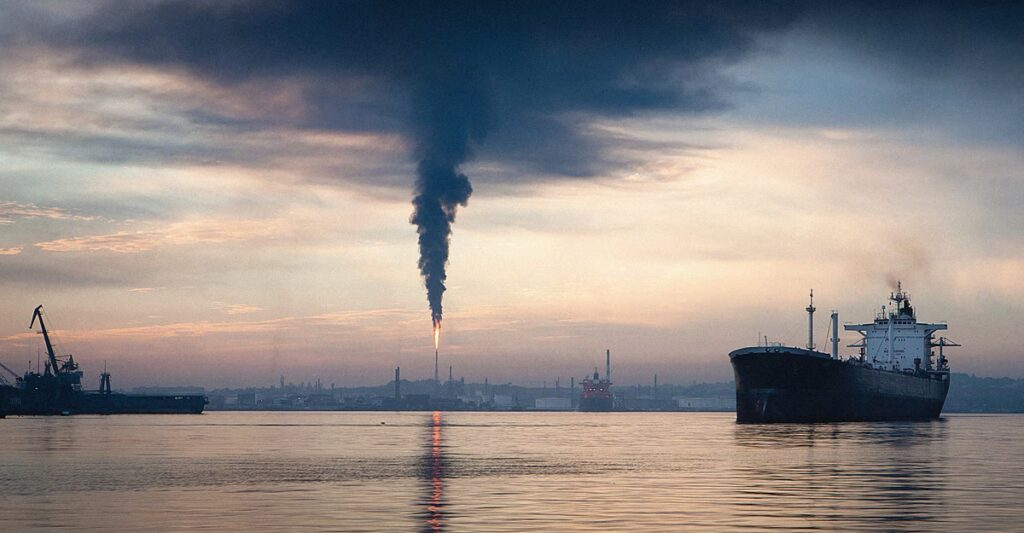
In the past week, Trump has added to his pressure campaign on President Nicolás Maduro by targeting the economic lifeblood of the regime: oil exports. The U.S. has seized three oil tankers in 11 days after Trump said on Truth Social that the United States was imposing a “TOTAL AND COMPLETE BLOCKADE” of tankers carrying Venezuelan oil that are subject to U.S. sanctions. The president added that the U.S. would also seek compensation for American assets that the Venezuelan government has seized, an apparent reference to past bouts of oil-industry nationalization by Caracas.
The new focus on Venezuela’s most abundant—and valuable—natural resource (the country has the largest estimated oil reserves in the world) was, in some ways, the clearest articulation yet of Trump’s ultimate aim. And some viewed the mention of a blockade as tantamount to a declaration of war, given that a blockade is recognized by international law as a belligerent act.
But the response of many Venezuela experts we talked with, regardless of their political leanings, was: This is how the pressure campaign should have started all along.
“I’m surprised they didn’t do it much sooner,” Juan Gonzalez, who served as a Latin America adviser at the National Security Council under President Joe Biden, told us. The administration’s previous moves have been dramatic and controversial: sending an armada of 11 ships and roughly 15,000 troops to the Caribbean and launching a series of missile strikes on alleged drug-smuggling boats that has killed more than 100 people. But neither action has directly threatened Maduro’s ability to stay in power. Hitting the single biggest source of revenue that has propped up Maduro’s government since 2013, in contrast, sets in motion a process that could undermine him. And providing a way for Maduro to appease the White House with compensation for past acts could bring him to the negotiating table.
“If the objective is to force Maduro to make really big concessions, this is a really smart move,” Gonzalez said.
Jason Marczak, a Latin America expert at the Atlantic Council, a Washington-based think tank, told us the blockade could be what’s needed to sever the “financial lifelines that keep Maduro in power.”
But the Maduro regime also has a long track record of dodging sanctions and withstanding economic hardship. This time could turn out to be no different. “Knocking out drug boats did not stop drug trafficking or hurt the regime,” Francisco Mora, the Obama administration’s deputy assistant secretary of defense for the Western Hemisphere, told us. “I think the now so-called blockade and the increase to the cost to get oil out of Venezuela hurts the regime. But it is not clear how much of an impact it will have.”
Despite the president’s bellicose rhetoric, this isn’t really a blockade. (The U.S. last imposed an actual blockade—preventing all ships from entering or exiting a port—during World War II.) In effect, Trump ordered the U.S. government to strictly enforce anti-Venezuela sanctions, some of which have been on the books for a while and across presidential administrations. That gives the Coast Guard the green light to carry out seizure operations if and when it encounters a tanker under sanction.
Unlike the campaign of air strikes on boats—which many experts consider illegal—there’s solid legal grounding for such seizures. But they’re not without risk. Oil props up both the regime and the Venezuelan economy, so conditions in Venezuela could worsen, driving even more migrants from the country. Gonzalez said it’s unlikely the U.S. can sustain an embargo for very long, “given the humanitarian and migration implications.” The administration appears to be gambling that it can get what it wants from Maduro before tipping his country into total chaos.
Maduro’s government has called the U.S. behavior “theft” and “an act of international piracy,” and filed a complaint with the United Nations Security Council. Maduro also ordered the Venezuelan navy to escort tankers headed to Asia.
Trump, in his social-media post, threatened to keep up the pressure on Maduro’s government “until such time as they return to the United States of America all of the Oil, Land, and other Assets that they previously stole from us.”
Trump appears to have been referring to a 2007 decision by Maduro’s predecessor, the anti-imperialist Hugo Chávez, to nationalize various foreign-owned oil projects. The U.S. oil giants Exxon Mobil and ConocoPhillips were kicked out of the country after they refused to allow Venezuela’s national oil company, Petróleos de Venezuela, to acquire majority stakes in their Venezuelan operations. Venezuela at the time was the fourth-largest foreign petroleum supplier to the U.S.
[Read: There’s a 92 Percent Chance Trump Is Making It Up]
Venezuela had previously nationalized its oil industry in 1976, when then-President Carlos Andres Perez vowed to assert greater control over his country’s resources, marking a significant shift in Venezuela’s energy policy after decades of embracing foreign investment. Exxon, Gulf Oil, and Mobil were forced to give up majority stakes in their own projects at the time. Several U.S. oil companies resumed operations in Venezuela in the 1990s, after the country’s economy began to tank and oil revenues were seen as key to revitalization. It remains unclear whether Trump’s comments were intended to take those projects into account.
Chevron is the only U.S. oil firm now operating in Venezuela, through a joint venture with the country’s national oil company. It does so on a restricted license, which was renewed by the Trump administration this year. The joint venture was previously structured so that Chevron sold the oil in the U.S. and then paid Venezuela half of the proceeds in cash. When Secretary of State Marco Rubio renegotiated Chevron’s license renewal, he allowed the joint venture to continue provided that Chevron pays Venezuela in barrels of oil-–not cash-–for any Venezuelan oil sold in the U.S. The idea was to limit Maduro’s ability to gain from Chevron’s output.
Those barrels have to be sold on the black market for Maduro to profit, Francisco Monaldi, an expert in Latin American energy policy at Rice University, told us. The only way he’s able to do that, Monaldi added, is if “he can get them to China”—something made difficult by the new blockade. About 80 percent of Venezuela’s oil currently goes to China, at least 15 percent goes to the U.S. via Chevron’s joint venture, and the remainder goes to Cuba, Monaldi said.
The Trump administration is also seeking to expand America’s direct access to Venezuelan oil fields by reclaiming the nationalized oil projects of 2007. Stephen Miller, Trump’s deputy chief of staff, said Wednesday on X that Venezuela’s oil industry had been built by “American sweat, ingenuity and toil,” and called Venezuela’s nationalization a “tyrannical expropriation” that he claimed constituted the “largest recorded theft of American wealth and property.”
Conoco won an arbitration award of $8.75 billion over the 2007 expropriation of three of its Venezuelan oil projects, Monaldi noted. It was the largest amount awarded to a foreign firm after those nationalizations.
If Maduro leaves or is forced from power and there is a successful transition to a Washington-friendly new government, then the U.S. may be able to push for compensation, though how that would be calculated is unclear. Venezuela’s opposition has a transition plan for revitalizing the country’s devastated economy, which includes inviting U.S. and other foreign oil companies to help restore production, along with a return to some of the old projects that were nationalized. If Maduro stays in power, however, all bets are off.
It’s hard to tell who owns or operates the dilapidated tankers that circumvent official tracking systems, known as the shadow fleets. Their total size is also unknown, though experts believe it has swelled since Russia’s 2022 invasion of Ukraine, after U.S. and European sanctions forced Russia to go off-radar with its oil shipments, too. S&P Global this year released a report suggesting that shadow fleets grew by 45 percent, from about 420 to 940 ships, in the year ending in May, and that they now account for 17 percent of the global tanker fleet.
Tanker Trackers, an independent monitoring site, says that roughly 400 tankers have entered Venezuelan ports since 2019. Of those, 160 are sanctioned by the U.S. Treasury Department’s Office of Foreign Assets Control, which administers and enforces economic and trade sanctions against foreign entities. Some of those ships are “stateless”—they are not registered with any country under international law—making them relatively straightforward for the U.S. to seize. Others may be sanctioned, but still are registered to another country. If the U.S interdicts one of those without permission, it is technically attacking another nation’s ship in what could be interpreted as an act of war.
The president did not say whether the U.S. would take possession of the ships it seizes or divert them, but so far, the U.S. has seized the tankers it has boarded. U.S. Southern Command, which is responsible for U.S. military operations in the Caribbean Sea, referred questions to the White House, which didn’t respond to a request for comment.
[Read: Trump knows what he wants, just not how to get there]
“The key will be in the execution. Do they stop every vessel and then inspect it for contraband cargo? Or do they only stop suspected ships?” Bryan Clark, a senior fellow at the Hudson Institute and a retired Navy officer, told us. “The former would hinder all traffic in and out of Venezuela, a de facto blockade, which goes beyond what the administration said it was aiming to do.” But, he added, “if they do this selectively, it seems they are enforcing the sanctions put in place.”
Stopping oil tankers could cause severe economic damage to Venezuela but not lead to the fall of the regime, Geoff Ramsey, a Venezuela expert at Recorded Future, a threat-assessment company, told us. If Venezuela can’t sell oil, it will hurt the government’s ability to import essential goods. “But that,” Ramsey said, “is not necessarily a death blow.”
White Crane, Kiara M, H Constance, Lattafa, Tamia, and Monique—these are the six additional tankers the Treasury Department sanctioned earlier this month, along with six shipping companies it said had transported Venezuelan crude oil in recent months. The U.S. has sanctions on hundreds of vessels it deems to be operating illegally as part of shadow fleets. This past January, the U.S. sanctioned 183 Russia-linked tankers, and in November, it sanctioned 170 tankers involved with Iran’s oil trade. About 180 Venezuelan tankers are subject to U.S. sanctions, and roughly 30 of those had been in Venezuela this month.
The Department of Justice released dramatic footage recently of the latest vessel seizure. American forces, led by the Coast Guard and joined by Special Forces and Marines, rappelled from a military helicopter onto the Skipper, which had been sanctioned by the Treasury Department in 2022.
White House Press Secretary Karoline Leavitt told reporters that the oil on the Skipper would be seized by the U.S. once a legal process to approve possession of the vessel is completed. That process requires the U.S. to get a federal warrant, seize the vessel, and then ask a court to hand it over to U.S. jurisdiction. During Biden’s presidency, the Justice Department followed a similar process to seize Maduro’s Dassault Falcon 900EX aircraft in the Dominican Republic. The aircraft was then transferred to the Southern District of Florida at the request of the U.S. based on violations of U.S. export-control and sanctions laws.
“The downside is it’s a very time-consuming, laborious, and onerous process, which is a problem if the government is trying to do it at scale, and not just a one-off,” says Martin De Luca, a former prosecutor and a partner at the law firm Boies Schiller Flexner, who has long worked on Venezuela matters.
If U.S. authorities decide to seize a ship, they inform the crew by radio and board the vessel with troops, led by the Coast Guard. Once on board, the Coast Guardsmen will confirm that it is a sanctioned ship and divert the vessel to a port, likely in U.S. territory. That’s if everything goes smoothly. Last year, two Navy SEALs died during a U.S. bid to board a ship off the coast of Somalia that was suspected of carrying weapons to Houthi rebels in Yemen.
The campaign against Venezuela is already incredibly unpopular with Trump’s base—a CBS News/YouGov poll last month said 70 percent of respondents, including both Democrats and Republicans, would oppose military action. Any mishaps that produce American casualties could lead to all-out war, which would be politically perilous. Not all Republicans love that their party is threatening war to settle scores on behalf of Big Oil. GOP Representative Thomas Massie, in a post on X, said that “no one campaigned on using our soldiers to overthrow Venezuela to make these Oil Companies whole again.”
The post Trump’s Venezuelan-Tanker Gamble appeared first on The Atlantic.