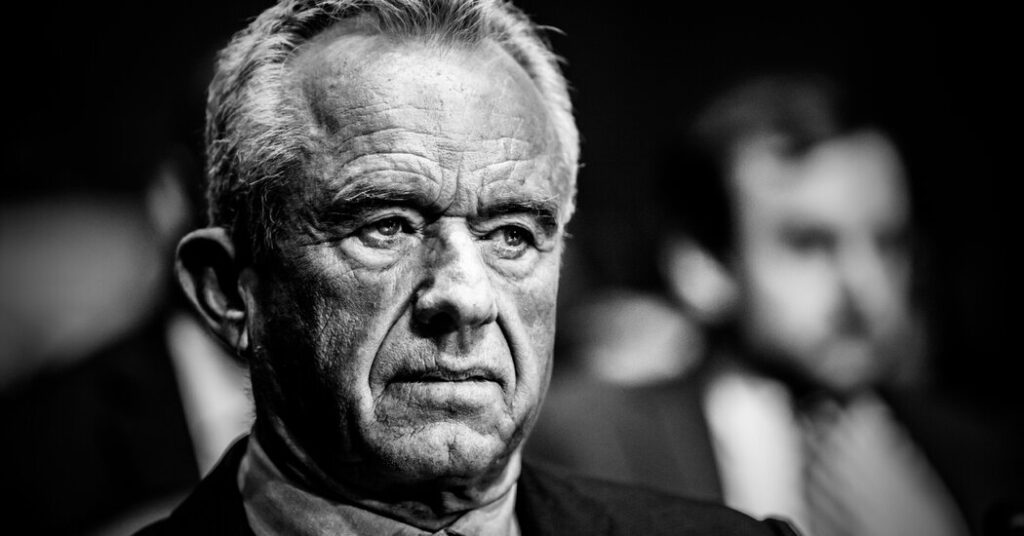
So much has changed in American public health under the leadership of Robert F. Kennedy Jr., the secretary of health and human services. Alexandra Sifferlin and Alex Ellerbeck, two editors in Opinion, convened a discussion with the public health practitioners Dr. Rachael Bedard, Dr. Michael Mina and Dr. Caitlin Rivers to take stock of a tumultuous year, including vaccine recommendation changes, measles outbreaks and the future of public health in America.
The conversation has been edited for clarity.
Alexandra Sifferlin: Reporting suggests that the Department of Health and Human Services is planning to overhaul the childhood vaccine schedule to recommend fewer vaccines for children and make the schedule recommendations closer to Denmark’s, which doesn’t currently recommend immunization against respiratory syncytial virus, or R.S.V., as well as other diseases like rotavirus, hepatitis A, flu, meningitis and chickenpox. Is this dangerous?
Rachael Bedard: I think it would be a huge mistake to do this. It makes no sense. The rationale is a vague idea about fewer vaccines and less cumulative exposure to vaccine adjuvants, like aluminum, that have been proved safe time and again. R.S.V. and meningitis kill children. Chickenpox infection can be terrible and, maybe more important, sets people up to get shingles later in life, which we now know potentially accelerates cognitive decline.
It would be a major advance for the anti-vax movement and a major step backward for the health of American children, if implemented. Or, more likely perhaps, such a change will only serve to further harm the credibility of the health agencies and create a situation where states look to other authorities for guidance.
Caitlin Rivers: These vaccines protect kids and communities. We have some of the world’s best public health and vaccine scientists. There’s no reason to make any policy decisions without our own careful, transparent review, as has been the standard for decades.
Michael Mina: These pathogens are not benign, and we vaccinate against them for key reasons. With the exception of the flu vaccine, the childhood vaccines that are potentially on the chopping block, if we go the way of Denmark, as reporting is suggesting, are all vaccines that we provide to our children to confer protection through most of their lives.
These vaccines are not unnecessary interventions but crucial educations to the immune system that support our children as they develop into adults and even older age. A move to reduce their uptake or reduce access would drive unnecessary disease for people we love and aim to care for the most.
It’s one thing to question timing of the vaccines, but to potentially remove the vaccines from a recommendation altogether is not encouraging a more healthy public but inviting disease — disease that we are so lucky to now have generations of people who have never had to think about, specifically because of the vaccine successes.
Sifferlin: The Centers for Disease Control and Prevention also recently changed its guidance on the hepatitis B vaccine, following advice from its Advisory Committee on Immunization Practices. All of the committee’s members were appointed by Kennedy. The agency has stopped its practice of recommending the shot for all newborns within 24 hours of birth, although parents can still opt to get it after consulting with their doctors. (The shot is still recommended at birth for the babies of women who do not screen negative for hepatitis B in pregnancy.) What did you make of that change?
Mina: I went into the meeting open to the idea that we could be more flexible about the birth dose. Right now we tell all parents that they need to vaccinate their kids within 24 hours of birth, but I think there’s room for some flexibility on timing if a woman tests negative for hepatitis B and is also very low risk, as long as the baby gets the vaccine by about 2 months. That type of flexibility is actually something we had in 1991 guidance.
Instead, the advisory committee took the extraordinary step of saying people should not get the vaccine before 2 months of age and left it unclear when, if ever, they should get the vaccine. I thought that demonstrated something very scary about the group, which is that it made a decision that went against the safety and effectiveness data.
Rivers: What stood out to me was the departure from the usual process. Historically there would be working groups formed that could spend months or even years going through the scientific evidence and documenting everything they’re finding, and then that process would culminate in a committee vote. That’s not what happened.
Bedard: I was also pretty appalled. To Mike’s first point: There’s a conversation to be had about whether it might be reasonable to potentially allow a more flexible recommendation for parents who are hesitant to give their child a hepatitis B vaccine dose on Day 1 of life if they are negative for the virus. But that wasn’t the conversation. There was lots of insinuating about safety concerns, when that’s not something we have data to support.
Sifferlin: How concerned should Americans be about this change?
Mina: I don’t think the average person needs to be concerned today about the hepatitis B decision specifically. The vaccine wasn’t removed from the market, so any people who don’t want their baby to get hepatitis B still have a very good tool for it. I don’t think we’re going to see rampant hepatitis B because of this.
What I am very concerned about is what it reflects about the future. This is still Year 1 of this administration. Now that it has the rails greased, I think we should be very concerned about what it means long term for recommendations for the rest of the children’s vaccine schedule and health care more generally. Especially since reporting suggests the administration wants to change the schedule.
Rivers: I agree with Michael’s comments. To push back on some assumptions: The hepatitis B vaccine is very popular, and indeed, most childhood vaccines are very popular. Around nine in 10 parents did not delay or skip the hepatitis B dose. Does skepticism from one in 10 parents merit a revision of the recommendation? I don’t see why it would. There are other vaccines that are a lot less popular that we still universally recommend because it’s the right thing to do, in terms of population health. I don’t think it’s the case that there was some great demand for this recommendation to be softened, because it’s quite popular.
Bedard: There was demand from a special interest group, the anti-vaccine movement. And in that way, I see all this as very similar to the pro-life movement, where a small segment of the population that has extreme feelings around an issue and that’s very organized pushes through its agenda.
Alex Ellerbeck: Dr. Bedard, you said there might be room to debate some limited flexibility in vaccine recommendations, but that wasn’t what the committee debated. Is that a discussion still worth having? Or, to Dr. Rivers’s point, does it just amplify the desires of a very small minority and cause more harm than benefit?
Bedard: In my ideal world, it’s not that we would make changes to vaccine recommendations; it’s that we would think really critically about a research agenda that helps us understand the sociological phenomenon of rising vaccine hesitancy that we see unfolding right now. How can policy best fit the reality of where the American people are and how they’re behaving in this moment? Such a research agenda is very far afield from anything we’ve seen from this administration, even though they often cite diminishing trust as a rationale for what they do.
Sifferlin: As Dr. Rivers said, most people in America vaccinate their children. But vaccine hesitancy is growing. According to a KFF/Washington Post poll, about one in six Americans delayed or skipped a vaccine dose. Now we are seeing measles outbreaks pop up around the country. How is this best addressed?
Rivers: I don’t dispute that vaccine hesitancy is increasing. I think we see that very clearly in the data. But it nonetheless remains true that coverage is very high. And if you look at the hepatitis B vaccine, for example, the lowest-covered group is among people who are uninsured. So as we head into 2026, we need to see issues around access and affordability as important contributors to reduced vaccine coverage. I don’t want us to be distracted, I guess, by a single aspect like hesitancy, when there is still a whole host of issues that keep us from creating the conditions for good health for as many people as possible.
Bedard: There’s not measles everywhere. There’s measles in communities well below the vaccine threshold for herd immunity. For example, outbreaks have occurred in Mennonite communities in West Texas, where two children recently died of measles — the first such deaths in the United States in years. To Caitlin’s point, there’s a context that goes beyond vaccine hesitancy as a strongly held attitude in that community. The Mennonite community in West Texas is not anti-vaccine because of Robert F. Kennedy Jr. That community has strong beliefs about the body, religion, technology and how they interact with secular society generally.
There’s also a high proportion of unvaccinated folks who are undocumented and who are going into the shadows right now because they don’t feel safe seeking health care. That’s going to affect vaccine rates. Medicaid cuts and rising health care premiums will as well. That’s not a vaccine hesitancy issue, necessarily.
Sifferlin: Is there a risk of a huge measles outbreak in the United States?
Rivers: The measles, mumps and rubella vaccine, or M.M.R. vaccine, is very effective and for most people confers lifelong protection. A vast majority of people, something like 90 percent of Americans, have received the M.M.R. vaccine and are protected from infection. That being said, we will continue to see these percolating outbreaks that take a long time to get under control and are dangerous to the affected communities. In South Carolina, for example, we’re seeing hundreds of children out of school because they have been exposed and are not vaccinated. For most people, I don’t think it’s an imminent threat, but it is absolutely disruptive.
Mina: It depends what you mean by “huge.” Is it a huge outbreak relative to elimination? Yes. But is it going to affect everyone? No. Like Caitlin said, most people are vaccinated. I think we can expect to see thousands of cases over this year and next year. Many more cases will go unidentified or unrecorded. A silver lining is that we are being reminded of just how protective and long lasting the M.M.R. vaccine is, because tens of thousands of vaccinated people have likely been exposed and there’s been few infections among the vaccinated.
People ask if they need to get revaccinated, and the short answer is that, with the exception of the immune compromised, you’re going to be quite safe if you got the vaccine years ago.
Bedard: Can I ask the epidemiologists a question that I get a lot? What about infants under a year old and parents who are worrying about potential exposure or whether they should vaccinate early? (The first dose of the M.M.R. vaccine is typically recommended at age 12 through 15 months.)
Mina: It’s safe to give an M.M.R. vaccine down to 6 months. A child with measles could walk through the grocery store, and if you come through two hours later with your unvaccinated infant, your child could get measles. It’s that contagious. So it’s worth thinking about getting an early vaccination if you are in a community with ongoing spread. But for a majority of people, I don’t think it’s that important at the moment.
Sifferlin: How to you think about Kennedy’s influence long term? Will public health forever be shaped by MAHA, or will we look back at the Kennedy era as a blip?
Bedard: There’s been significant institutional destruction at Health and Human Services and more broadly to the country’s global health programs that are not a blip and will be very hard to rebuild. Like the dismantling of the United States Agency for International Development.
As for Kennedy, I do think that public health is going to be dealing with the ramifications of him and this period for a very long time. We need to think really hard about how to meet the public where it is, even if Kennedy’s leadership at H.H.S. turns out to be short-lived.
Mina: If you asked public health people if they were super-happy with how the C.D.C. was run before the pandemic or how the National Institutes of Health funded research, I think many would’ve said no. But there wasn’t a lot of political will to significantly update things. We can’t undo what’s been done, and there’s no point in arguing that we should just go back. So let’s start planning for what’s next. How can we make the most out of this? The optimist in me would like to think we can come out of this with a better system.
Sifferlin: Postpandemic, it seems personal freedom has become an even greater value in people’s health decision making. How can the public be persuaded now to embrace the kind of collective action that public health requires?
Bedard: There are lots of areas in which public health works really hard to create policy and recommendations with a deep respect for people’s autonomy. Harm reduction is about acknowledging that people are going to behave or make choices that potentially put themselves at risk and then creating policy that decreases the risk of those behaviors. That’s a public health innovation.
Because Kennedy has made vaccines so front and center this year, we’ve talked a lot about vaccine policy. Which is complicated because of the need to achieve herd immunity for certain potentially deadly infections in order to keep everybody safe. There may be ways to think about doing harm reduction around vaccine policy. I don’t know that that’s necessary, but I’m a big believer in harm reduction principles and bringing them into all areas of our work.
Rivers: For infectious diseases, the choices that you make for yourself and your family also affect other people. If you are infected, you become infectious. So it is not just a choice for you. It’s a choice that affects the entire community. If we do need to make some changes around vaccine policy, for example, then we really need to be thinking about what corresponding changes we need to make that successful.
Flexibility around the hepatitis B dose already exists, for example. These are recommendations that families can choose to accept, decline or delay. But if that’s going to become more common, then we need to be thinking about how to make better vaccine registries, which is done at the state level, and the quality is very varied. How do you know if a baby has received the hepatitis B vaccine? In some health systems, this is easy. It’s electronic. In other health systems, you may never know. When was the last time you as an adult got your tetanus booster? You often have to keep track of that information yourself.
What I’m gesturing at here is not so much the specifics of hepatitis B but all the other accompanying conversations that need to happen when you make such changes.
Ellerbeck: We’ve talked about the future, but I’d also like to ask about how we got to a place where a vaccine critic is leading H.H.S. Do you view this moment as a result of backlash to public health that requires deep soul searching, or is there a risk of overinterpreting that, and this is an overcorrection?
Rivers: I’m always wary about doing something in order to affect a third latent variable. What I mean by that is it really bothers me when I hear my infectious-disease colleagues say something like “The risk to the American public is low,” and what they mean by that is, “I don’t want you to worry.” But does that actually correspond to the true risk? Not always.
Take the hepatitis B birth dose, for example. I think we should make the best recommendation based on the evidence and what we know about the risks, the benefits, values and priorities, which is the framework the Advisory Committee on Immunization Practices used to use. That should be the recommendation. I’m not really in favor of pulling back out of a sense that some people don’t accept it. We need to begin with recommendations that best protect communities and their health and from there figure out how to meet them where they are, whether through improving access and affordability or addressing their concerns.
Bedard: I think it’s important for everyone, including people in the public health establishment, to think critically about what variable we’re optimizing for. I worry we are currently optimizing for protecting the sanctity of current vaccine policy rather than the variable we should care about most: minimizing the harms of infection.
If we make preventing and minimizing harms of infections our primary goal, I’d push back slightly to say that while getting vaccine rates to where they need to be is obviously a huge priority, there are also other things we can and should do. There have been anti-vaxxers in this country since its earliest days. There are likely to be vaccine-hesitant communities forever. Vaccines cannot be the only thing we offer anti-vax communities. We need to think about building trust with them so that they are willing to engage on other strategies — testing, surveillance, quarantine, treatment — even when they won’t accept vaccines.
Mina: I think the original question was: Is Kennedy as health secretary a backlash against public health? I don’t think so. Over the last 20 years I’ve been getting to know people who are vaccine hesitant, and I would say that a vast majority of people who are vaccine hesitant or who might be labeled anti-public health are actually very pro-health. They just rely on different information.
When people don’t vaccinate their kids, it’s not because they don’t care about their kids or because they want their kids to get sick. It’s because they love their kids so much and they’re genuinely confused. If you’re genuinely confused, the most appealing approach is the one that doesn’t stick a needle into your kid’s arm.
We should try to understand why one of the most prominent anti-vaccine misinformation gurus is now leading health in America. We could look back with a jaded lens, or we can try to understand why people are making the choices they’re making. It’s a hard nut to crack but deserves rigorous discussion and a little less dismissal.
Dr. Rachael Bedard is a geriatrician, a palliative care doctor and a writer. Dr. Michael Mina is an epidemiologist and immunologist who has studied vaccine-preventable diseases. Dr. Caitlin Rivers is an epidemiologist and the author of “Crisis Averted: The Hidden Science of Fighting Outbreaks.”
The Times is committed to publishing a diversity of letters to the editor. We’d like to hear what you think about this or any of our articles. Here are some tips. And here’s our email: [email protected].
Follow the New York Times Opinion section on Facebook, Instagram, TikTok, Bluesky, WhatsApp and Threads.
The post Vaccines, Measles and Kennedy: Three Experts on the Future of Public Health appeared first on New York Times.