HOW TO COOK A COYOTE: The Joy of Old Age, by Betty Fussell
A few years ago, the food writer Betty Fussell got a call from The New York Times obituaries department. The good news, she writes in “How to Cook a Coyote,” her fond and bite-size new memoir, was that she was being interviewed for an advance obituary. She shrieked with happiness, scaring the birds outside her window.
The bad news, she writes, was the paranoia. The obit questions got personal. Was this some new kind of Nigerian phone scam, aimed at elderly high achievers? She worried, too, that the reporter knew something about her health that she did not. Fussell got through the interview, and began adding two sentences to her morning prayers:
Dear God, please do not let the Pope or King Charles or any major movie star or musician die at the same time as me. Just give me two inches, Lord, and no misspellings.
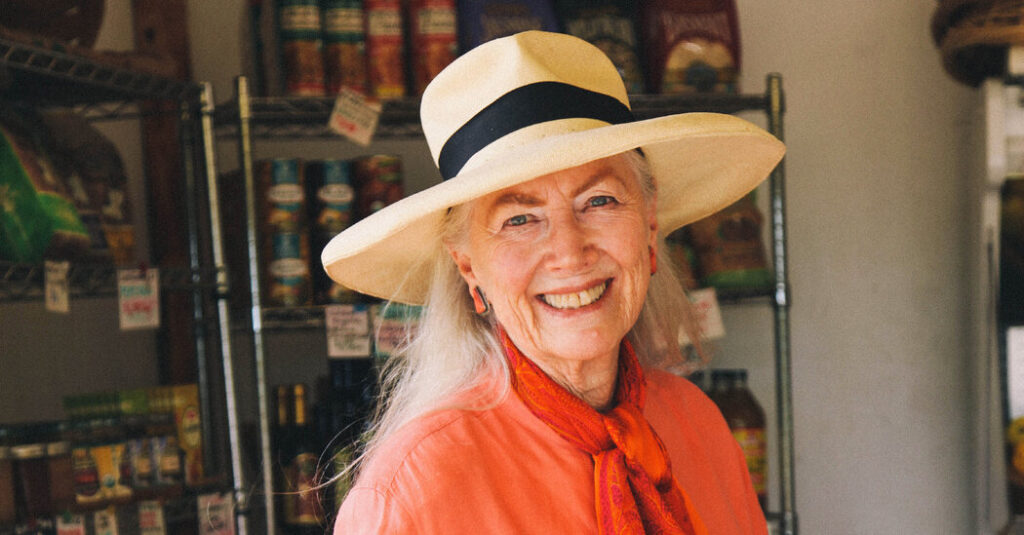
Fussell, who turned 98 this year, deserves more than two inches of type. She has long been among America’s earthiest and most cerebral cookery writers. Much of her best material was collected a few years ago in a book (poorly and derivatively) titled “Eat, Live, Love, Die.” It contains a grinning, blood-flecked essay, “On Murdering Eels and Laundering Swine,” that should be printed and tucked into the apron of every incoming culinary student in the country.
Fussell’s chef d’oeuvre is her memoir “My Kitchen Wars” (1999), a prickly pear of a book that recounts her marriage to the historian and critic Paul Fussell. “My Kitchen Wars” contains some of the best writing about competitive midcentury American dinner parties I’ve ever come across. Hers was a generation that came of age under the sign of Julia Child and labored mightily and sometimes painfully underneath it.
The subtitle of Fussell’s new book is, against the wisdom of the ages, “The Joy of Old Age.” If reading obituaries makes us glad we’re still here on the green side of things, good memoirs of advanced age — I’m thinking especially, in recent times, of Roger Angell’s, Diana Athill’s and Donald Hall’s — make one grateful, especially in this twilight time of year, for the parts of oneself that still work as they should.
Fussell is almost totally blind these days. It’s not true, she says, that your other senses sharpen in compensation. Blindness sharpens only your fear. She is unhappy to be moving to a smaller space in her assisted-living facility in Santa Barbara, Calif. Where she once wielded the elaborate batterie de cuisine of a good French kitchen, she is now limited to a microwave oven.
The conceit of her book is that she’s cooking one last ambitious meal, a coyote pie, and we are present at her table. She sources her coyote from the Hudson Valley in New York; it tastes like venison, she writes, because it fed largely on deer. She’s fond of coyotes because they’re tricksters and shape shifters. In her apartment a head-to-tail coyote skin covers one of the chairs. On the terrace, her pot plant is thriving.
Fussell’s title is a nod to M.F.K. Fisher’s “How to Cook a Wolf” (1942), that classic of scarcity, a book about food and cooking during wartime rationing. Fussell’s memoir offers scarcities of a different sort.
Her appetites remain sharp. Each Saturday morning, she climbs into her retirement home’s van to visit her local farmer’s market. Stay out of this woman’s way: “I use my walker as both grocery cart and aggressive tank to weave at full speed,” she writes. “I play the old-lady card and shout ‘Beep beep!’”
The outing exhausts her. Soon she is home to Pavarotti and Sutherland on the sound system and moules marinières, a baguette and “a cold glass of Zaca Mesa Viognier.” Fussell dislikes eating alone, and she writes vividly about how awful the isolation of Covid was for the elderly.
Not long before he died at 77, the poet John Betjeman was asked if he had any regrets. He replied that he wished he’d had more sex. Fussell’s book is about sex to the extent that she lovingly catalogs the handful of lovers she took in the decades after her divorce from Paul, when she was 55.
One younger Turkish man had a “lion’s hump, big belly and furry back,” as opposed to her “deltas of sags and wrinkles, acres of moles.” She continues, she writes, to masturbate.
This book is about family. She recounts visits with her children, Sam and Tucky. She appears to somewhat regret the flaying she gave Paul Fussell in “My Kitchen Wars” over his peacock’s ego and his double life. She wrote the book in a white heat, she writes, as “a comic farce.” Paul never forgave her for airing their problems.
He remarried quickly after their divorce. His death in 2012 scotched her “movie fantasy of a deathbed reconciliation.” Paul’s new wife deplored Betty. She “estranged Paul from his own children and disinherited them by shifting their promised inheritances to her own children.”
Eventually her children were mailed “a small box of ashes along with some personal effects: a Purple Heart, 12 photos of Paul’s parents, a college graduation robe, and two moth-eaten jackets.” But Fussell kept a candle lit for Paul for the rest of his life. In the end, it seems, whatever algorithm initially paired this couple had gotten it right.
In “How to Cook a Wolf,” written when she was in her early 30s, Fisher wrote: “It is good, now when war and its trillion grim surprises haunt all our minds, to talk with other older humans about what they have done in their days to fool the wolf.” Fussell’s book is one of these vital conversations.
“Nothing of any importance comes with a manual,” Percival Everett wrote in his novel “I Am Not Sidney Poitier.” This includes old age — our stiffening bodies and hardening brains. One of the lessons of Fussell’s book is to stir what’s left of your wits and to, at all costs, keep your sense of humor intact. It functions like the little mesh on the halved lemon that keeps the pips from falling into your oysters.
Fussell provides the recipe for her coyote pie. Use the best cornmeal for your crust, she writes, even if you must have it sent via mail order. If you fail to use the good stuff, “do not seek forgiveness from the corn goddess” for the mess that might result.
HOW TO COOK A COYOTE: The Joy of Old Age | By Betty Fussell | Counterpoint | 164 pp. | $27
Dwight Garner has been a book critic for The Times since 2008, and before that was an editor at the Book Review for a decade.
The post A Last Meal With One of the Finest Food Writers in America appeared first on New York Times.