Perhaps you’ve noticed: The seasons don’t behave like they used to. The weather is hotter and colder and increasingly out of order. The familiar has become distressingly unfamiliar.
What better way to convey this operatically than through the ultrafamiliar seasonal music of Vivaldi? This is the clever idea of the playwright Sarah Ruhl and the countertenor Anthony Roth Costanzo. Their show “The Seasons” scrambles Vivaldi’s “The Four Seasons,” combined with some of this Baroque composer’s weather-related arias and choral works, then supplies new words by Ruhl to tell a story about climate crisis today.
After its premiere at Boston Lyric Opera in March, “The Seasons” had a debut on Friday at Opera Philadelphia, where Costanzo is the general director. To help evoke weather, he and Ruhl gathered a strong cast of singers and starry collaborators, including the set designer Mimi Lien, the choreographer Pam Tanowitz and the director Zack Winokur. The result, though, is too much like what it seeks to represent: intermittently thrilling but ultimately a jumble.
Ruhl’s story follows five artists who gather at a country retreat to learn from nature. As can happen at artist colonies, they pair off quickly. The Poet (Costanzo) falls in love with the Painter (Kangmin Justin Kim), while the Choreographer (Megan Moore) hits it off with their host, an actress turned farmer (Abigail Raiford). Also present are the Performance Artist (Whitney Morrison) and the more allegorical figure of the Cosmic Weatherman (John Mburu). The weather tosses their stories around, especially after all hell breaks loose in the second act.
We meet the Weatherman first. In his stentorian bass, Mburu addresses the audience directly, reminding everyone of their duty to the world and exhorting them to wake up and fight. How little we listen to such messages seems to be the main point of the largely satirical first act. The Farmer amusingly prattles about nature while preparing a salad on social media. The Poet, complaining in song about a breakup, mopes until he forces himself on the Painter; their romance and lovers’ spats come off as juvenile.
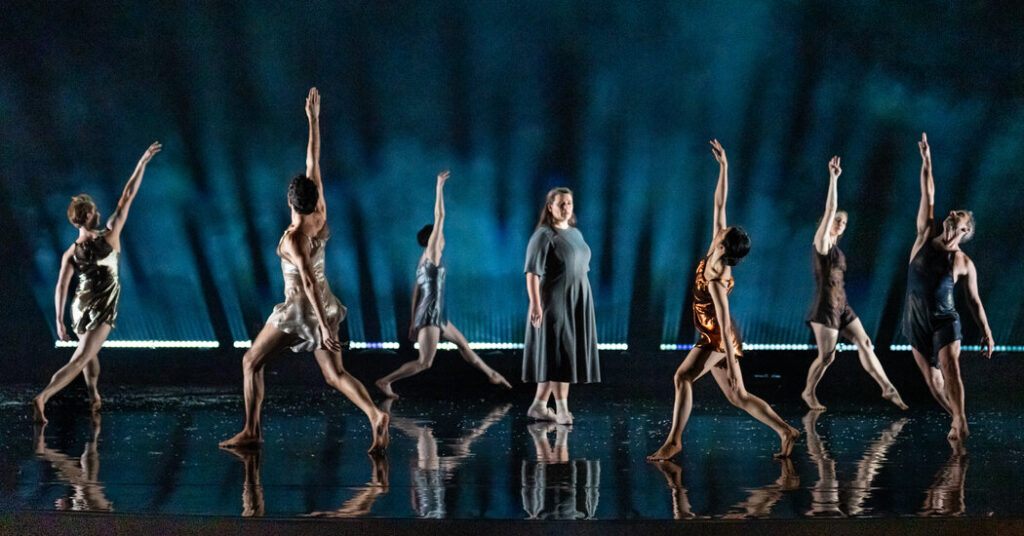
To express their emotional weather, they have arias (sung in Ruhl’s English and Italian or Latin). To express external weather, the production uses dancers and soap suds. Lien, working with the bubble design technologist Jack Forman, magically conjures snow, rain, smoke and ice. Fire, less vividly, is largely the province of John Torres’ lighting.
This aspect of the production works best at the end of Act I, when the Poet is caught in a blizzard and nearly freezes to death. Bubble machines fill the air with snow, cold light sweeps through, and as Costanzo sings the “Farnace” aria “Gelido in ogni vena” in his smallest voice, you can’t help but feel the chill.
There are no dancers in that scene. They are excellent, but the production struggles to integrate them effectively. The choreography evokes spring in the manner of Mark Morris doing Isadora Duncan, with flowy, Botticellian figures. Tanowitz slips in some signature quirks like twitchy feet, and she complements the music, as when the Choreographer’s mournful “Vedrò con mio diletto” is accompanied by the dancing of Maggie Cloud, whose twisting balances express an idea from one the Poet’s projected haiku: that even the trees bend with yearning. Cloud, personifying nature, shrugs.
But Tanowitz, master of beauty and wit, doesn’t really do elemental, and even with the presto drive of Vivaldi’s “Summer,” the choreography fails to convey the extreme weather of Act II. It doesn’t help that Corrado Rovaris’s conducting is on the tame side, and that the voices (all countertenors and sopranos, apart from Mburu) cluster in the thinner air of upper registers. “The Seasons” wants for weight.
Lacking a conventional set, the production is packed with wonderful set pieces: the vocal acrobatics of the Performance Artist’s “In furore iustissimae irae,” the forceful cri de coeur of the Weatherman’s “Or più tremar non voglio.” The flute soloist Emi Ferguson is most remarkable of all. Carried around by the dancers as she plays magnificently, she looks calm and graceful enough to be a dancer pretending to play the flute. Yet the pieces don’t quite add up.
Ruhl has much to say about the difficulty of making people pay attention to the climate crisis and the equivocal role of artists. The Poet laments the practical powerless of poetry, and the unheeded Weatherman complains about how music soothes us and makes us forget. “The Seasons” is better at soothing us than waking us up, but it does try to warn us.
During a final section that you need to read the synopsis to understand, the Commonwealth Youth Choir arrives. Picking up the castoff garments of the adults, they walk forward singing about peace on Earth. They do not look ready to inherit it.
The Seasons
Performed at the Perelman Theater in Philadelphia.
The post Review: ‘The Seasons’ Jumbles Warnings About Climate Crisis appeared first on New York Times.