Feargus Urquhart, chief executive of Obsidian Entertainment, began a recent day in the weeds of fantasy fiction, nerding out about a helmet with an art director at the video game studio for 25 minutes. Not long after, his mind was catapulted back to the real world, as he clicked through Excel spreadsheets outlining its plans for 2030 and beyond.
The work never stops at Obsidian, which puts out games at an impressively swift clip.
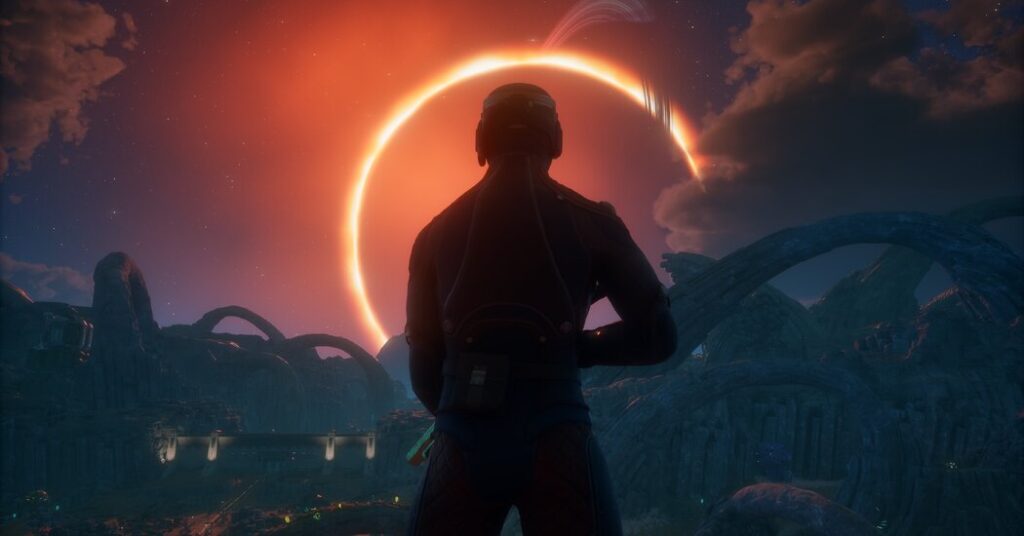
Many studios known for role-playing games release a new title every five to 10 years, speculating on the success of blockbusters. Yet Obsidian released three well-received titles this year alone: Grounded 2, an open-world survival game, impressed early-access players, and the boldly psychedelic Avowed and the satirical space adventure The Outer Worlds 2 were both nominated for best role-playing game at this month’s Game Awards.
It helps that Obsidian’s games, though lavish and artfully constructed, are neither the most beautiful nor the most interactive that the medium offers. That lets the studio, which makes appealingly reactive narratives through the careful interplay of characters, plot and factions of various political persuasions, develop projects more quickly.
Obsidian, which was founded in 2003 and acquired by Microsoft in 2018, is a smaller studio than many of its counterparts. CD Projekt Red, which made the Witcher 3 and Cyberpunk 2077, has more than 1,100 staff members; Larian, the studio behind Baldur’s Gate 3, numbers over 500. Obsidian employs just 285.
“They’re punching above their weight for their size,” said Jose P. Zagal, a professor who teaches game design at the University of Utah. “More generally, they’re willing to take chances on new universes, and they often have bigger ideas and themes at play.”
In Avowed, which has an effervescent, ecological setting, you are the envoy for a distant emperor with the job of rooting out a plague while softening the ground for colonial expansion. You can embrace your role as a violent hand of a conquering force, strike a middle ground with the land’s occupants or cast aside the occupying mission altogether.
Obsidian, which got its start developing brand-name sequels like Star Wars: Knights of the Old Republic II, Neverwinter Nights 2 and Fallout: New Vegas, has built in-house software to facilitate its valorous fantasies at scale and speed.
Brandon Adler, the game director of the Outer Worlds 2, said those tools had enabled designers to track the tens of thousands of forks in the road generated by a player’s own impish decisions, all of which are reflected in the game’s dynamic conversations. This kind of storytelling elasticity is not easy to pull off, but it is vital for selling the illusion of a world that shifts in surprising ways.
Urquhart and many of his colleagues played tabletop games in their youth, and the central appeal of those pen-and-paper sessions — fun and empowerment — has morphed into the studio’s mission for its virtual epics.
“A lot of us get through a day,” Urquhart said, “and we’re like, ‘Did I get anything done? Did I make any decisions that mattered?’
“An R.P.G. is about: I get to go into this world. I get to make decisions. I get to grow. I get to be a hero.”
When sitting down to make a new game, or deciding to radically shift the direction of one already in production, Obsidian typically starts with world building, said Carrie Patel, who was the director of Avowed and has since left the studio. Think geography, cities, politics, ethics and ecologies — the elements that make a place come alive — rather than specific plot beats.
“We want the player to feel they are in this big, cohesive space,” she said, “rather than walking through a video game Potemkin village.”
In Avowed, a disease known as dreamscourge infects people, animals and even the land itself. The game draws on works of “new weird” fiction like Jeff VanderMeer’s “Annihilation” and China Miéville’s “Embassytown.” The ostensible sentience of the game’s setting contains shades of Andrei Tarkovsky’s surreal sci-fi movie “Solaris.”
The game is a daring R.P.G. vision, and a far cry from the creators’ original conceit of a darker, more traditional swords-and-sorcery experience with multiplayer: “Skyrim with friends,” explained Urquhart, Avowed’s executive producer. Obsidian has shown it is not afraid to experiment with forms beyond its R.P.G. heritage; its previous game before this year’s releases was Pentiment, a gorgeous murder mystery set in 16th-century Bavaria.
An Obsidian game should feel almost like improv, said Patel, who is also the author of a political fantasy series. While great novels “offer a window into people’s minds, the things they love and fear,” she added, video games must leave space for decision-making.
“One thing we would have to pull back on, especially with newer team members, is the authorial hand telling the player what the ‘right’ option is,” she said.
One early quest in The Outer Worlds 2 involves infiltrating a heavily guarded radio transmitter, though precisely how to do it is up to the player. Both the game world and plot splinter in different directions, all while optional side quests appear organically.
It is not just conversations that play like improv in The Outer Worlds 2. Do enough of one particular action, like crouching to avoid detection, and you develop a so-called “flaw,” a permanent negative condition. Crouching eventually gives you bad knees, which causes them to creak loudly and alert nearby guards.
For Adler, this system invokes the freewheeling spontaneity of playing Dungeons & Dragons. “I’ve had a character lose an arm, and I’m like, ‘OK, this sucks,’ but now I have this unique thing about my character,” he said. “I can have a different play style, do something differently. It’s like, now my character actually has character.”
In contrast to the experiences it offers players — emphasizing player agency above all — Obsidian is beholden to Microsoft, which has made large reductions to its staff and abruptly halted the funding of several high-profile video games, including Everwild by the esteemed developer Rare. According to a report in Bloomberg, Microsoft has also imposed a 30 percent profit margin on all of its commercial outputs, video games included.
Urquhart acknowledged having conversations about that figure but said there was “no mallet with the word ‘30 percent’ that I walk in, sit in my chair and somebody beats me with.”
Still, he knows his games need to make money. Which prompts another question: How does Obsidian measure commercial success in an era of the Xbox subscription service Game Pass, which Microsoft has admitted can cannibalize game sales? While avoiding specifics, Urquhart stressed that he was pleased with the number of hours players have logged in The Outer Worlds 2.
Urquhart continues to promote economic prudence at Obsidian which is based in Irvine, Calif. Senior Obsidian leadership has given industry talks about the studio’s plans for the next 100 years, and its employees are proud of the company’s ability to retain talent in an industry with high attrition rates.
In the spirit of role-play, employees get to pick an R.P.G. class when they join Obsidian, getting related gifts upon reaching major tenure milestones. Because Adler picked the wizard class, the company gave him a staff after 10 years. A decade more at Obsidian and he will be bestowed with an ornate wizard headpiece.
Urquhart said Obsidian had major plans, including more entries in the shared universe of Avowed and Pillars of Eternity, and more experimental projects like Pentiment. Marcus Morgan, the studio’s vice president of operations, said he wanted to push even harder into the bleeding-edge reactivity of its cult classic Alpha Protocol, in which you could freely kill off major characters.
Creative ambition and fiscal pragmatism have long created magical results at Obsidian. And Urquhart is not easily swayed by fads or trends.
“It’s like the stock market,” he said of his leadership philosophy. “I can either put $100 into a mutual fund every month, or I can try to play the market exactly right. And I’m a ‘put a hundred dollars in a mutual fund every month’ kind of guy.”
The post Did Obsidian Master the Art of the Efficient Epic? appeared first on New York Times.