It was January 1994 and a local ABC News team was broadcasting live from inside the Whitehall Street subway station in Manhattan with substantial breaking news. The Metropolitan Transportation Authority had not run out of subway tokens, the newscaster assured viewers, but it was replacing them with “something called a MetroCard.”
On Day 1, early reviews were positive.
“It’s a lot lighter than carrying a lot of tokens,” one commuter noted. “I think it’s a great idea.”
“More convenient,” another said. “Less holes in my pocket.”
Still, unlike with tokens or coins, the M.T.A., which oversees the subway and buses, had to patiently teach people how to purchase and use the MetroCard. And riders were slow to adapt. In 1996, two years after its debut, only 8 percent of the transit system’s five million daily riders were using the card.
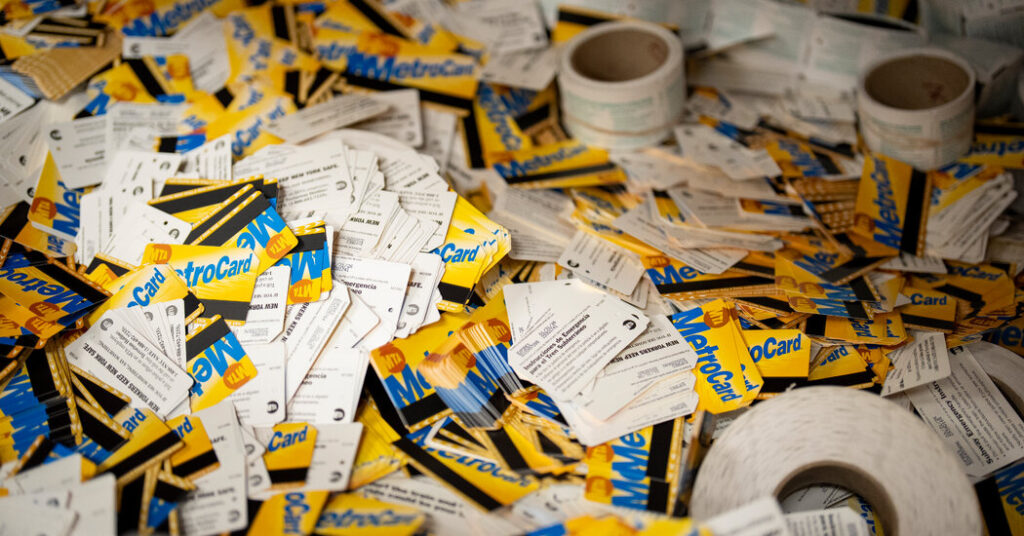
Three decades and 3.2 billion MetroCards after it was first issued, what once felt like cutting-edge technology has become outdated. Dec. 31 is the last day the MetroCard will be sold in New York.
New York City’s transit system is in the final stages of transitioning to OMNY, a tap-and-go payment system. The MetroCard will still function for part of 2026, but its days are numbered.
The truth is, the MetroCard has felt old-fashioned for years, a relic of a predigital era. The first OMNY readers were installed in 2019, and by the end of 2020, the entire city had tap-to-pay readers. Already, 94 percent of subway trips are paid for via OMNY.
As for the other 6 percent — trips paid for via MetroCards — the M.T.A. understands the nostalgia. “I feel the love, and I feel the heartache of the transition,” said Shanifa Rieara, the chief customer officer for the authority. “But it is time.”
In other words, after 30 years, it’s time to say goodbye.
When the flashy new MetroCard arrived in 1994, New Yorkers were asked to abandon the small brass tokens that had provided entry into the subway system for half a century and instead adopt a flimsy piece of plastic the size of a credit card. This is the future, the city said.
The token had heft and weight, and, like an ancient Roman coin, carried with it millennia-old human understanding of what currency means: this for that.
Textured like talismans and easily transferred from person to person, tokens meant rides for you, a friend, or a stranger in need, standing at the turnstile, asking for help.
The MetroCard was slippery, hard to share, full of secrets. Unknowable. Inscrutable. A yellow and blue riddle. Simply gazing upon one revealed nothing. Did it hold one ride, or unlimited rides? Did the magnetic strip even work? Like visiting an oracle, you had to embark on a quest to a train station in order to swipe and learn the truth.
(Even if you wanted to take the bus, you needed check your balance in a subway station so as not to be caught swiping an empty or expired card on the M104.)
The choices at the vending machine were downright existential: Would you prefer to add time? Or add value? In life, everyone wants more time! But who would turn down more value?
Swiping a MetroCard could be a finicky, tricky business. You could be too slow; you could be too fast. And if you accidentally double-swiped, you might as well just turn around and take a cab. (With a pay-per-ride card, you had to wait 18 minutes after swiping before you could use the card again!)
In 2016, it took Hillary Clinton — then a candidate for president and former secretary of state who had earned a bachelor’s degree in political science from Wellesley College and a law degree from Yale — five swipes at a Bronx subway turnstile before she was granted entry to the 4 train platform.
Someone was always trying to game the system. Hustlers sold swipes, and word on the street was, if you creased the magnetic strip, a regular MetroCard could become an unlimited card, offering free rides. (The rumor was true, but you could be charged with a felony.)
As the decades went on and more and more people used MetroCards, train stations soon became littered with old, valueless or expired cards.
Try to throw one away, and it would often zigzag through the air with an unexpected trajectory, like a chaotically deflating balloon. Piles of them accumulated near trash cans.
A gust of dank wind rushing through a subway tunnel would sometimes send several cards fluttering onto the tracks like confetti.
Little metal boxes set out to collect used MetroCards were often vandalized and rendered useless.
But it wasn’t all bad: At the time of its debut, one ride cost $1.25, and the MetroCard was sold in neat and tidy $5 increments.
One free transfer per ride was available on the original MetroCard: You could go from a subway to a bus, from a bus to a bus, or from a bus to a subway. (If you were trying a more complicated bus-subway-bus or bus-bus-subway transfer, you had to pay another fare.)
When MetroCard Gold was introduced in 1997, the cost increased to $1.50, but the number of free transfers increased as well, allowing you to transfer from a bus to a subway to another bus.
Suddenly, a MetroCard could get you from borough to borough across vast swaths of geography, from Pelham Bay to Far Rockaway, for the same price as a bagel with cream cheese. Plus, people discovered you could use a MetroCard to remove acrylic nails.
From the start, the back of the MetroCard was treated as a tiny billboard, with public service announcements and ads for TV shows, museum exhibits, sports teams and new albums from your favorite musicians. From David Bowie to Dolly Parton, “Law & Order” to Wu-Tang Clan, the cards highlighted moments in the zeitgeist.
“The card was made to be collected,” said Jodi Shapiro, who curated the new FAREwell MetroCard exhibit at the New York Transit Museum.
In fact, the authority initially wanted the MetroCard to also be a calling card, to be used at pay phones (remember those?) but ultimately could not come to an agreement with the telephone company.
But the MetroCard successfully cemented itself as a part of New York City history, and as an essential element of daily life. So New Yorkers grew attached.
When Kerri O’Connell, the founder and designer of WorkNY, an accessories brand, saw that the MetroCard’s final days were imminent, she decided to make a commemorative MetroCard belt buckle, fashioned in brass, and post it on her TikTok account. The video now has over 400,000 views, and hundreds of comments expressing sadness and nostalgia. Ms O’Connell has expanded her MetroCard designs to include a pendant on a chain.
A native New Yorker, Ms. O’Connell said she had many fond memories of the MetroCard, and had received her first one in high school.
“That was like a key to the city,” she said. She was 14 years old and needed only two rides per day to get back and forth from her home in Queens to her school in Manhattan, but her student card held three. Suddenly, she could go downtown. She could visit friends in the Bronx. “It just really unlocked the whole city for me,” she said.
Ms. O’Connell, 42, now lives upstate, but friendly ghosts of the MetroCard continue to haunt her.
“I have drawers full of MetroCards that have, like, 10 cents on them,” she laughed. “Every jacket I have has a MetroCard in its pocket.”
The M.T.A. is commemorating the MetroCard’s final days with a host of special happenings: public service announcements from celebrities, including Andy Cohen and the girl group Katseye; chances to get a special blue MetroCard, like the one from the 1990s; and a campaign involving limited-edition food items, like a Cardvaark cake from Carvel and a MetroCard cookie from Zabar’s.
Ms. Rieara of the M.T.A. described the fanfare as an attempt to “retire the MetroCard with dignity.”
Don Mawsey, a licensed New York City tour guide who posts about the city on TikTok, made a video in which he challenged himself to visit all of the participating establishments, scoring a special slice at Stretch Pizza and an M.T.A.-themed bubble tea from Gong Cha.
Mr. Mawsey doesn’t consider himself a transit nerd, but, he said, he has amassed a small stash of MetroCards. When he heard they were being phased out, he said, “I started to save any one I would get.” He has one with the Kennedy Airport AirTrain advertised on the back, which is rare but not technically a limited edition card. Still, he reasoned: “They’re all limited now, right?”
Here’s a look back at some of the highlights of the MetroCard’s brief life:
Timeline photo credits: M.T.A.; Marilynn K. Yee/The New York Times; Vincent Alban/The New York Times
Dodai Stewart is a Times reporter who writes about living in New York City, with a focus on how, and where, we gather.
The post Goodbye (and Good Riddance?) to the MetroCard appeared first on New York Times.