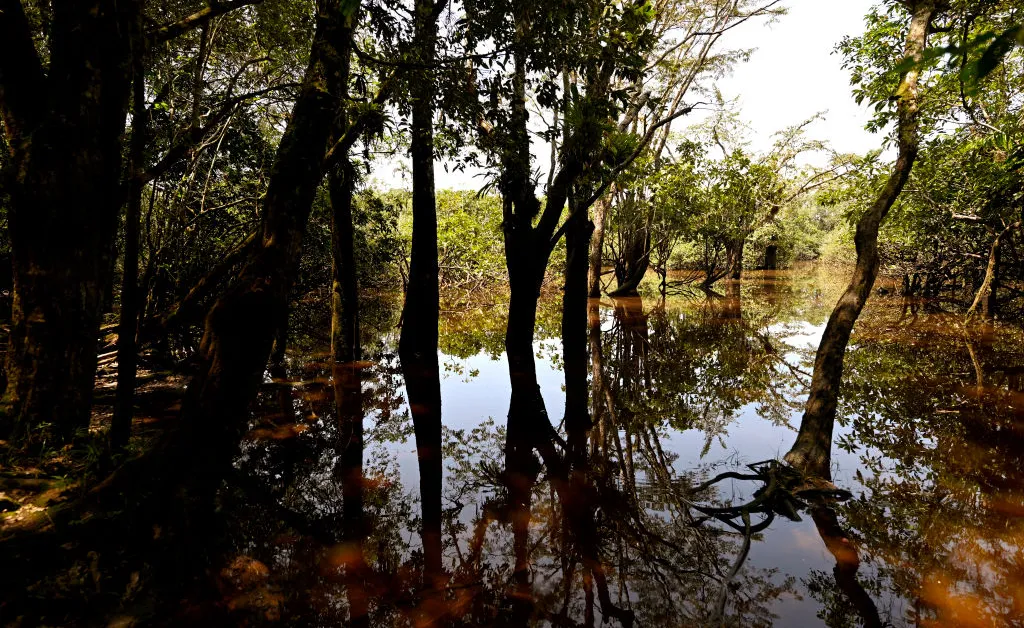
Nearly two decades ago Ecuador became the first country to legally enshrine the rights of nature in its constitution. This landmark move made the country the first in the world to recognize ecosystems as living entities with legal rights. Now, that is all at risk.
On Nov. 16, voters will head to the polls to decide on a constitutional referendum that, if approved, would dissolve the current constitution—paving the way for the potential erosion of the fundamental rights it established for nature and Indigenous communities. If voters approve the referendum, it would open the door for Ecuador’s President Daniel Noboa to rewrite the constitution; it’s unclear what any potential revisions might look like.
[time-brightcove not-tgx=”true”]
“The fact that they want to change a constitution that recognized so many rights, not just rights of nature, but also rights of Indigenous people … it means that they’re walking backwards,” says Gustavo Redín Guerrero, vice president of CEDENMA, a network of environmental organisations that focuses on environmental protection and conservation in Ecuador.
Read more: Nemonte Nenquimo on Respecting the Amazon and What is Owed to the Planet
Ecuador has rewritten its constitution a number of times in the last century, but the 2008 constitutional rewrite, spearheaded by former President Rafael Correa’s left-wing PAIS Alliance, stood out for being a collaborative process that allowed for the involvement of the country’s citizens. The text “is quite exceptional because it was the result of a very participatory process where communities and different sectors of organized civil society were able to bring forward their own ideas of how we should live together, of how we should care for Ecuador,” says Cristina Espinosa, assistant professor of sustainability governance at the University of Freiburg.
Noboa, who came to power after winning a snap election in 2023 with the center-right National Democratic Action party, has said that a new constitution is necessary to combat crime in the country, but has given little details as to what that might look like. According to a Bloomberg report, Noboa wants to limit due process and the rights of prisoners, and impeach Constitutional Court judges he believes are hindering the fight on crime. But environmental activists fear that in doing so, a rewrite could strip away the rights of nature established 17 years ago.
“The political orientation of Noboa is quite different from the political orientation of the government in place in 2008,” says Espinosa, who expects any potential re-write would likely be less participatory, and include reforms to ease extractive agendas. “Noboa belongs to one of the wealthiest families in Ecuador, and I think that he has in mind a very different country than the one that was imagined with the constitution of 2008.”
Noboa has been openly supportive of increasing extractive mining practices in one of the most biodiverse countries in the world. In July, he issued an executive order eliminating the country’s Ministry of the Environment, Water, and Ecological Transition and transferring its functions to the Ministry of Energy and Mines—effectively removing any oversight for oil and mining industries. His government also announced a plan in September to auction the rights for 49 oil and gas projects in the Amazon worth more than $47 billion.
Read more: Jane Fonda Is on a Mission to Save Ecuador’s Rain Forest
Environmental advocates view this upcoming constitutional referendum as another concerning step in this direction. “They are trying to erase every [protection] from the constitution for [mining companies] to have more access to explore more gold, copper, and other resources,” says Indigenous leader Majo Andrade Cerda.
Ecuador’s 2008 constitution inspired a wave of other countries: Bolivia, India, and Mexico have since had court rulings or enacted laws at the national or state level recognizing the rights of nature. And Ecuador’s constitution has also had a national impact over the years. In 2011, for example—the first successful legal case upholding the rights of nature in the country—a provincial court ruled in favor of the Vilcabamba River, after a roadwork project was polluting the river. Not only did the constitution provide a legal basis to protect the river, but the outcome also benefited the Indigenous communities living alongside the river.
“When we are talking about nature’s rights we are talking about Indigenous people’s rights,” says Cerda.
Read more: The Fight to Save Ecuador’s Sacred River
Voters will head to the polls this Sunday to decide if the constitution should be rewritten—reports show that President Noboa’s “yes” side seems to be significantly outspending the “no” campaign on advertising. But the outcome of a yes vote—and the potential impact on the country’s natural resources—will be felt, advocates warn.
“It’s not just going to happen in the Amazon, it’s going to happen in the Andes, in the Galapagos,” says Cerda. “It’s going to affect every Ecuadorian.”
The post Ecuador’s Constitution Was the First to Protect the Rights of Nature. Now That’s at Risk appeared first on TIME.