My mother is buried in an interfaith cemetery. She was born in Beirut, married in Damascus, and forced by war to leave both. Layers of loss marked every aspect of her life — where she lived, the languages she spoke, even her sense of certainty. That she now rests among strangers who are mourned by those with different prayers, different ideas about the afterlife or even its possibility, is fitting, in its own quiet way.
When the burial ends, soil packed, shovel set aside, last visitor gone, the silence that follows is not empty. It is the part of grief that has no script. The funeral itself — my mother’s was in October — is only the opening prayer. The real rite is the long, unscripted afterward, when no one is watching and the living must learn, slowly, how to rejoin the world. The ceremony had its choreography — prayers, eulogies, the measured lowering of the casket. The days that come next have none. Yet they carry the real weight.
Every religion and belief tradition has an answer for those unscripted days, because they know it is the living, not the dead, who need escorting back into daily life. In Judaism it is shiva: seven days of covered mirrors and neighbors arriving with bagels and stories. In Islam, the community feeds the family for three days, then gathers again on the 40th for Quran recitation and dates. Catholics pray a novena; Hindus perform shraddha for 13 days; many Buddhists transfer merit on the seventh day and at three months; the Lakota keep a spirit bundle for a full year, releasing it only after four seasons of mourning feasts. The secular improvise: Spotify playlists, social media threads of old photographs. Same impulse, different grammar. The function is always the same.
In the holiday season, absences that might have gradually taken on a softer edge are suddenly sharpened again. Traditions that mark togetherness illuminate the spaces left behind — an empty seat, a dish no longer made, a name no longer spoken spontaneously. Grief folds itself into the rituals of celebration, quietly, insistently. In recent years, with partisanship intruding on so much of life, it sometimes reaches into mourning too — obituaries might cite the deceased’s interest in climate change or the Second Amendment, and even suggestions of where to make donations in lieu of flowers might be tinged with politics.
We draw ideological lines while we breathe, and assume that those markers will endure. But the cemeteries tell another story. Interfaith and nonsectarian burials — and the green, eco-friendly options they often encompass — have risen significantly in recent years. Consumer preference for natural burials alone has quadrupled since 2020 (from 4 percent to 16 percent, according to the Choice Mutual insurance company), and funeral directors projected cremation rates at 63 percent in 2025, with many people opting to scatter or memorialize ashes in shared, secular spots.
Americans are learning to die together faster than they are learning to live together.
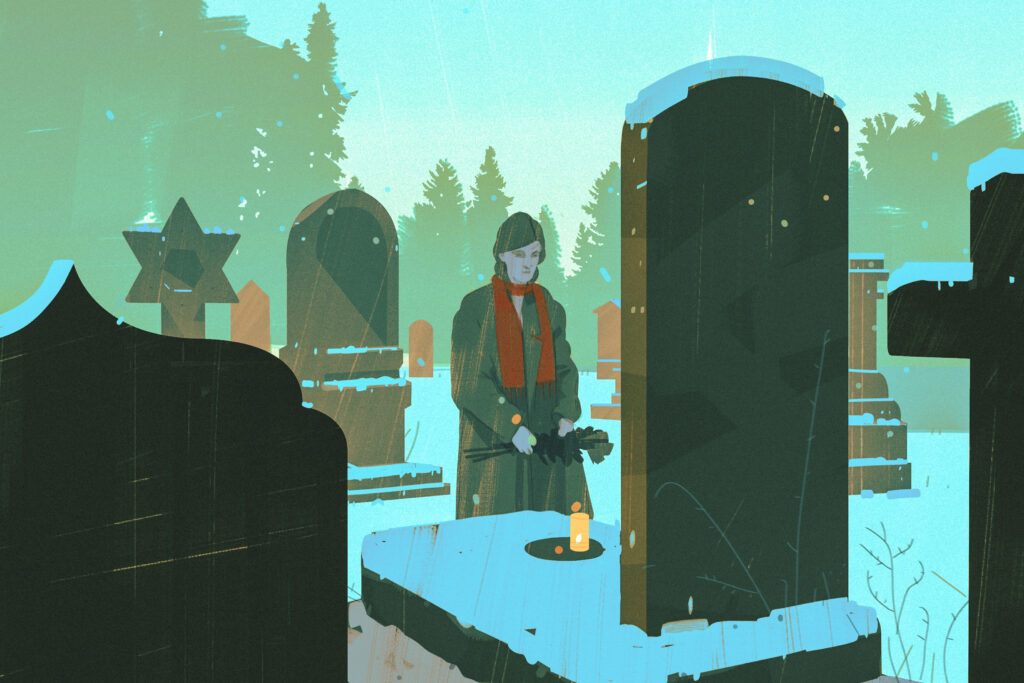
When I return to my mother’s grave, I see the evidence. Jewish pebbles sit beside Muslim headstones aligned to Mecca; Catholic crosses neighbor simple humanist plaques. Different languages. Different symbols. Different hopes for what happens after the last breath. And yet: the same rectangle of earth. The same silence beneath it.
That is the quiet revelation of the interfaith cemetery: At the moment of ultimate convergence, our differences become visible, fragile, almost tender.
We will keep arguing about health care and borders and pronouns. We will keep unfriending each after elections. But eventually, someone we love will stop breathing. And we will stand at the edge of a hole in the ground, holding whatever ritual we inherited or invented, and discover that the earth is patient enough for all of us.
I think about Mom while I’m at work. I keep her number in my phone. Every so often, I still reach for it without thinking, as though there were something urgent she needed to know. Or maybe it is just love that hasn’t figured out where to go. Especially as we start hanging ornaments and lighting candles and everything in the world turns toward togetherness, the grieving think inevitably of those they’ve lost, hoping to meet again. Until then, love keeps traveling the only way it knows: outward, stubborn, patient as soil.
The post My mother’s number is still in my phone appeared first on Washington Post.