A few years ago, I was out jogging on Hampstead Heath near my home in north London when I suddenly had to stop. I didn’t feel tired or breathless in any ordinary way. It was as if my legs had been unplugged. I also had a weird fluttering sensation in my chest, like someone had dropped an Alka-Seltzer into my blood. I walked it off for a minute or two and then ran on without incident. The next day the same thing happened.
My G.P. couldn’t find anything wrong, and eventually I went to a private doctor who suggested a couple of tests, including a CT scan, which would have cost about 3,000 pounds. But we were about to go on a family holiday, a three-week road trip from Austin, Texas, where I grew up, to California. I decided to deal with the medical stuff when we got back to England.
By that point, I had already started a novel about a man who felt like he was being pushed from the center of his own life. His wife had had an affair when the kids were small; he’d recently been suspended at work. I gave him some of my symptoms, as part of his more general decline: Things were happening to him that he couldn’t quite understand. My idea was that after he dropped off his daughter at university, he would keep driving — across America. Our family holiday was also a research trip.
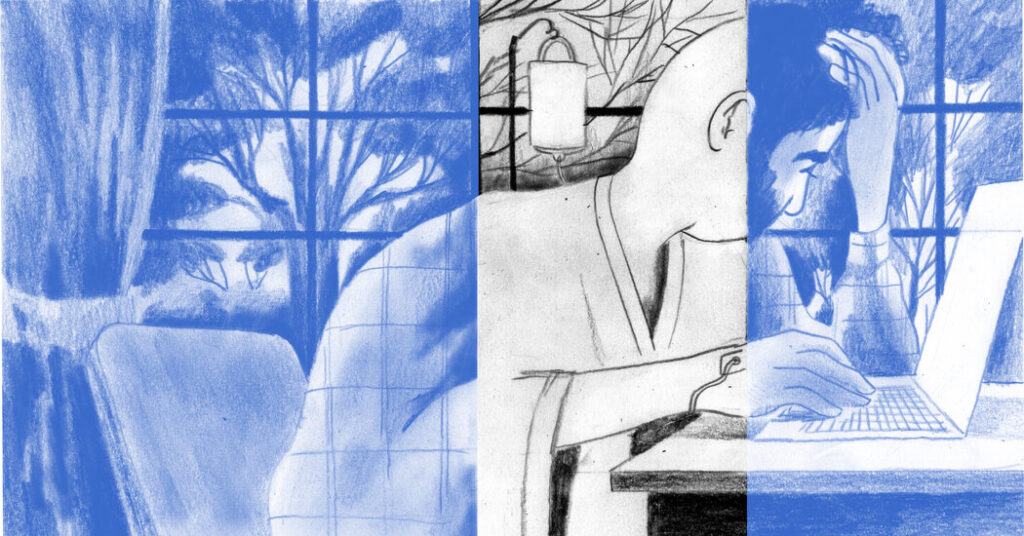
Meanwhile, I got sicker. In Big Bend National Park, the lenses of my eyes started to wrinkle like old skin. Was it just my imagination? After diving into a motel pool in Santa Fe, I came up bright purple in the face, and my wife made me promise not to go swimming anymore. Jogging felt like dragging a car behind me. But it was hot; Santa Fe is at a high altitude — who knows? “Middle-aged man complains of tiredness” is not a medical emergency, even if I woke up each morning with a swollen face. In Las Vegas, getting out of the hotel bed, I blacked out — just for a few seconds. Veins had started sprouting across my chest and stomach.
We still remember this trip as the best family holiday we ever took. The worrying had a kind of Technicolor effect, in a landscape already supersaturated with vividness. Everything seemed very real; everything seemed to matter. It was all good background material for my novel.
By the time I finished the first draft, I was going through chemo.
One of the things I noticed even then was an urge to get this sequence of events straight in my head — the way I just have. You start to feel like the Ancient Mariner, going over and over the same story. In Big Bend … in Santa Fe … in Las Vegas. Partly to figure out what I could have done differently; if I’d had that scan in June, we would never have gone on that trip. But it also felt simpler than that. In “Wonder Boys,” Michael Chabon’s comic novel about the creative writing racket, one of the star students gets drunk and stoned at a festival and can’t stop describing what’s happening to him as various people lead him away. “He’s narrating,” his professor says, the way you might say about an anxious kid. “He’s self-soothing.”
It was October before a doctor worked out what was going on. He called around 9 p.m., the day after another scan. I had a six-inch tumor in my mediastinum, which had squeezed shut the main vein returning blood to my heart. Early the next morning, we got in a cab. I remember making a note on my computer before heading out (it was the thought running through my mind as I woke up): You’re about to become one of the pushed around.
That night, during an X-ray, I passed out. My wife was waiting in the corridor, heard the nurse shout and ran in to find me unconscious, with a pool of urine at my feet. After that, the doctors wouldn’t let me walk anywhere. I was wheelchair-bound and didn’t make it home for several days.
There’s a scene in “When Harry Met Sally” when Harry and Sally are driving together from Chicago to New York. It’s early in the movie; they don’t know each other. “When I buy a new book, I always read the last page first,” Harry brags. “That way, in case I die before I finish, I know how it ends. … I spend hours, I spend days [thinking about death]…. When the shit comes down, I’m gonna be prepared, and you’re not.”
He’s playing it for laughs, but the scene reminds me of this period in my life. There are things you know but can’t really feel most of the time, like the fact that we die, but in those days I could feel it strongly. Is part of the point of books to give us access to those feelings? Do they prepare us for them?
I didn’t know before the treatment started whether I’d still work on the novel. I thought, Give yourself a break. But in some way being a writer was good preparation for what I was about to go through. I tell students that half the skill of writing is being able to get into routines. The doctor in charge read us the riot act at the beginning. “The chemo alone can kill you,” he said. So every day was shaped by simple goals: Try to eat something. Always fresh food, no leftovers, no takeaways. Get some exercise. Like a dog, I needed to be walked, because my wife didn’t trust me on my own. Try to sleep. (I was on steroids, which made this difficult.) Some of these challenges are also what face professional writers: how to give shape to days in which nothing much happens.
So I started working a little, 10 minutes in the morning, or more, if I could stand it. My sickness also changed the book. That sense of middle-age drift I began with had been replaced by something else. Every ordinary thing I did now had a purpose; the stakes were always high. This is what you want from a certain kind of realism. And the sicker I became, the more I felt at the center of something, of attention and love. I wanted to include that feeling in the novel. Also, chemo isn’t a solitary business: You’re in a room full of people going through the same thing. It’s a bit like buying a new car; you suddenly notice it everywhere — in a bandanna, thinning eyebrows or a pale face; in a stranger passing in the street. It starts to feel like a normal part of the human condition.
Another thing you become sensitive to is the way people tell stories, and what effect those stories have on you. The well-meaning friend who says, “Oh, I know a guy who had something similar, and what happened to him was. …” Afterward, you have to deal with whatever small charge this detonates inside you.
My doctors and nurses struck me more and more as people who were expert in the telling of stories. I’ve never forgotten the first conversation I had when we got to the hospital on that now long-ago morning. At this point all we knew was that I had a six-inch tumor in my mediastinum, probably lymphoma, but there are many different kinds of lymphoma. Do you think it’s treatable? I asked the doctor. She thought very carefully about her answer.
Everything is treatable, she said. The treatment just has different goals.
It was a qualified answer, but it also gave me comfort. I knew that she would always be truthful with me, and she would always offer something to hope for. This seems like a good recipe for fiction.
The post When I Got Sick, My Novel Got Better appeared first on New York Times.