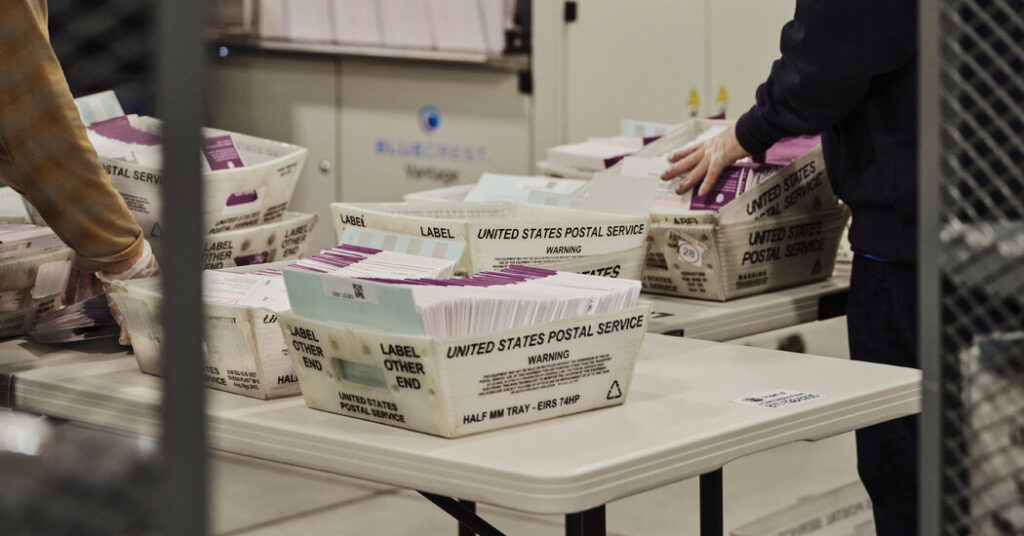
The Supreme Court is set to decide this term whether states can count mail-in ballots received after Election Day. The case centers on a law in Mississippi, but a total of about 18 states and territories accept such late-arriving ballots as long as they are postmarked by Election Day.
Should the court rule that all ballots nationwide must be received by Election Day, it could lead to the rejection of tens, if not hundreds, of thousands of ballots in the future, affecting a swath of American voters in rural and urban areas.
In 2024, at least 725,000 ballots were postmarked by Election Day and arrived within the legally accepted post-election window, according to election officials in 14 of the 22 states and territories where late-arriving ballots were accepted that year. (Four of these states — Kansas, North Dakota, Ohio and Utah — have since changed their policies and will accept only mail ballots that arrive by Election Day.)
Another roughly 104,000 mail ballots were rejected nationwide for arriving after the deadline, according to a federal report on election data.
The roughly 725,000 ballots represent a sliver of the total number of mail ballots cast in the 2024 election across the 14 states and territories — about 24 million, according to federal election data. Nonetheless, 725,000 voters constitute nearly the population of a congressional district, a significant number to be potentially left uncounted.
Of course, a decision by the court eliminating late-arriving ballots would not effectively cause 725,000 votes to be left uncounted. Voter education efforts by election officials, and potential changes in policies and procedures, would most likely help the vast majority of voters avoid having their ballot rejected based on the court’s ruling.
But education and policy changes can go only so far. During the 2020 election, the State Supreme Court in Pennsylvania, a top political battleground, ruled that ballots postmarked by Election Day should be counted if they arrived within three days after the closing of polls. Roughly 10,000 ballots arrived and were counted in those three days, according to the secretary of state at the time.
That onetime allowance wasn’t codified into law, and the current law requires all ballots in Pennsylvania to be received by Election Day. In 2024, 6,816 ballots were rejected by the state for arriving after the date. (Because the total number of mail ballots cast was lower than it was in 2020, the share of voters who sent in late ballots in 2024 was basically unchanged.)
A majority of Pennsylvania’s late ballots came from younger voters, who generally vote less frequently than older ones.
“For people who are voting once every four years, or once every two years, they’re not familiar with all these procedures and changes, and this could have a big impact on them,” said David Becker, the executive director of the Center for Election Innovation and Research, a nonpartisan group that advises election officials. “And by the way, those people broke for Trump in 2024.”
Determining whether Democrats or Republicans would suffer greater harm as a result of an Election Day deadline is a murky task. Democrats still far outpace Republicans in their use of mail voting, a trend intensified by the 2020 election.
So, in most states, the rejected ballots are likely to lean more Democratic than Republican. In Virginia, 73 percent of the ballots that arrived after Election Day and were counted in 2024 were cast for Vice President Kamala Harris, compared with just 23 percent for Donald J. Trump. Mail ballots that arrived before Election Day had almost the same partisan breakdown.
In New Jersey, which does not provide election results in such detail but does include individual-level turnout reports with party registration information, 48 percent of the ballots that arrived after Election Day were sent by registered Democrats, compared with just 18 percent from registered Republicans, and 34 percent of independent and unaffiliated voters casting ballots that arrived late.
But mail voting is still popular among Republicans in some deeply red, rural parts of the country. In Nevada, the counties with the highest mail ballot turnout were Douglas County (at 63 percent) and Nye County (at 58 percent), according to the secretary of state’s office. Both counties voted in favor of Mr. Trump by more than 30 percentage points.
While plenty of problems can cause mail delays for rural voters, including natural disasters, traffic and bad weather, the Postal Service has also made changes that could be felt more acutely in rural areas. As part of its 10-year plan announced in 2021, the service has consolidated and changed policies at some of its regional processing centers, which could lead to delays in delivery and in postmarking mail.
These changes could leave Republican-leaning voters at greater risk of seeing their ballots arrive late if they mail them within a week of the election.
The challenges facing rural voters were on clear display in southern Oregon during the last presidential election. Postal Service changes meant that the only central postal sorting center in the state was in Portland.
That in turn meant that when a voter in Medford, a rural city in southwestern Oregon, put a ballot in the mail, even though the town clerk’s office was only a few miles away, the ballot had to travel about 280 miles north on Interstate 5 to Portland, to get a postmark stamped, before returning to the Medford elections office to be counted.
“It is definitely a possibility that it could hurt Republican voters more than Democratic voters,” Mr. Becker said. He noted that rural voters, who tend to lean Republican, do not have as many alternatives to casting a ballot in person as those who live in urban and suburban areas, which lean more Democratic.
The decision is also likely to have an impact on military and overseas voters, whose mail ballots are granted additional time to arrive in roughly 30 states. While it is difficult to determine a national total of these ballots — many states do not segregate when their military and overseas ballots arrive — the number is likely to be in the thousands. In Illinois, 3,099 ballots from military and overseas voters arrived in the legally permissible 14-day period after Election Day in 2024.
A report from the federal Election Assistance Commission found that the most common reason for rejected overseas and military ballots was that the ballot was received after the state’s deadline.
Voting rights groups argue that beyond the raw numbers, a decision establishing a hard Election Day deadline would almost certainly affect some military and overseas voters, and that alone should be a major cause for concern.
“The numbers are not the issue,” said Susan Dzieduszycka-Suinat, the president of the U.S. Vote Foundation, a nonpartisan organization. “It is the principle at stake.”
Nick Corasaniti is a Times reporter covering national politics, with a focus on voting and elections.
The post How the Supreme Court’s Mail-In Ballot Ruling Could Affect Voters appeared first on New York Times.