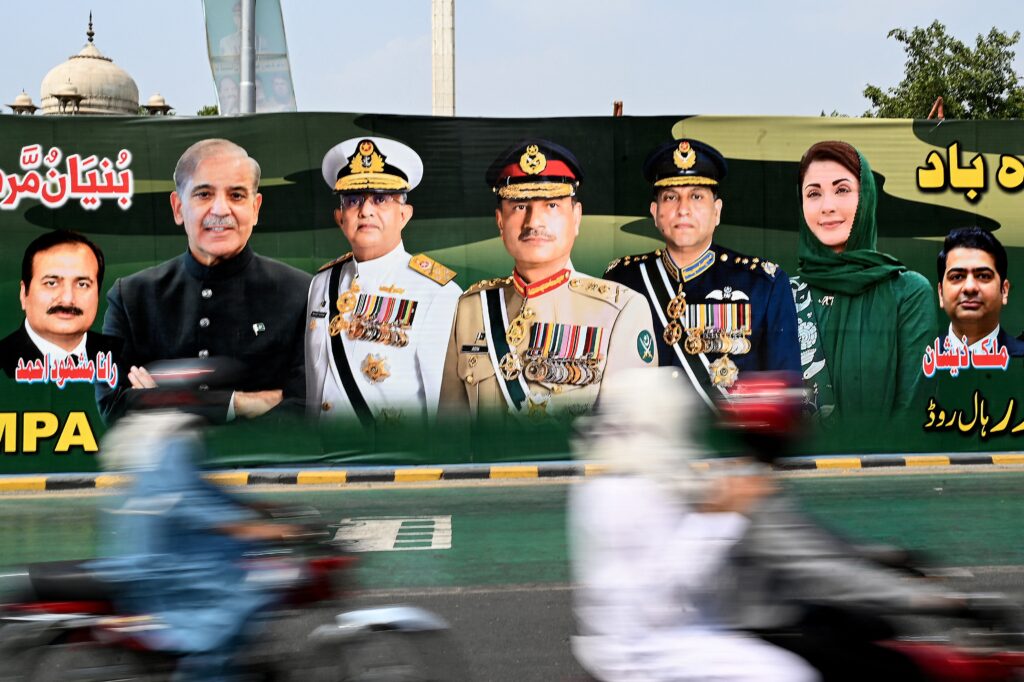
Pakistan’s military is tightening its grip on the country with sweeping legal changes that critics say are centralizing power in the hands of army chief Gen. Syed Asim Munir.
Munir, Pakistan’s former spy chief, was appointed by the government this month to be the country’s chief of all defense forces, a newly created position that gives him more power than any Pakistani military official since Gen. Pervez Musharraf’s military dictatorship ended in 2008.
Having recently been granted lifelong legal immunity, Munir, who is believed to be around 57, now operates under only limited oversight from Pakistan’s civilian government.
Munir is accumulating power as the country’s primary opposition party, led by jailed former prime minister Imran Khan, has suffered setbacks in recent by-elections and been removed from key legislative positions. Khan was ousted by Parliament in 2022 after falling out with the military and has been imprisoned since summer 2023.
He and his wife Bushra Bibi, who has also been in prison since January, have been convicted on numerous charges since 2023, even though most verdicts have since been suspended or overturned. They were each sentenced to 17 more years in prison on Saturday in a new fraud case. Khan still faces numerous other charges. He and Bibi have denied all accusations against them.
Many of Khan’s associates have also been sidelined or arrested. Last week, his former spy chief, Faiz Hameed, was sentenced to 14 years in prison on charges that included political interference and abuse of power.
Pakistan’s military has long been viewed as the final arbiter of the country’s politics. Civilian prime ministers have seen their fortunes rise or fall depending on how well they got on with the army. But Munir’s critics warn that his expanding control could cross the unofficial red line that has enabled civilian and military leaders to coexist for nearly two decades.
“Political polarization is deepening and recent events have intensified confrontation, raising questions about the role of the security apparatus,” the political analyst Zahid Hussain said. “Political reconciliation is urgently needed.”
Munir and his allies might believe Pakistanis are on their side. The military was the target of criticism and at times violent protests after Khan’s arrest on corruption charges in 2023. But it has benefited in recent months from a period of nationalistic fervor since Pakistan’s brief military conflict with archrival India in May.
Munir and his allies have also built a personal rapport with President Donald Trump, which could reduce the risk of U.S. pushback to democratic backsliding.
But privately, some in Islamabad question whether Munir is stretching the limits of his power.
“He could squander some of the goodwill that he just won back,” said Michael Kugelman, a senior South Asia fellow at the Atlantic Council.
Pakistan’s military is a complex and layered institution that remains deeply attuned to its public perception, analysts say. “The military has faced hostile sentiment from the public in the last few years that is very rare in Pakistan’s history,” Kugelman said, “and it doesn’t want that.”
In recent public comments, Munir has appeared to downplay the significance of his elevation. When Munir’s appointment as chief of all defense forces was confirmed this month, he said his new role would not impact the “internal autonomy and organizational structure” of other military branches, the Pakistani state broadcaster reported.
A Pakistani security official said the “reforms” were introduced “under directives of” the Parliament, and the civilian government and civilian control of the military remains unchanged.
The restructuring is aimed at “improving coordination, joint planning, and operational effectiveness,” the official said in a statement to The Washington Post.
“On the domestic political environment, the armed forces have reiterated that they are apolitical and do not represent any political ideology,” the official said. “Narratives that aim at creating rifts and undermining national cohesion will not be allowed.”
Munir joined the military in the 1980s and quickly rose through the ranks. In 2018, Khan, then prime minister, approved him as head of the ISI, the nation’s primary spy service, but Munir was removed only months later amid reported tensions with Khan.
Shortly after Khan was himself ousted in 2022, the new government around current Prime Minister Shehbaz Sharif promoted Munir to chief of army staff — the most powerful position in Pakistan’s military.
His tenure was almost immediately beset by controversy and opposition. Khan’s arrest in 2023 sparked riots; some of his supporters blamed the military.
The most serious challenge to the authority of the army in decades rattled an institution that had rarely been criticized so directly. Surging inflation and militant violence further fueled public discontent.
But the opposition faded after a week of fighting with India, Pakistan’s far more populous neighbor, ended with both sides claiming victory. Nationalistic fervor in Pakistan boosted the generals’ standing across political divides, and Munir’s promotion to the rarely awarded ceremonial rank of field marshal in May drew little initial criticism.
The Trump administration has also been quiet. Pakistan wooed President Trump early in his second term by publicly claiming that he brokered its ceasefire with India and later nominating him for the Nobel Peace Prize.
Weeks after the ceasefire, Trump invited Munir to have lunch with him at the White House — a highly unusual private meeting between a U.S. president and a foreign military chief, and a tacit acknowledgment of the Pakistani military’s sway over its civilian government. Trump later referred to Munir as his “favorite field marshal,” and goods from Pakistan secured one of the lowest U.S. tariff rates among major Asian economies.
In Pakistan, however, Munir’s consolidation of power carries mounting political risks.
Khan’s party, reeling from the arrest of many of its leaders, has largely refrained from attacking Munir directly.
“PTI has never questioned the existence or importance of the institution of the armed forces, nor does it believe in personalizing or politicizing state offices,” Sheikh Waqas Akram, the party’s central information secretary, wrote in response to a Washington Post query.
But the party’s base, its leader and the military all appear to have stronger feelings. Munir, speaking through a spokesman, and Khan accused each other this month of being “mentally unstable.”
Pakistan’s Dawn newspaper scolded both.
“This cycle of toxicity must end,” the paper wrote in an unusually blunt editorial. It noted that Khan’s party “continues to enjoy significant popular support, and criticism of it should not go so far as to equate it with anti-state inclinations.”
Protesters have continued to demand Khan’s release despite a years-long crackdown in which hundreds of supporters have been jailed. Many protests have been led by politicians from Khyber Pakhtunkhwa, one of Pakistan’s four provinces. The province, which is governed by Khan’s party, has been targeted by a mounting insurgency of Pakistani Taliban militants that has weakened public trust in the security forces.
When Pakistan’s government publicly pondered the imposition of emergency rule there this month, regional politicians warned that the public response would be furious.
“If they have the courage to impose it, then let them do so,” said Sohail Afridi, the province’s chief minister.
The post Pakistan’s military chief consolidates power unseen in years appeared first on Washington Post.