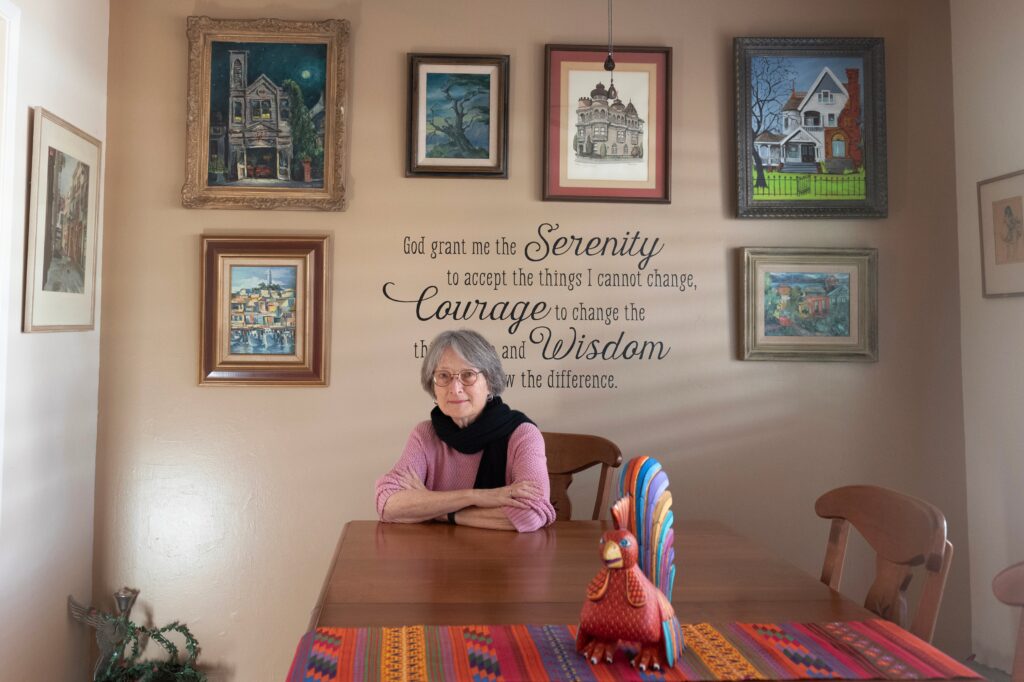
Jocelyn Combs set up a filing box with her will and trust. She has designated who will have power of attorney, told friends and family where to find her passwords, and begun culling her possessions, save for mementos and other items she’s set aside for her daughter.
She also had an accessory dwelling unit built on her property in Pleasanton, California. A caregiver could live there, she said. Or she could, and rent out her house for extra income.
It’s all part of her aging plan, drawn from the often-overwhelming experience of caring for her own parents — who both lived into their 90s — and one legacy the 76-year-old is adamant about sparing her only child. Combs is still going through boxes of her parents’ belongings years later.
“It was brutal. The emotional toll, the financial toll, all of it,” Combs said. “I’m trying to set myself up to be less of a burden to my daughter.”
Baby boomers and Gen Xers are decluttering their houses, sifting through paperwork and making other end-of-life plans in growing numbers, older adults, and elder law attorneys and financial planners say. Surveys from the National Alliance for Caregiving and advocacy group AARP show 47 percent of family caregivers — mostly caring for aging parents or adults with disabilities — said they had such arrangements this year, up from 42 percent a decade ago. About half the caregivers report financial hardships, including lost income due to depleted savings, because of those responsibilities.
“We’re seeing a huge spike in elder care planning,” largely driven by adult children, said Gabriel Shahin, chief executive of Falcon Wealth Planning. “Ten years ago these conversations only happened after a crisis, now they’re happening proactively.”
More people are expected to shoulder caregiving duties as baby boomers — those born between 1946 and 1964 — age and lifespans increase. The number of Americans 65 and older is projected to increase more than 30 percent by 2050 — with these older adults making up 1 in 4 Americans by then, compared with about 1 in 10 in the 1980s.
The demographic changes are compounded by shortages of professional caregivers, typically aides or nurses who provide household or medical help that might otherwise fall to family members. Already, the number of family caregivers has increased 45 percent since 2014, according to surveys conducted by the caregiving alliance and AARP. About one-third of family caregivers have been providing that care for five years or more, one of those surveys shows.
Then there’s cost: The median out-of-pocket cost for a private nursing home room was $10,650 a month in 2024, while an assisted-living facility cost $5,900, according to insurer Genworth.
“Not only is caregiving becoming more prevalent [and] more stressful, it’s also lasting longer,” said Jason Resendez, president of the caregiver alliance. “This is not a looming crisis. This is something that people are living through right now every day.”
Many say the experience has spurred them to take action.
Connecticut resident Pam Ferraro and her husband bought long-term care insurance and have deliberately broached the oft-taboo topics of dying and cognitive decline with their children.
“Feel free to call me out,” she said she’s told her adult children. “You know, ‘Mom, guess what. Your driving days are over.’”
In 2018 and 2019, Joan Savitt spent several months flying — or making the 11-hour drive — back and forth from her home in Boston to Cleveland after her mother, now 101 years old, moved into an assisted-living facility. Savitt spent days clearing out the house where her mother raised six kids, packing up 55 years’ worth of stuff, creating a 39-page Google document where family members could pick out items they wanted, and then mailing those items out. She also arranged for the repairs the house needed to pass city inspections and go on the market.
It took her six months to sort through her mother’s finances and accounts — a chore that involved faxing power of attorney documents and spending hours on the phone adding her name to credit cards and canceling others, including one TJ Maxx card her mother hadn’t used in five years.
After four years, Savitt and her husband moved to Cleveland. Savitt drives her mother to appointments to treat her macular degeneration.
Savitt believes the pressure and strain of caregiving affected her health. She developed a cotton-wool spot on her eye, which her doctor attributed to a spike in her blood pressure. She seethed at relatives who didn’t show up to help when she asked or who made what she deemed onerous demands, such as mailing them heavy and unwieldy objects at her expense.
Savitt’s advice to others: Don’t be a martyr.
“If I had realized that this is a matter of my health and my sanity, that might have overridden the desire to get along with everyone,” she said.
As for her own plans, she intends to downsize if she outlives her husband: “I would have an estate sale, and then I would move out of this house pretty quickly.”
Savitt’s story is common, as caregiving responsibilities often fall on one family member — typically a daughter or the person living closest to the aging adult. That can lead to strain between siblings, Resendez said. Other times, it can stir feelings of resentment and guilt in the caregiver who is putting their own life on pause to be there for their parents.
Susan Patrick, 72, of Virginia said she cared for her mother for about 30 years, eventually becoming estranged from two siblings she felt weren’t contributing. After her mother could no longer drive, Patrick and her husband set her up in a house across the street from them so that Patrick could drive her to appointments. But the responsibilities grew as her mother’s health declined. Patrick eventually quit her job as a lawyer, halving her family’s income. Her husband was supportive, but the pressure took a toll, she said.
“We couldn’t go anywhere. We couldn’t do anything,” she said.
Patrick asked her siblings to take over her mother’s care for a few months each year to give her a break. Two of her siblings tried to help but two didn’t, she said. It turned into a huge argument, and the relationships never recovered, she said. One of Patrick’s siblings said it didn’t make sense for her to host their mother, partly because her house was far away and multilevel.
For many, the strain of caring for aging parents becomes a catalyst for adults to examine what they want for themselves and their children as they age.
It “becomes, like, an aha moment for the next generation of caretakers,” said Eric Einhart, partner at the Russo Law Group and president of the National Academy of Elder Law Attorneys.
After Colleen Gleason’s parents died, she met with an elder law attorney, filed a living will with local hospitals and told her son and a friend that she wants to be cremated. She also took steps to ensure her estate doesn’t end up in probate court, which could be an expensive hassle for her son.
Gleason spent much of her parents’ final years making the five-hour drive back and forth from her home in Virginia to their house outside Philadelphia, checking that their medications were correct, setting up meal deliveries, and responding to medical crises.
“During that time, it was just this constant, ‘How am I going to do this?’” she said.
Gleason’s son has assured her he’ll take care of her as she ages. While she doesn’t blame her parents, she doesn’t want to repeat the cycle.
“I said, ‘I don’t want to put that on you,’” she recalled. “My parents put that on me.’”
The Post is collecting stories about aging in America. Are you caring for an aging family member? Tell us about your experience here or email [email protected]
The post Overwhelmed caring for aging parents, baby boomers try to spare their kids appeared first on Washington Post.