On certain Sundays, there are two lines to get into the Grand Bazaar, an open-air market on the Upper West Side of Manhattan. One line is just to get through the chain-link fence, beyond which shoppers can browse handmade sweaters, rugs and vintage coats. The other line is for a chance to buy a handbag made by Francis Pierre Laborde.
Mr. Laborde’s purses come in electric blue, pony hair, leather, gold, browns, polka dots; the combinations can seem endless. On a table in his regular spot at the market, he displays his bags like an assortment of Willy Wonka chocolates, each possessing a magic power accessible only with purchase.
The frenzy over the handbags began late last year on TikTok, after a young woman posted a video of herself acquiring a handmade leather purse. “I need everyone to blow this man’s brand up,” the woman wrote in a caption. “We need more local nyc designers without crazy price tags.” (He has increased his prices slightly since then, and his bags now range from $295 to $1,200.)
Last month, the purses once again sold out in minutes — 27 minutes, to be exact, according to Mr. Laborde. But in contrast to past appearances at the Grand Bazaar, on that November morning, shoppers swarmed his table, creating a chaotic scene with shouting and grabbing. The experience led him to create an online ticketing system to ensure fairness and to keep crowds from turning into mobs.
“The last time he was here, they bum rushed it the table,” Kia Forsythe, 36, said, while waiting her turn to purchase her bag at the Bazaar on a cold Sunday morning. “It was crazy. I waited for an hour and a half to get in and then another two hours just for them to say it was sold out,” she said. “I don’t think he was expecting that massive crowd to come. I don’t think he understood that he went viral yet.”
The surge in demand last year came to Mr. Laborde without any real marketing effort on his part. Besides a neglected Instagram account and a website he created to sell the bags, the brand had little in the way of a social media footprint. Now, all that has changed, seven years after Mr. Laborde began selling his purses at the market.
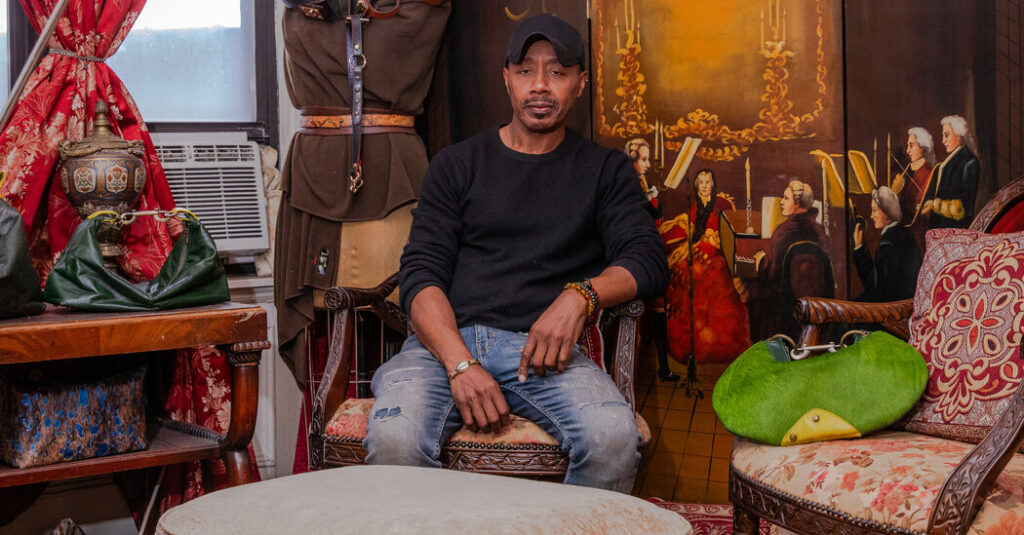
“There were times when I did not know if I can keep on doing this,” Mr. Laborde recalled, sitting in the living room of the Harlem apartment that doubles as his studio. “I have had so many hard times, but I kept pushing.”
Mr. Laborde immigrated to New York from Haiti shortly after he finished high school. He knew he did not want to attend college in Port-au-Prince, where he was raised, but even as a teenager on the island, he knew fashion was his passion.
“In Haiti, all my clothes were tailor-made,” he said. “Every time I had my clothes made I had to change everything — the color and style. This is when I knew I loved fashion. I always had this dream to do sewing and stuff.”
When Mr. Laborde arrived in New York — a “very, very, very private person,” he declined to specify when, besides to say that Madonna and Michael Jackson were in heavy rotation on the radio at the time — he lived with his father and his sister in Brooklyn and found work at a cup store. He quickly enrolled in a language school to learn English. (He spoke only French, Spanish and Creole at his arrival.)
After two years, Mr. Laborde found a job as a designer at a textile company on Sixth Avenue, near Radio City Music Hall, one in which he felt he could be creative. “I really loved that job so much,” he said.
While there, he enrolled at the Fashion Institute of Technology. One class at a time was all he could afford. According to F.I.T., he received an associate degree in fashion design in 1999.
“It was surreal,” Mr. Laborde said of attending college in the United States, adding, “To be here in college with everybody, like people from all over the world, and studying history and all that stuff, that was like a dream.”
He tried to find work in the fashion industry after graduation, but things did not pan out. In 2004, after some odd jobs and a stint at a trade school learning graphic design, he decided to begin making accessories. He recalled noticing that everyone was wearing the same bag — the Louis Vuitton Neverfull — and thinking that some variety might do the consumer some good. He audited handbag-making classes at F.I.T. to learn the basics.
Soon, Mr. Laborde was moonlighting as a handbag maker. He sold his purses to friends and at parties his neighbor threw for him. Sometimes, he turned his living room into a showroom and invited friends over to shop. Many times, friends bought his purses just to make sure he could make rent.
In 2016, a friend told him about the Grand Bazaar on the Upper West Side and suggested he start selling his goods there. The market, which squeezes 150 vendors a week into a cafeteria and an adjoining schoolyard on West 77th Street, operates all year long. On his first day at the market, in 2018, he sold four clutches and made $1,500. But that was just the first day.
“After a few Sundays, I will be there and nothing,” he said, remembering the days he didn’t make a single sale. “I knew people had to get to know me.”
That same year, he was let go from his job selling skin care products and decided to dedicate all his time to making bags.
“It was hard because when you don’t make money, how do you pay your bills?” Mr. Laborde said. “I didn’t want to go back to the job. I know it’s going to be tough, but I’m just going to do it.”
Last year, that fawning TikTok video gave the people a chance to get to know Mr. Laborde. “I started seeing my Instagram — I’m like, Why all these people?” he said. “It was like, follow, follow, follow.”
Masani Bailey, 33, was one of the people who discovered Mr. Laborde around that time, she said while waiting in line to enter the market.
“I did some research on TikTok,” Ms. Bailey said. “I saw all the hype around it, and I was like, It’s going to be a process.” She and a group of friends formed a group “to strategize to make sure we got the bags,” she recalled. “That was before we learned about the ticket system.”
Alana Gardner, 47, was sent a video about Mr. Laborde on Instagram from a friend.
“I collect bags, so I said I’ll go check them out,” Ms. Gardner said as she shivered in line this month. “This is my third attempt to try and get a bag,” she added. “I want to see them. I’m tactile. I want to touch it.”
As the customers began to creep into the outdoor market, a crowd began to form around Mr. Laborde’s table. A round of applause broke out. A woman wearing a sable-fur jacket, aviator glasses and a New York Yankees hat was clutching a gold and blue pony hair hobo bag.
“I got it,” she said as she held the purse over her head like a trophy.
Mr. Laborde walked up to her and gave her a hug. “Thank you!” she said.
“There were times I would be here, I would go home with zero dollars,” Mr. Laborde said. “So, this is kind of overwhelming.”
Sandra E. Garcia is a Times reporter covering style and culture.
The post The Harlem Handbag Maker Who Creates a Frenzy With Every Drop appeared first on New York Times.