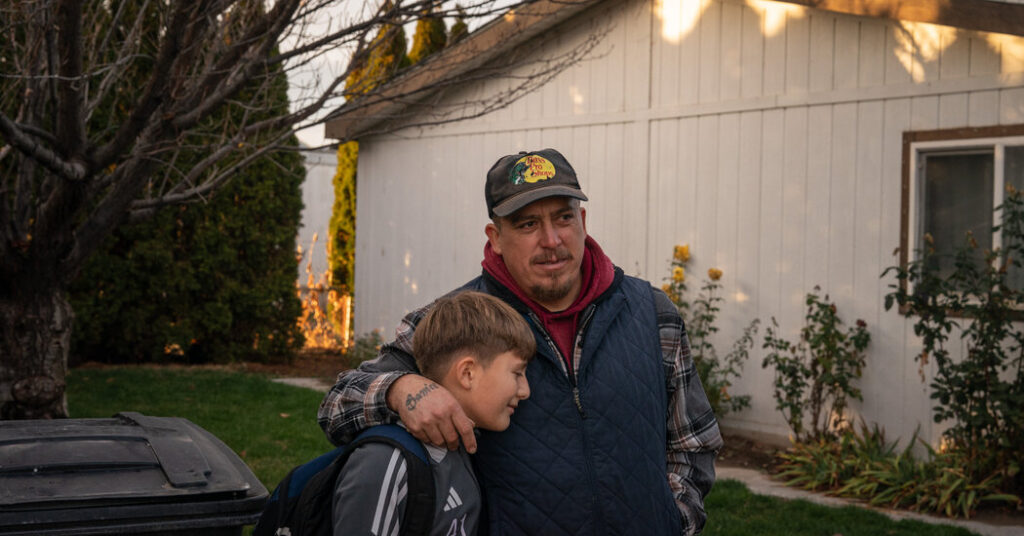
Luis Martinez was still trying to figure out how to tell his 11-year-old son that his cancer might be back when his phone rang. He squinted to make out the name of his son’s soccer coach.
The coach wanted to know if Luis could drive his son, Rooney, to a tournament in Seattle, three hours away. A last-minute dropout meant their team suddenly had a chance to compete against the best players in the state.
Rooney was in the next room running his nightly footwork drills, the ball thudding against the wall. Luis figured he would want to go. He closed his eyes. He used to feel he knew exactly how to keep his son safe, but lately he wasn’t sure.
The coach had called instead of texting because Luis struggled to read messages. His eyes had been damaged two years earlier, when he was 38 and had nearly died of a cancer linked to the job he’d done his whole adult life: fighting wildfires for the federal government.
The coach waited. To have a shot at winning, the team needed its best players, and Rooney was one of them.
He offered to cover the entry fees, then asked again, could they make the drive?
Luis hesitated. His doctor had said she didn’t like the look of his most recent blood work and had scheduled more tests. She had warned him to pay attention to his fatigue. A long drive was probably more than his body could handle.
When Luis called Rooney over to ask if he wanted to make the trip, he instantly said yes. For weeks, he had sensed that something was wrong with his father. Luis was moving more slowly and going to the clinic more often. So Rooney was trying to stay close and work harder at making him proud. They ran soccer drills every afternoon until the light faded, and found local games most weekends. A road trip would mean more time together after Luis had spent months away on wildfires.
In their small, secluded town, nearly everyone was connected to the private companies that the government hired to fight fires. Smoke-related sicknesses were a shared fact of life. So were periodic immigration crackdowns. Lately, the road to Seattle was becoming a corridor for ICE enforcement.
Families were staying home, waiting until the danger eased. But Luis didn’t feel he had that kind of time. He told the coach they would try to make it. He had a week to decide.
Luis was about Rooney’s age when his father pulled him out of school to work in the fields in Mexico. At 18, he crossed the desert and made his way to Mattawa, a town of 3,500 people in Washington’s Columbia River basin. Almost entirely Latino and surrounded by miles of orchards, the town had been bypassed by highways and chain stores. Most of Luis’s neighbors had arrived the same way, crossing illegally and taking whatever work was available.
Luis immediately fell into a rhythm of pruning fruit trees in the winter and fighting fires in the summer.
He worked for a private firefighting company, but in the field, everyone took orders from U.S. Forest Service supervisors. He was usually assigned “mop-up,” one of the smokiest parts of the job. After flames had died down, he would get on his hands and knees to feel for spots that were still smoldering. When he found lingering embers, he smothered them with dirt.
By the end of the day, ash and grit would fill his nose and mouth. He might do this for weeks on end, cloaked in poisonous smoke that the Forest Service has known for years can damage hearts and lungs and cause fatal cancers.
Over time, he noticed how inconsistent the directives were. One day, his crew might be told to clean up everything 10 feet into a burned area; another day, 100. Sometimes the supervisors sent them back to the same patch again and again, stirring up more ash. “It was like, ‘We’ve been here five times — there’s nothing left,’” he said.
He figured these were at least safer assignments, farther from flames. In fact, mop-up is among the most carcinogenic work on a fire.
The Forest Service’s own researchers warned in 2016 that supervisors were assigning mop-up more often than needed, endangering firefighters’ health. The agency’s policy is to limit mop-up to only what is strictly necessary. In practice, though, that work is still frequently being done — it has just fallen to immigrants.
Dozens of the firefighting companies that the government relies on are built on immigrant labor. Worker advocates and the Forest Service’s internal watchdog have estimated that as many as 70 percent of these firefighters are undocumented.
By his 30s, Luis had watched many co-workers his age collapse into illness: heart failure, incurable cancer, lung problems that put them out of work. His company offered no health insurance. When someone got sick, Luis would spend days cooking carnitas to sell in town to raise money.
He had thought he would eventually return to Mexico, but then Rooney was born. Named for Wayne Rooney, the Manchester United star considered one of England’s best players, Rooney mostly lived with Luis. They had always been inseparable, the boy’s mother said. She lived nearby and took Rooney when his father was fighting fires.
When Rooney turned 7, Luis bought him a soccer ball and started taking him to tournaments. Soon, he was invited to join a travel team, and Luis began dreaming of a college scholarship. He kept Rooney’s homework folders on the table and lined his soccer trophies and certificates for perfect attendance along the kitchen wall. When he was away for fire season, he called his son every night.
It felt like a stable life. Then one day in 2023, Luis’s vision suddenly dimmed, as if cobwebs were covering his eyes. After a trip to the emergency room, he was quickly diagnosed with a rare leukemia that often causes life-threatening hemorrhages. In Luis’s case, the bleeding had started in his eyes.
When Rooney got to his father’s hospital room, Luis could recognize him only by his voice. The boy was just a shadow in a hazy door frame.
Rooney began visiting most days after school. He changed his father’s socks and ate his Jell-O cups. At night, he crawled into the hospital bed and asked to stay over.
The Forest Service recognizes that wildfire smoke is linked to leukemia and other cancers. When firefighters who work directly for the federal government fall sick with these illnesses, they’re entitled to workers’ compensation coverage, which pays for medical care. But these benefits do not extend to contract workers like Luis.
After a month in the hospital, he received a bill for $133,000. He had been earning $20 an hour fighting fires, a number that shrank after taxes and deductions for Medicare, Social Security and other benefits that, as an undocumented immigrant, he was not allowed to use. “There are lots of people who prefer to die in Mexico,” he said. “But my place is here with Rooney.” Luis asked the hospital to set him up on a payment plan.
When the hospital sent him home, he still saw the world in shadows and needed regular injections in his eyes. At night, while making dinner, he sometimes cut his fingertips.
He wanted to shield Rooney as much as possible, so he continued to get dressed every day and go to the orchards, where he sat in the sun while his friends worked. They raised money for him, as he had for others. Luis kept a list of every person who helped — more than a hundred names — folded in the closet beside his son’s clothes.
After 11 months of chemotherapy, Luis went into remission last year, though his doctors explained that he was not cured. His vision had improved enough to drive and manage daily tasks. They told him to find lighter work, maybe in a store. But in Mattawa, there were only two kinds of jobs: the orchards or the fires. And fires paid better. So in April, he asked to be put back on a crew.
For years, Luis had pitied the sick men who kept going back to fires. He also thought they were reckless, choosing money over safety and endangering their crewmates.
Now, though, he felt he had to go, even when Rooney asked him not to. “I told him, here everyone has to work so they can eat,” Luis said.
.css-1mxer6r{max-width:600px;width:calc(100% – 40px);margin:1.5rem auto 1.75rem;height:auto;margin-left:auto;margin-right:auto;font-family:nyt-franklin;color:var(–color-content-secondary,#363636);border-top:1px solid var(–color-stroke-quaternary,#DFDFDF);border-bottom:1px solid var(–color-stroke-quaternary,#DFDFDF);padding-top:20px;padding-bottom:20px;}@media only screen and (min-width:1024px){.css-1mxer6r{width:600px;}}.css-1medn6k{font-family:nyt-franklin,helvetica,arial,sans-serif;font-weight:500;font-size:1.0625rem;line-height:1.5rem;}@media only screen and (max-width:480px){.css-1medn6k{font-size:1rem;line-height:1.375rem;}}.css-1f84s5v{font-weight:700;font-size:1.0625rem;}@media only screen and (max-width:480px){.css-1f84s5v{font-size:1rem;}}.css-1f84s5v a{color:var(–color-signal-editorial,#326891);-webkit-text-decoration:underline;text-decoration:underline;}.css-1f84s5v a:hover{-webkit-text-decoration:none;text-decoration:none;}.css-1hvpcve{font-size:17px;font-weight:300;line-height:25px;}.css-1hvpcve em{font-style:italic;}.css-1hvpcve strong{font-weight:bold;}.css-1hvpcve a{font-weight:500;color:var(–color-content-secondary,#363636);}.css-214jt4{margin-top:15px;margin-bottom:9px;}@media only screen and (max-width:480px){.css-214jt4{font-size:14px;margin-top:15px;margin-bottom:10px;}}.css-214jt4 a{color:var(–color-signal-editorial,#326891);-webkit-text-decoration:underline;text-decoration:underline;font-weight:500;font-size:16px;}@media only screen and (max-width:480px){.css-214jt4 a{font-size:13px;}}.css-214jt4 a:hover{-webkit-text-decoration:none;text-decoration:none;}.css-1mxer6r{max-width:600px;width:calc(100% – 40px);margin:1.5rem auto 1.75rem;height:auto;margin-left:auto;margin-right:auto;font-family:nyt-franklin;color:var(–color-content-secondary,#363636);border-top:1px solid var(–color-stroke-quaternary,#DFDFDF);border-bottom:1px solid var(–color-stroke-quaternary,#DFDFDF);padding-top:20px;padding-bottom:20px;}@media only screen and (min-width:1024px){.css-1mxer6r{width:600px;}}.css-1medn6k{font-family:nyt-franklin,helvetica,arial,sans-serif;font-weight:500;font-size:1.0625rem;line-height:1.5rem;}@media only screen and (max-width:480px){.css-1medn6k{font-size:1rem;line-height:1.375rem;}}.css-1f84s5v{font-weight:700;font-size:1.0625rem;}@media only screen and (max-width:480px){.css-1f84s5v{font-size:1rem;}}.css-1f84s5v a{color:var(–color-signal-editorial,#326891);-webkit-text-decoration:underline;text-decoration:underline;}.css-1f84s5v a:hover{-webkit-text-decoration:none;text-decoration:none;}.css-1hvpcve{font-size:17px;font-weight:300;line-height:25px;}.css-1hvpcve em{font-style:italic;}.css-1hvpcve strong{font-weight:bold;}.css-1hvpcve a{font-weight:500;color:var(–color-content-secondary,#363636);}.css-214jt4{margin-top:15px;margin-bottom:9px;}@media only screen and (max-width:480px){.css-214jt4{font-size:14px;margin-top:15px;margin-bottom:10px;}}.css-214jt4 a{color:var(–color-signal-editorial,#326891);-webkit-text-decoration:underline;text-decoration:underline;font-weight:500;font-size:16px;}@media only screen and (max-width:480px){.css-214jt4 a{font-size:13px;}}.css-214jt4 a:hover{-webkit-text-decoration:none;text-decoration:none;}
Got a confidential news tip? The New York Times would like to hear from readers who want to share messages and materials with our journalists.
See how to send a secure message at nytimes.com/tips
Soon, he was able to start paying bills. But it felt like the job was getting more dangerous.
In August, a firefighter who had grown up near Luis had a heart attack and died on a Montana fire. Days later, immigration agents appeared at a Washington wildfire and pulled aside a crew for questioning. One firefighter was deported. Another, who had lived in the country since he was 4, was sent to detention.
After the raid, some of Luis’s colleagues started turning down deployments. Those who kept going tried to avoid drawing attention to themselves.
During a large fire in October, The Times watched as a team from Luis’s company was sent alongside two government crews to a hillside that had partly burned. When the supervisor asked them to check for smoldering ash, the two government crew leaders said the smoke exposure wasn’t worth it: The fire would likely tear through the area again anyway.
But the immigrant firefighters got directly to work. They hiked up the charred hill and called out warnings in Spanish as smoke enveloped them. They poked into holes, finding smoldering roots and stirring up embers. They kept at it until dark.
The next day, the whole hillside burned.
Forest Service supervisors told The Times they feel pressure to assign mop-up even when it may not be strictly necessary. Residents grow alarmed when smoke lingers. Supervisors also fear being blamed if a fire reignites, a worry sharpened by the Palisades fire in Los Angeles, which may have begun with a leftover ember. They often give mop-up to contractors. (The Forest Service said “mop-up is where we lock in the hard-fought gains in suppressing a fire” and supervisors are trained to weigh risks against potential gains.)
By the time the fire season ended, Luis was exhausted. His muscles ached, his legs were going numb and he couldn’t keep up with Rooney during their daily soccer drills. He told himself maybe it was his age, 40 now. But at the end of October, he went in for blood tests. The doctors said things he couldn’t quite understand and gave him an injection. “They told me my results were very bad and I was backsliding,” he said.
Luis had kept the news to himself, and the coach’s call had come as he was trying to figure out how he could rest with bills piling up and a sixth-grader counting on him. Now he sat beside Rooney at Mass, debating whether to make the trip.
So many people wanted to pray lately that their church, Our Lady of the Desert, had moved its services into a warehouse. Mass was held in Spanish, and nearly every pew held firefighters and their families. As incense filled the room, some started coughing.
In the back, Luis knelt and prayed for protection. Rooney leaned his head on Luis’s shoulder, repeating the wish he’d made every day since his father went back to firefighting: Please let him not get sick again.
After Mass, they drove to do soccer drills next to an orchard. They usually ran a few warm-up laps around the field together. But today, Luis let Rooney run ahead while he struggled to walk one lap.
“I know I’m sick again,” he said in a low voice. “I can feel it.” He stood to catch his breath and watched Rooney run toward him.
The day before the tournament, they were training again.
“Are you going to take him?” another father asked. They were standing at the edge of the field, hands jammed into their pockets against the cold, watching their sons practice. “Won’t there be ICE there?”
Luis didn’t know. Mattawa still felt safely isolated, but firefighters who worked for his company were being picked up in the cities closer to Seattle. He told the other father he hoped ICE would not raid a children’s soccer tournament. “That would be too cruel,” he said.
Rooney sprinted by, cheeks flushed. Luis waved him back into position and reset the cones. Most of the other children on the team, which was based in a larger town an hour away, trained with soccer academies. Luis and Rooney had learned the drills by watching videos on Luis’s phone.
When they drove home, Luis stayed 10 miles under the speed limit and waited at stop signs until the road was empty in all directions. His eyesight had improved, but he still drove only in daylight, when the weather was clear.
He had barely made it inside when there was a knock. It was the recruiter who had sent him to his first wildfire crew at 18, stopping by because he’d heard ICE was patrolling the roads.
A whole Oregon-based crew had been detained, he said. “If they start asking for papers next summer, we’ll go from 15 crews to five.”
Luis looked over to see if Rooney was listening, but he seemed absorbed in a video game.
When he first got sick, Luis borrowed money to apply for a humanitarian relief program that shields immigrants with serious illnesses from being deported. The mayor wrote him a character reference letter. His lawyer said he had a good chance. But this year, under President Trump, his case stalled.
After Rooney fell asleep beside him, Luis scrolled on his phone, the text set to the largest size. He saw real-time ICE alerts, fund-raisers for legal fees, posts on protecting children if parents were deported.
Luis switched to looking at training videos. He watched his son breathing under the heavy blanket.
“It’s just us,” he said. “I have to make sure he stays on a good path.”
Luis closed his eyes. Tomorrow, he decided, they would drive to Seattle.
Before they left, Luis and Rooney bowed their heads before a small altar they kept in the kitchen. Luis prayed to the memory of his parents and to God to protect them on the road. Rooney prayed to play well.
Luis kept his immigration paperwork in the glove compartment. Standing in the sunny driveway, he smoothed and photographed each page.
“That way if they rip it up, I’ll still have it,” he said. He had heard the best thing to do if he was stopped was simply refuse to answer any questions. “I can’t answer that,” he said aloud in Spanish. While he practiced a few more times, Rooney threw his backpack in the back seat and waited.
At a gas station outside town, Rooney jogged up and down the aisles. He picked a corn dog for himself and nothing for Luis. He’d seen a brochure called “Does sugar feed cancer?” in a doctor’s office, and didn’t want to tempt him. “I have to make sure he stays healthy,” Rooney said.
Between fires over the summer, Luis had found work in the orchards and, for the first time, Rooney had gone with him. Rooney said he wanted to help pay for his school clothes. Watching his son come home dusty and exhausted, Luis worried he was passing on the same burden he’d experienced as a child. He told Rooney it was so he would remember why school, soccer and college scholarships mattered.
“But he understands too much already,” Luis said. “He talks like an adult now.”
Back on the highway, Luis scanned the side of the road like he had during mop-up, looking for anything that stood out. The silence between them deepened when they passed a stopped patrol car.
Rooney was too nervous to sleep, and spent the hours until Seattle playing games on his phone.
At the sports complex where Seattle’s professional teams trained, Luis and Rooney stared at the children on the other teams. They were tall, with logos buzzed into their salon haircuts. Their cleats were from the mall, not sent by relatives in Mexico. They wore pressed uniforms stenciled with their names. Rooney’s said “James,” a hand-me-down from the coach.
Rooney’s team, the Cubs, would have to win all their games on this first day to make it to the finals. The coach held Rooney back until the team was down 0-2. When he got in, he scored three goals in the space of a few minutes.
After the third goal, Rooney glanced at his father and saw that he looked proud. “Have fun, Rooney,” Luis shouted.
Luis couldn’t make out the expression on Rooney’s face, just the number on his back. But he knew the drills by heart and felt good seeing them put into action. It was a little like being on the fire line, everyone pulling in the same direction.
The team won every match that day. Luis and Rooney spent the night at a friend’s in Seattle, and Luis cooked for everyone. Restaurants and churches were mostly empty now, the friend said; ICE had been patrolling all week.
At the complex the next morning, Luis watched Rooney warm up. He was glad they had come. “It’s the only thing I have to give him,” he said. “To show him when I’m gone that I loved him and supported him in the things he cared about. He’ll remember this when he’s older and trying to find his way.”
Soon, it would be time to get on the road. Rooney would fall asleep against the car window, a medal resting on his chest.
There would be more tests and appointments waiting for Luis back home. But he wouldn’t tell Rooney. Not just yet.
Julie Tate contributed research.
Audio produced by Patricia Sulbarán.
Hannah Dreier is a reporter for The Times who covers laws and policies by telling the stories of the people they affect. She can be reached at [email protected].
The post ‘It’s Just Us’: The Firefighter, His Son and a Treacherous Choice appeared first on New York Times.