When President Trump announced tariffs this spring, toymakers immediately began to worry about Christmas.
A majority of toys sold in the United States are produced abroad, mainly in China. With American consumers already squeezed by stubborn inflation, pricier toys could put a damper on the crucial holiday shopping season.
Sales at Mattel, the maker of Barbie, Hot Wheels and American Girl, have fallen since April. The toymaker’s retail partners have been delaying orders until closer to Christmas, a sign of an uncertain outlook for tariffs and the economy.
After Mattel warned in May that it might raise prices and Ynon Kreiz, the company’s chief executive, said it was unlikely to move toy production to the United States, Mr. Trump threatened to impose a 100 percent tariff on the company’s products.
In a rebuke aimed directly at Mr. Kreiz, Mr. Trump said, “He won’t sell one toy in the United States.”
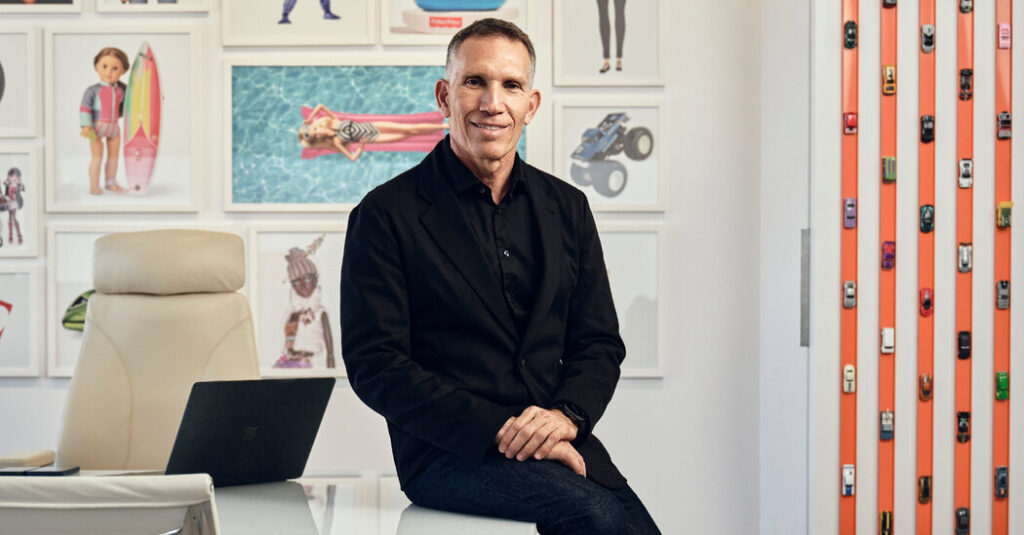
That threat went unfulfilled. Mr. Kreiz, 60, has been busy steering the toy giant into the all-important fourth quarter. At Mattel’s headquarters in El Segundo, Calif., workers spend months tinkering with Hot Wheels racetracks, 3-D printing toy prototypes and imagining new looks for Barbie and Ken.
“Parents prioritize spending money on their children and will cut on other things before they touch toys,” said Mr. Kreiz, a father of four.
He became chief executive of Mattel in 2018, after spells at Fox Kids and the digital video platform Maker Studios, which was acquired by Disney. During his seven-year tenure at Mattel, he has focused on producing entertainment using Mattel’s intellectual property, like in the blockbuster “Barbie” movie, creating a revenue stream less at the mercy of tariffs, trade barriers and the holiday calendar.
This interview has been edited and condensed.
What is the biggest way that kids have changed how they play in the past 10 or 15 years?
Even with the advent of screen time and digital games and all of it, the physical toy industry has grown.
What changed is the way kids spend their time in terms of attention. The market is much more fragmented now. Back in the day, 10 years ago, if you tried to reach consumers with children, you would find them on linear television.
Today, given the proliferation and fragmentation of channels and where people spend time, it’s harder and the importance of big brands is higher than ever.
How is the “K-shaped” economy playing out at Mattel? Are lower-income families not able to spend as much on toys?
The high-priced items are probably more exposed to economic times.
When people are more price sensitive, you focus your offering on lower-price items. We sell the diecast Hot Wheels car for $1.25. It’s so accessible. At the same time, we offer high-priced items, especially for adult collectors who are less price sensitive. The economy is probably going to influence price points.
Give me a sense of how Mattel is managing tariffs. One popular strategy retailers have used is to take on a third of the tariff cost, pass a third to consumers and the remaining third to the supplier. Is that a model Mattel has seen?
It doesn’t work exactly like that.
We have a few things we can do to try to address the tariff cost impact. We can move manufacturing around, depending on tariff levels. We can also change the product mix, depending on the countries where we source it.
Some of it we also address through pricing. But we always keep the consumer in mind and think how that would impact their choices and reaction.
How are you making sure that the prices you set are right?
We’ve been through this before. We’ve seen how people respond to different products, different price points, different play patterns. The strategy is to have a pricing architecture that is broad enough and flexible enough and can cater to different consumers.
It’s more akin to the fashion industry than packaged goods. It is hit driven. There are certain things that are hot or not, and you need to figure it out.
President Trump has suggested that parents buy fewer toys because of inflation and tariffs. To what extent do you accept or reject that notion?
We don’t see what we do as only selling toys. Yes, we sell product off a shelf, but there’s so much more to that in terms of the value that we bring to parents, families, consumers and fans.
Toys are a necessity, not a luxury. It’s not a “nice to have” for parents with young kids.
Are you factoring in tariffs as a permanent part of doing business?
There could always be something unexpected that you didn’t plan for at the start of the year. Much of what we do is about designing a flexible company that can adapt and respond to changing landscapes. It could be a global pandemic, it could be trade dynamics. It could be anything.
That sounds like a “maybe.”
No, we’re watching the space. We’re following the way things will develop in terms of tariff levels and trade dynamics in general. When things settle, we’ll know how to continue to operate. But you just don’t know.
Earlier this year, President Trump called you out. It’s a fear that a lot of chief executives have. How did you manage that moment and what did you learn?
We have a clear North Star. I always think about what is right for our consumers. You need to be transparent. We always try to convey a clear and honest, truthful, authentic message about what we’re trying to do.
Mattel has two movies coming out next year — “Masters of the Universe” and “Matchbox.” Talk to me about the future of theaters, which are under threat. Could “Barbie” have been as big if wasn’t shown in theaters?
There’s no question that theatrical releases are big events. They move the market, they grab a lot of attention and they have their own gravity. But I do believe that there are additional ways to engage and excite fans. The drumbeats of episodic content, for example. The prevalence of social content.
I love to watch movies in theaters. Seeing the excitement shared among many people is unique. But it’s probably getting harder to achieve that in the theaters. That’s where big brands have asymmetric importance in driving fans to go to theaters.
Whether it’s Amazon buying MGM or Warner Bros. now being for sale, the excitement it’s driving is telling. That’s all about access to big brands that people know that have a large built-in fan base.
Mattel announced a partnership with OpenAI earlier this year. What do you say to parents who might be concerned about artificial intelligence in their kids’ toys?
We will never do anything that will not be safe and wholesome for children. We will never risk our reputation or our relationship with our consumers.
Do you feel like A.I. is inevitable and Mattel needs to figure out how to integrate it?
A.I. is here; it’s happening; it is already becoming part of our day to day.
Not thinking about A.I. and not finding ways to integrate it is not a possibility. You have to embrace technology; you have to embrace A.I.
You grew up in Tel Aviv. Tell me about your upbringing.
My mother was a psychologist. My father was an engineer. My father was born in Israel. My mother was born in Austria and then grew up in England and moved to Israel in her 20s.
One side of the family was very Israeli, and the other one was very international.
What was a lesson that you learned from your mom?
That there’s a big world out there. Growing up in Israel in the ’70s was very insular. I had a very happy upbringing in Israel but always felt that there was so much out there.
What’s a lesson you took from your father?
He was a classic engineer: very organized and methodical. My mother was much more outgoing, bohemian. So that combination of an artistic mother and an engineer father was formative.
When did you decide that you wanted to move to the United States?
In high school. You serve in the military for three years and I knew I would travel after that, take a gap year. It ended up being two.
I was into windsurfing. I organized my travels to the windiest places I could find in the Caribbean and ultimately in Hawaii. I was chasing the wind.
You have talked about how Haim Saban, the media mogul, was an important influence on your career. What’s the best piece of advice he gave you?
Trust your instincts. He’s a very instinctive person, and at the same time, he’s organized and a clear, forward thinker. Seeing how he navigated through his instincts and read the room was formative.
You worked with him to develop the Fox Kids Europe network. You were in your early 30s at this point. What did you learn about being a manager during that time?
You need to ask people who worked with me. What was unique about Haim is that the way he empowered people around him. He let me go and build and run this business from scratch with no real prior experience.
You jump in and sometimes you have to hope there’s water in the pool. Sometimes, you have to hope there is a pool.
It’s time for the lightning round. What was your favorite toy growing up?
Hot Wheels.
What is your favorite toy now?
My water sports. Kite surfing.
What’s your favorite gadget in the office?
Zoom.
How many hours do you sleep and which hours?
Six hours on average. 11 p.m. to 5 a.m.
What’s the first app you check in the morning?
I wake up and I check news apps.
What’s the best advice for running a meeting?
Be on time.
What’s your biggest pet peeve as a chief executive?
Letting meetings run over time.
Jordyn Holman is a Times business reporter covering management and writing the Corner Office column.
The post How Many Toys Will Parents Buy for Their Kids This Christmas? appeared first on New York Times.