Steps away from some of New York City’s most storied retail corridors, a different kind of vendor has recently been setting up shop. And this time of year, it’s make or break.
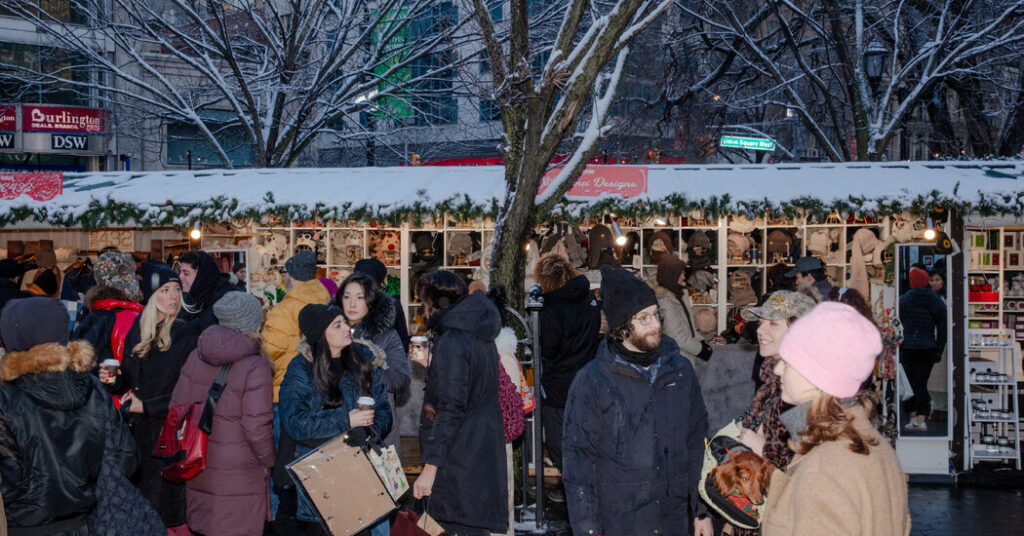
Hundreds of small-business owners have been hunkered down in aisles of cramped, often chilly stalls that have remade several Manhattan parks into festive markets.
With millions of visitors every year, New York’s largest seasonal markets — at Bryant Park, Columbus Circle, Union Square and the newest location, Herald Square — bring in a significant share of vendors’ yearly revenue.
But the hours are long and cold, and the upfront expenses substantial. Renting the stalls can cost tens of thousands of dollars, and breaking even, let alone turning a profit, is not guaranteed. And this year, vendors face many additional challenges, including rising costs from tariffs and inflation, as well as a decline in big-spending international tourists.
Here are some of the stories of these businesses.
True Ascend
The owners of True Ascend gained access to their stall two days before the Herald Square market opened in early December. Like everyone else’s, it was bare.
So they got to work. They painted the walls orange, installed a wood floor and hung lights and shelves. Then they displayed their jewelry — earrings, rings, necklaces and bracelets with charms, many with New York themes like pizza and yellow taxis.
The total expense was about $100,000, including for construction, booth rental and the cost of merchandise to stock the shop, said the owners, Diypse Duman, 29, and Bilana Uluengin, 21. The women, who are sisters, recently opened a store in Montclair, a suburb in New Jersey, and are veterans of street fairs and weekend markets but had done nothing at this scale, cost or length, they said.
Ms. Duman and Ms. Uluengin had 31 days to make their money back and, with some luck and online marketing, maybe more. If they broke $100,000 in sales, Urbanspace Markets — the operator of the Herald Square bazaar and Manhattan’s three other major holiday fairs — would collect a share of their revenue.
“Oh, I would love to pay them,” Ms. Duman said.
The Herald Square market is outside a major tourist attraction, Macy’s, and is the newest bazaar from Urbanspace, having opened in 2024.
On their first day, the sisters made about 20 sales, a decent start, but they, like many vendors, were hoping for a surge of shoppers in the days before Christmas.
With booths side by side, competition is tough, so the sisters brought in online influencers to promote their shop. They saw a pop in sales, with customers gravitating toward the charms. A bracelet with several charms costs about $60.
With just days before Christmas, the sisters were still not sure how their sales would turn out. But no matter the outcome, they said, the experience was worth it.
“We’re happy because we got our foot in the door for these New York City markets,” Ms. Duman said. “We learned a lot.”
Pigeon Be Pigeon
For Simon Hyun, a holiday booth is the closet thing he will ever have to a brick-and-mortar store. A lot of vendors are like him.
Mr. Hyun sells his art, which features what may be the unofficial bird of New York City: the pigeon. The animal is featured on pins, hand-drawn on notecards and painted Art Deco-style with bright acrylic colors on canvas, usually with the Manhattan skyline in the background. He calls his brand Pigeon Be Pigeon.
Outside the city’s holiday markets, Mr. Hyun shuffles between his art studio in the Bushwick neighborhood of Brooklyn and Manhattan, selling his work at fairs and parks and on street corners, sometimes running afoul of the police. It’s been his life for more than 15 years.
After losing his first job after college during the Great Recession — he worked in the mailroom of a student loan company — Mr. Hyun shifted careers entirely. At first, he sold T-shirts emblazoned with photographs of pigeons. Then he started making his own art.
“The thing about being in the city, you learn to adapt,” said Mr. Hyun, 40, who was born in the Bronx. “That’s one of the skills that all New Yorkers have — survival.”
He had his first holiday stall in 2017, at Columbus Circle, just inside Central Park. He was concerned about the upfront costs and whether he would make money. But he did and he immediately saved the funds for a down payment on a stall for the next year’s market.
Today, Mr. Hyun has two booths, one in Union Square and another in Bryant Park, the most coveted market among vendors because it attracts the most tourists. It is also open the longest and has the most expensive rental stalls.
At Bryant Park, his booth cost nearly $30,000. Large crowds have returned to the market this year, meandering through rows of vendors and around a large skating rink and Christmas tree. But the mix of people is different this holiday season, he said.
“We’ve always had this joke at the market that you’ll never go broke as long as the Australians are coming,” he said. “This year, there are very few Australians.”
Meow Cleeva
Urbanspace established the first market in New York City at Grand Central Terminal in the early 1990s before moving it to Union Square, where it has operated every holiday season for 32 years. The company imported the idea from London, which has had holiday fairs since the ’70s.
They were created as a response to chain stores, before the dawn of Amazon and same-day delivery, and as a way to support independent artists and retailers. Now, with four markets and hundreds of vendors in Manhattan, they have become their own behemoths, sometimes drawing complaints from nearby shop owners who say they hurt business.
To operate the markets at Columbus Circle and Union Square, Urbanspace pays the city’s Department of Parks & Recreation about $2.4 million a year in fees, plus a share of revenues, the city said.
“The markets are busier and stronger than ever,” said Eldon Scott, the president of Urbanspace, noting that attendance appears to be ahead of last year and “way up” from before the Covid-19 pandemic. “People still want to see and experience what’s going on in the city, meet the makers behind the products they’re buying and hear their stories.”
The interactions are what bring Martha Colón back every year. She had booths at Union Square and Bryant Park before settling on Columbus Circle. It’s the market with the shortest run time, and she prefers its slower pace and smaller crowds. Her booth cost $12,000.
In every encounter with a potential customer, Ms. Colón shares the story of her art. Using a pen and a paintbrush, she sketches a character of her own creation, Meow Cleeva, a sexy and svelte dog walker in New York City. Ms. Colón, 59, is working on a graphic novel based on the character.
The market is her only event of the year. What she makes isn’t substantial, but it’s enough to allow her to rent an artist’s studio in Midtown. “I don’t go on vacations,” she said, “I cannot hire somebody full time.”
On a good day, she makes about $2,000. Some merchants aren’t as fortunate, she said.
“A lot of the vendors didn’t come back this year,” Ms. Colón said, bemoaning that some new retailers were selling generic items like hats and scarves. “It’s more commercialized now.”
Parish Po’ Boys
Few U.S. cities are as well known for their cuisine as New Orleans, so Tony Lauricella understands why many orders at his food stand start with a suspicious question: “What parish are you from?”
“They always test me,” he said.
It happened again on a recent chilly afternoon at Union Square, this time with a woman who had ordered a cup of chicken and sausage gumbo. “I’m from the Seventh Ward,” she said, a neighborhood in New Orleans.
Mr. Lauricella grew up nearby, across the Mississippi River in Jefferson Parish, where he memorized the recipes for his grandmother’s gumbo, his mom’s red beans and rice and his dad’s seafood marinade. His stall is stacked with New Orleans staples like Zatarain’s spices and Tony Chachere’s seasoning.
Mr. Lauricella, 62, has made this food his whole life, but he never thought he would do it for a living. For decades, he worked for top creative agencies, traveling the world making commercials and advertisements for brands like Kmart and Tropicana. He was laid off a decade ago.
“I had to pivot,” he said.
He has been selling po’ boys and gumbo ever since, landing a recurring spot in 2015 in Smorgasburg, an open-air food market in New York. But the fair only operates during the warmer months, so Mr. Lauricella applied for one of the holiday markets last year for the first time.
This year, he borrowed about $28,000 from friends for a down payment on a booth at the Union Square market, which started in mid-November. By early December, he had made enough to repay them.
His sales were on track to generate about a third of his annual income, Mr. Lauricella said. Still, he hadn’t decided yet whether he would return next year.
“If I don’t move to California,” Mr. Lauricella said, laughing. “Every day, you’re on your feet, and every night, you smell like fried shrimp on the subway ride home.”
Drawings of New York
A week ahead of opening his booth at Herald Square, Bryan Cordova was nervous. A friend in the New York City vendor community had shared her experience selling clothes there in 2024. It had not gone well.
Mr. Cordova had already spent $33,000 to rent a large booth at a prime spot facing a Macy’s exit. Another $7,000 had gone toward filling the stall with flooring, shelving, lights and lots and lots of his sketches of New York City landmarks.
His concerns, he soon found out, were overblown. Mr. Cordova made $10,000 during the first weekend of the market, and he has been restocking the booth ever since. His drawings of Midtown have been his best sellers, followed by those of the Lower Manhattan skyline and the Dumbo neighborhood in Brooklyn. His smaller prints sell for $15 to $80.
Mr. Cordova, 27, studied to become an architect but quit a firm early in the pandemic after saving enough money to travel the world. Everywhere he went, he took out a pen, sketched his surroundings and marketed his prints, making his first sale in Barcelona, Spain, to a British man who took pity on him after a gust of wind sent his work flying. He made a few euros.
“It’s nothing different from what I did five years ago,” he said, standing inside his booth. “It’s still vending on the street. Just the presentation has changed, my confidence has changed.”
Matthew Haag is a Times reporter covering the New York City economy and the intersection of real estate and politics in the region.
The post N.Y.C. Holiday Markets Offer Profit and Peril for Small-Business Owners appeared first on New York Times.