On the sixth floor of the Pompidou Center, generations of art lovers have stood transfixed before paintings by Henri Matisse, Marc Chagall and Andy Warhol.
Walking down its corridors recently, I found only boxes, exposed pipes and the sound of my heels echoing off the barren walls.
A floor down, where rooms were recently dedicated to contemporary art, only one piece remained: Jean Pierre Raynaud’s “Container Zero” — an enormous shipping container lined with gleaming white tiles. But it was boxed up, the word “fragile” stamped on its side.
It felt like visiting your childhood home stripped of its furniture — intimately familiar yet deeply disorienting. How would Paris get through five years without this place?
The Pompidou, Paris’s cultural hub and host to the world’s second-largest collection of modern and contemporary art, has been closed for a 463 million euro renovation (roughly $540 million).
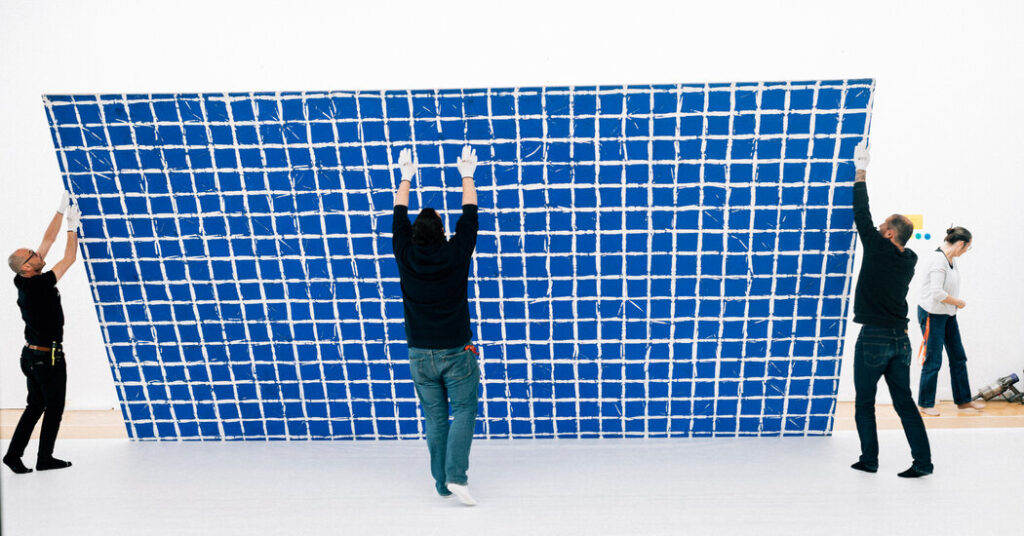
To prepare, almost all 120,000 of its works of art — including some so big they were hoisted out by a crane — have been carefully disassembled, repaired, packed into tailor-made boxes, tucked into unlabeled trucks and trundled away. I was among the last lucky people to glide up the center’s famous escalator — which looks like a hamster tube fixed to the center’s outside wall — and bid adieu to its view of Paris.
Though its postmodern design horrified traditionalists when it first opened in 1977, the Pompidou has since become one of the most loved art institutions not only in France, but also in the world. For Parisians, the center is the place to see modern and contemporary art and to go to the cinema, theater, concerts or to read. The building held the city’s largest public library.
In 2024, some 4.6 million people visited the Pompidou. While the nearby Louvre recently became a symbol of national embarrassment because of the ease with which burglars stole priceless jewels from its collection, the Pompidou occupies a less complicated place in French hearts.
“A chapter is closing — a chapter of the Pompidou Center and, in some ways, of my life too,” Valérie Millot, the deputy head of the Pompidou’s restoration department, told me one day last April while we watched a canvas — Simon Hantaï’s “Tabula” — being taken down and oh so carefully rolled up. “We experienced extraordinary things here.”
For the Pompidou’s president, Laurent Le Bon, the much-needed renovation is cause for celebration. The building’s antiquated heating systems will be replaced, asbestos removed and the lower floors redesigned. He sees the moment not as a closure, but as a “metamorphosis,” Mr. Le Bon said in an interview. Many works will be shown in the museum’s growing number of satellite sites in places like Seoul and Brussels. “People will finally understand that our activities aren’t just in this building,” Mr. Le Bon said.
The process of emptying the museum is one of the biggest in the history of France. The Louvre was emptied of 4,000 national treasures, including the “Mona Lisa,” just before World War II.
That took three days. The Pompidou’s move was slow and meticulously planned over years. And I had a front-row seat to watch it happen, piece by piece, over months.
Three weeks after the museum closed its permanent collection in March, I went to the fifth floor to find a crew of 10 people slowly pulling apart an artwork so complex that curators referred to a 300-page study to complete the process. The work — “Le Magasin de Ben,” or “Ben’s Store,” by Ben Vautier — looks like a life-size junk shop, roughly six yards deep and four yards wide, full of bric-a-brac.
The work began life as an actual store opened by Mr. Vautier in Nice that sold used records and books. He quickly transformed it into an experiential art piece, covering every visible surface in the shop with found items — buttons, funnels, dolls’ heads, gas masks. Handwritten messages to the visitors were scrunched around. “Every person who passes by this door becomes a living sculpture,” read one over the back door.
In the 1970s, Mr. Vautier dismantled the shop and reassembled it in the museum. When I arrived, workers were slowly extracting each piece and assessing what repairs it needed. Then, after being photographed, each item was delicately wrapped and installed in one of 17 boxes — enough to fill two and a half moving trucks.
“He made things out of nothing,” said Astrid Lorenzen, 63, the director of restoration, looking up from a plastic bag filled with lightbulbs. “Someone stuck some gum to the door frame. He transformed it into the nose of a face.”
“Salon Agam,” another vast walk-through artwork, proved even more difficult to pack up.
Created by the Israeli artist Yaacov Agam, “Salon Agam” doesn’t just fill an entire room: It is the room itself — a foyer once installed in France’s presidential palace.
The foyer was commissioned in the early 1970s by President Georges Pompidou, for whom the Pompidou Center was later named. Mr. Agam spent more than two years designing and installing it inside Mr. Pompidou’s private apartment within the Élysée Palace.
The room looks like a giant kaleidoscope. Mr. Agam transformed the walls into visual accordions, covering them with beveled and multicolored vertical panels, dotted with abstract patterns. Entering the room was meant to feel like walking into a painting that “changes with every step,” Mr. Agam recalled in an interview with Le Figaro.
The president died before Mr. Agam had finished, and the artwork was later moved to the center.
Decades later, museum workers planned to pack it up in three weeks. It took five, as staff custom-built 28 boxes to hold all the parts. Some were too big to fit in the freight elevator and had to be carried out by crane.
The experience of taking apart such an intricate artwork removed some of its mystery, said Pierre-Emmanuel Potey, the museum’s contemporary collection coordinator. But it also offered curators a new and richer understanding of the artist’s genius, Mr. Potey said.
“It allows us to have a more intimate relationship with the artwork,” Mr. Potey said. “Because we get that much closer to the artist.”
By December, most of the artwork in the museum had been hoisted away; a small handful was scheduled to leave in the coming weeks. Only one will remain: Mr. Raynaud’s “Container Zero.” When the artist sold this tiled shipping container to the museum in 1988, he signed a contract that allowed the artist to regularly curate it by putting personal items inside — and committed the museum to never remove it from the building.
“It’s like a person so in love, it can’t be separated,” Mr. Raynaud said in an interview from his Paris apartment.
At 86, Mr. Raynaud is not sure he will see the museum, or his container, reanimated. If he is alive, he said, he will arrive with a new item for the container. If not, he has left a panel of 20 white ceramic tiles with the museum. The contract states that this panel will be hung in his container after he dies, signaling the end of his curation.
“Its destiny,” he said, “is to die or be reborn with the center.”
Catherine Porter is an international reporter for The Times, covering France. She is based in Paris.
The post This Museum Housed 120,000 Works of Art. Now It’s Empty. appeared first on New York Times.