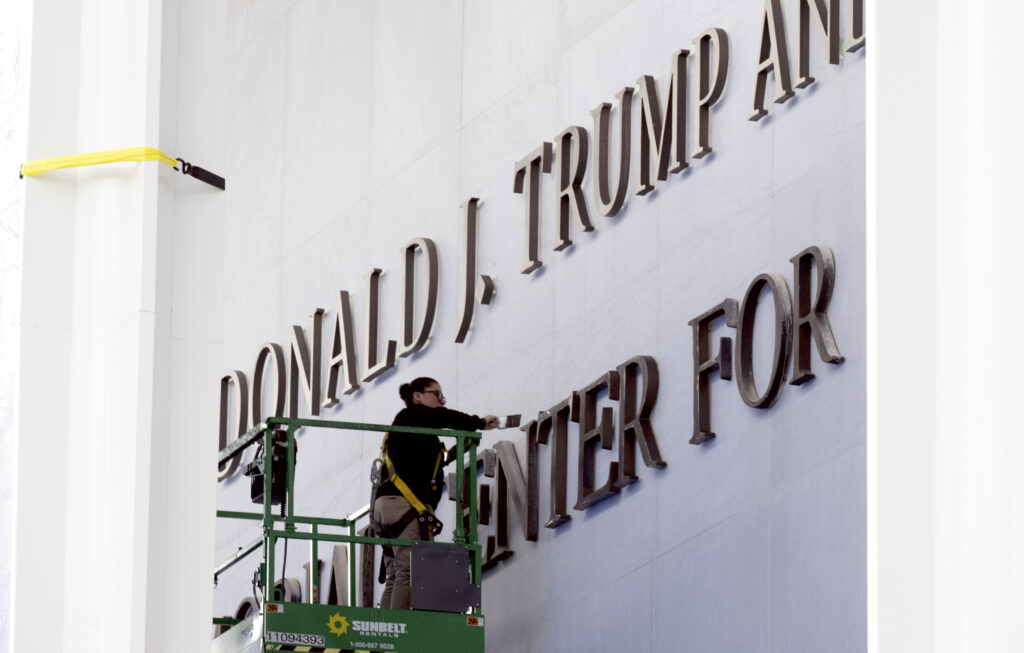
Less than a day after the Kennedy Center announced it was renaming itself after the president, construction workers had already updated signage at its iconic building overlooking the Potomac to read: “The Donald J. Trump and the John F. Kennedy Memorial Center for the Performing Arts.”
But across the internet, the name was largely unchanged.
On Ticketmaster and StubHub, where tickets are available to see the National Symphony Orchestra play Handel’s Messiah or the Monty Python musical “Spamalot,” the original name remained.
While the Kennedy Center’s X and Instagram pages had rolled out the Trump prefix, its Facebook account still bore the old name — albeit with a Trump Kennedy Center logo affixed. Google’s search engine returned results without the president’s name, except in news stories mentioning the change. AI chatbots, including Anthropic’s Claude, Google’s Gemini and OpenAI’s ChatGPT, listed the venue — which first opened in 1971 to honor the former president — as the Kennedy Center. Yelp, which told The Washington Post that it generally updates a business listing once its name changes on its website, switched to the new name Friday evening.
Meanwhile, some media outlets rejected the name change, even as they reported on it.
“At The Atlantic, the Department of Defense is the Department of Defense, the Kennedy Center is the Kennedy Center, and the Gulf of Mexico is the Gulf of Mexico,” said Jeffrey Goldberg, the publication’s editor in chief, referring to a suite of name changes from Trump this year.
Trump, whose name has adorned apartment buildings, office buildings and casinos for decades before his presidency, has been on a heated renaming spree in the first year of his second term.
In January, he issued an executive order renaming the Gulf of Mexico as the “Gulf of America” and changing the title of North America’s highest peak, Denali in Alaska, back to Mount McKinley, which was the formal name until the Obama administration changed it in 2015. In September, he rebranded the Defense Department as the “War Department,” though Congress never changed formally changed the name. “This name sharpens the Department’s focus on our own national interest and our adversaries’ focus on our willingness and availability to wage war to secure what is ours,” Trump’s executive order read, reviving a previous name abandoned after World War II.
Earlier this month, the State Department added Trump’s name to the Institute of Peace, an independent nonprofit group created by Congress, renaming it the “Donald Trump Institute of Peace.”
The rebrands have forced media outlets and other organizations that regularly reflect the names of important institutions to decide whether to adapt to a president’s preferred name or keep the known one.
“Words matter. What we call things matters,” said Jane Hall, an associate professor in the School of Communication at American University. “At the very least, this is an attempt to put the Trump brand [on the Kennedy Center], but I think it’s deeper than that. He is claiming equal status with John F. Kennedy as a patron of the arts, and to call it the Trump Institute of Peace again is to say that he is a peacemaker.”
The White House and the Kennedy Center did not respond to requests for comment. X, Meta, Anthropic, Google and OpenAI did not respond to requests for comment. (The Washington Post has a content partnership with OpenAI.)
The issue has resulted in some dust-ups. Trump barred Associated Press press journalists from some White House events after the organization, which runs the news industry-standard stylebook, said that it would not change how it referred to the Gulf of Mexico. It said it would update the Alaskan mountain’s name, since it lies solely within America’s borders, but the body of water borders multiple countries that had not all recognized the switch.
“The Gulf of Mexico has carried that name for more than 400 years,” Amanda Barrett, vice president of standards and inclusion, wrote at the time. “As a global news agency that disseminates news around the world, the AP must ensure that place names and geography are easily recognizable to all audiences.”
After the AP sued the Trump administration in federal court, it has been allowed back for many events, though litigation is still ongoing. The AP did not respond to multiple requests for comment, but its articles still refer to the Kennedy Center by its long-standing name.
Tom Rosenstiel, a former executive director of the American Press Institute, said that it is incumbent on journalists to give ample context to explain the organization’s official name along with what Trump is now calling it. “News organizations don’t need to take sides here or adopt anyone’s language,” said Rosenstiel, now a professor at the University of Maryland. “Describe the facts.”
Like the Atlantic, The Washington Post said no change is imminent. “We will continue to use the Kennedy Center pending further clarity from ongoing legal and policy developments, and we will adjust our terminology as appropriate,” a spokesperson wrote in a statement. The Post continues to use Defense Department, Institute of Peace, and Gulf of Mexico.
The decisions to change names aren’t solely up to news organizations. Across the internet, a tale of two names still reigns.
Wikipedia’s volunteer editor corps has publicly discussed whether to change the Kennedy Center’s name but has so far kept the old one. In a discussion forum for the page, editors broadly favored keeping “Kennedy Center” as the article’s title, citing the online encyclopedia’s policy to use “commonly recognizable names,” as only Congress can officially change the name. Wikipedia still titles an entry “United States Department of Defense,” but notes in the first line of its article that “Department of War” is an alternate name. It still has entries named “United States Institute of Peace” and “Gulf of Mexico.”
“It’s important to note that Wikipedia’s decision-making processes take time,” said a spokesperson for Wikimedia Foundation, which hosts the crowdsourced encyclopedia but isn’t involved in editorial decisions. “Volunteers discuss, debate, and often disagree until a shared consensus can be reached on what content to include on Wikipedia. This consensus can change as more reliable sources are published and reviewed.”
There has been more deference for recently renamed military bases. The Pentagon under Trump restored the names of Fort Bragg, formerly Fort Liberty, and Fort Benning, formerly Fort Moore, but said the names did not refer to Confederate generals, but other veterans with the last names Bragg and Benning, skirting a law that bars naming military installations after Confederate soldiers.
The extent of Trump’s litany of name changes is unprecedented, said Tom Hollihan, a professor of communication who studies media and politics at the University of Southern California.
No more so than where Trump has renamed institutions after himself or his allies have done that for him. “I expect that there will be a systematic undoing of most all of these changes when the Democrats return to control of the White House,” he said, calling the renamings without congressional approval “ludicrous actions.”
Russell Riley, professor and co-chair of the presidential oral history program at University of Virginia’s Miller Center, said it is hard to imagine any former presidents applying their own names to organizations.
“This is more a cultural than a political matter: For generations past, raw self-promotion was considered a sign of weak character and thus to be avoided,” Riley said. “It is beyond imaginable that Abraham Lincoln or Dwight D. Eisenhower or Ronald Reagan might have insisted during their terms that anybody demean their public service by glorifying it prematurely with some physical honorific.”
The post Trump’s renaming spree hits the Kennedy Center, but will it stick? appeared first on Washington Post.