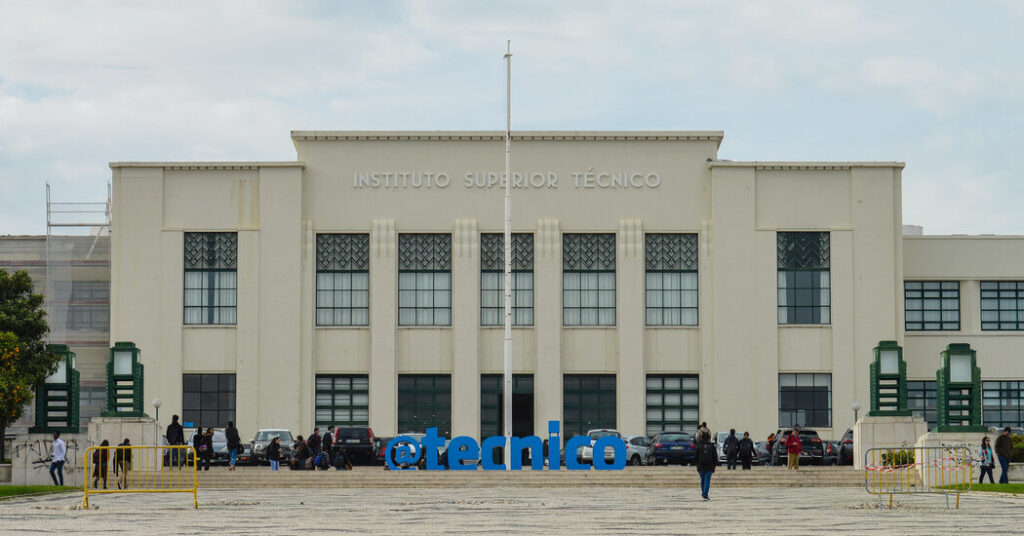
When Claudio Neves Valente, a standout physics student in Portugal, headed off to graduate school at Brown University more than 25 years ago, he seemed to have a promising career in science ahead. Soon after, though, he stopped taking classes. Then he cut off all contact with his family back home, a relative said.
In fact, he seemed to vanish.
His mother and father had not seen or heard from him until Friday, when they saw his image in news reports and learned that he was accused in the shooting of students in one of Brown’s science buildings and of a Massachusetts Institute of Technology professor he had once gone to school with in Portugal. Mr. Neves Valente also did not appear to leave a social media trail or any discernible evidence of what he had been doing, professionally or otherwise, in recent years.
“They are devastated,” Mirita Domingues, a relative of Mr. Neves Valente’s, told The New York Times. “His mother said this morning that she had always worried that the next time she would hear about him, he would be dead.”
The only child of a well-to-do family, Mr. Neves Valente, 48, attended private school before enrolling at a public high school in Torres Novas, a small railway town about 70 miles northeast of Lisbon, the Portuguese capital. He excelled in school, scoring top grades in every subject, according to the school’s principal.
Mr. Neves Valente had been a happy child, playful, smart and dedicated to his family, according to Ms. Domingues.
In 1995, he was accepted at the prestigious Instituto Superior Técnico to study physics, and he participated in the International Physics Olympiad in Australia, representing Portugal with four other young men. The professor who led the team recalled Mr. Neves Valente as the brightest of the group, though Portugal did not rank highly in the international competition.
José Morgado, Mr. Neves Valente’s high school physics teacher, said he had trouble squaring the image of the killer on the news with the quiet, brilliant boy he taught for three years in high school, whom he described as the best student he ever had.
“I never forgot him,” Mr. Morgado said. “I spoke of him often to my students.”
At the Instituto Superior Técnico, Mr. Neves Valente studied physics alongside his victim, the M.I.T. professor Nuno F.G. Loureiro, and graduated at the top of their class in 2000, according to the university. A spokesman for the institute, Portugal’s premier school for science and engineering, said by phone that Mr. Neves Valente and Dr. Loureiro had studied in the same class from 1995 until 2000. Mr. Neves Valente received the higher mark, the spokesman said.
But Mr. Neves Valente’s early academic success belied a troubled life as an adult. Not long after moving to the United States to enroll at Brown, he grew remote from his family, Ms. Domingues said.
Soon, she said, he disappeared entirely. The family heard nothing of him until he was identified as the suspect in the killings of Dr. Loureiro and the students at Brown, where Mr. Neves Valente had briefly studied.
Christina H. Paxson, Brown’s president, said that Mr. Neves Valente had been enrolled at the university for three semesters as a graduate student before he went on leave in 2001. He formally withdrew from the university in July 2003 and did not complete either a master’s degree or a doctorate.
Scott Watson, a physics professor at Syracuse University, described himself as Mr. Neves Valente’s only close friend when the two were classmates in the Brown physics graduate program. “He wanted to isolate himself,” Dr. Watson said on Friday.
Several other classmates said they did not remember him well, though they noted that students in the physics program spent the bulk of their time in the Barus and Holley building, where the campus shooting took place last weekend.
Dr. Watson recalled that Mr. Neves Valente was often unhappy and even angry, complaining that classes were too easy and that the food on Brown’s campus was subpar. The two friends enjoyed meals together at a local Portuguese restaurant.
Mr. Neves Valente could be “kind and gentle,” his former friend recalled — as well as brilliant. But the suspect could also be a bully, Dr. Watson said, going so far as to call a Brazilian classmate his “slave.”
“I had to break up a fight once,” Dr. Watson said.
Mr. Neves Valente appears to have posted to a Brown physics message board soon after he stopped attending classes in the spring of 2001, saying he was back in Portugal and leaving a contact email for classmates.
In the post, Mr. Neves Valente wrote in Portuguese: “The greatest liar is the one who is able to lie to themselves. These exist everywhere, but they sometimes proliferate in the most unexpected places.”
He had come to the United States in August 2000 on an F-1 visa, a type commonly issued to international students, according to an affidavit from a police detective in Providence, R.I., where Brown’s campus is. About 17 years later, the affidavit said, Mr. Neves Valente flew into Kennedy International Airport and was admitted to the United States as a legal permanent resident.
It is unclear whether he was in Portugal from 2001 through 2017, what he did over those years and where he worked once he returned to the United States.
His last known address was in a middle-class neighborhood north of Miami, according to the affidavit. But a man who identified himself as the longtime owner of the one-story yellow house at the address said on Friday that he had no knowledge of the suspect.
The Miami-Dade County Sheriff’s Office said deputies “responded to a location provided through a tip” to assist in the shooting investigation. “However, the search did not yield any results,” the office said in a statement on Friday.
Mr. Neves Valente flew into Providence in October, law enforcement officials said on Thursday. They believe he moved around New England between then and now.
At least two firearms were recovered inside the storage unit in Salem, N.H., where Mr. Neves Valente’s body was found on Thursday, according to a person briefed on the investigation who was not authorized to release the information. He died of a self-inflicted gunshot wound, the authorities said.
Dr. Loureiro, the M.I.T. professor who studied with Mr. Neves Valente in Portugal, was shot Monday night in his home in Brookline, Mass., and a day later, he was pronounced dead. After graduating from Instituto Superior Técnico, Dr. Loureiro remained at the school, as a researcher and then team leader at its Institute for Plasmas and Nuclear Fusion, before eventually joining M.I.T.
Mr. Neves Valente stayed only briefly as a teaching assistant before moving to the United States, according to the Diário da República, the Portuguese government’s official gazette.
It is unclear if their paths crossed again before Monday.
Reporting was contributed by David C. Adams from Miami; Alan Blinder from Atlanta; Tiago Carrasco from Lisbon; Patricia Fonseca from Torres Novas, Portugal; Ernesto Londoño from Minneapolis; Jenna Russell from Boston; and Maria Cramer and Stephanie Saul from New York. Daphné Anglès contributed research from Paris, and Georgia Gee and Kirsten Noyes from New York.
Azam Ahmed is international investigative correspondent for The Times. He has reported on Wall Street scandals, the War in Afghanistan and violence and corruption in Mexico, Central America and the Caribbean.
The post A Brilliant Student Who Vanished and Then Became a Wanted Man appeared first on New York Times.