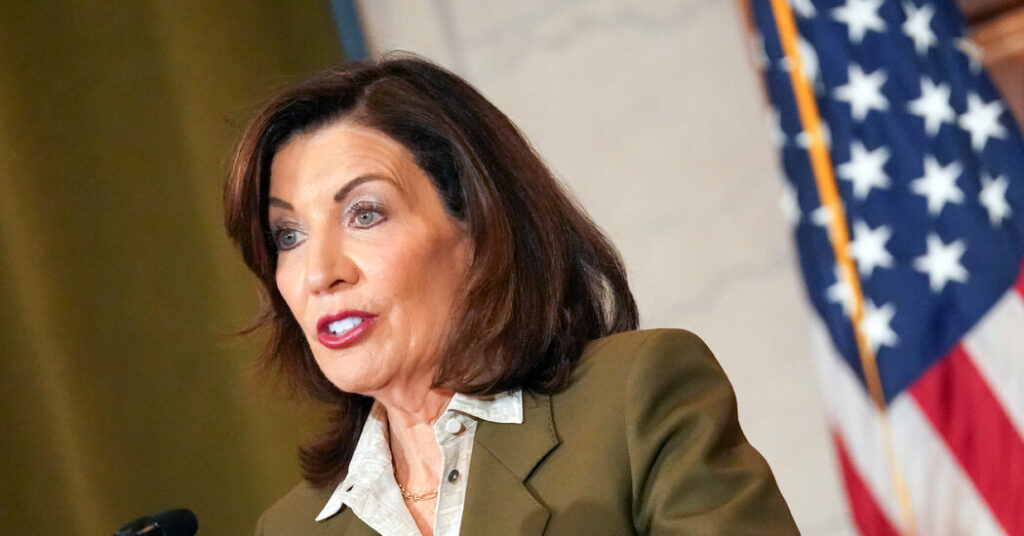
Gov. Kathy Hochul of New York on Friday repealed a rule that required utilities across the state to provide free natural-gas hookups to new customers, in a move that could lower energy bills for some residents.
The repeal of the provision, known as the 100 Foot Rule, halts the practice of requiring existing utility customers to subsidize new hookups within 100 feet of a gas-main connection, through charges on their utility bills. Now, new customers will have to pay for the service entirely themselves.
“It’s simply unfair, especially when so many people are struggling right now, to expect existing utility ratepayers to foot the bill for a gas hookup at a brand-new house that is not their own,” Ms. Hochul said in a statement. “I have made affordability a top priority and doing away with this 40-year-old subsidy that has outlived its purpose will help with that.”
The repeal applies only to residential buildings and will take effect in 12 months in New York, which joins other states like California and Massachusetts in removing similar charges on energy bills. Getting rid of the rule could result in nearly $600 million in savings on bills every year, according to a recent analysis by the Public Utility Law Project, a nonprofit.
Kenneth Gillingham, a professor of environmental and energy economics at Yale University, said the policy was a “nudge in the direction of the state’s climate goals,” and that it would “keep a lid on rates for existing customers.” But gas prices could rise for other reasons, he said, including extremely cold winters and increased demand from data centers.
Some climate activists and other supporters of Hochul’s move say repealing the requirement helps to push back on the expansion of gas infrastructure and encourages new utility customers to consider other options for heating their homes.
But critics say that striking the rule could stymie further residential development by raising costs for builders who will have to pay thousands of dollars upfront for their energy needs.
The decision is a significant victory for climate activists in a year when some critics have accused Ms. Hochul of sacrificing the state’s ambitious climate goals in response to soaring energy demands and a Trump administration that is bullish on fossil fuels.
“For decades, New York’s for-profit gas companies have made a fortune recklessly building pipelines and passing costs onto consumers,” said Jessica Azulay, the executive director of the Alliance for a Green Economy, a nonprofit.
However, Michael Colpoys, the president of the National Fuel Gas Distribution Corporation, said that shifting the expense of new gas lines onto new customers might discourage construction projects that include affordable housing. He added that limiting access to gas could be risky as energy demands increase. “Natural gas is critical for heating during extreme cold and supporting the electric grid during peak demand.”
Ms. Hochul, like other state leaders, is treading a thin line between appeasing voters and the Trump administration. She must follow the state’s ambitious 2019 climate law, which calls for eliminating emissions by 85 percent over the next quarter century, while salvaging any wind and solar projects she can under an administration that has been hostile to them. President Trump has described global warming as a “con job” and has gutted subsidies for residential solar energy and electric vehicles.
In response, Ms. Hochul has embraced what she calls an “all of the above” approach to energy, which includes gas and nuclear, to keep prices low and energy sources abundant.
This summer, she announced plans to build a nuclear power plant capable of producing enough electricity for as many as a million homes. By the fall, she had approved a new underwater gas pipeline near New York City, which had been rejected three times.
But Ms. Hochul, faced with possible energy shortages in the state as soon as next summer, has said that she must “govern in reality.” She has put certain decarbonization laws on hold, such as the All-Electric Buildings Act, which bans gas power in a wide swath of new construction.
The governor’s approach has frustrated climate experts who want to see less gas used, not more. But State Senator Liz Krueger, who has fought for the repeal for years, sees the decision as an encouraging step toward making energy more affordable and environmentally friendly.
“This is a massive win for New York’s gas customers, and for clean air and a livable climate,” she said. “But there is much more that New York can and must do.”
Hilary Howard is a Times reporter covering how the New York City region is adapting to climate change and other environmental challenges.
The post Hochul Repeals Rule Allowing New Customers Free Gas Hookups appeared first on New York Times.