As police searched this week for the gunman responsible for a shooting rampage at Brown University, the Trump administration and its allies seized on the violence to cast the school as incompetent and ideologically hostile to conservatives — amplifying unfounded theories that a Palestinian student was responsible for the bloodshed and targeted a young Republican.
Their commentary added fuel to President Donald Trump’s campaign to dismantle diversity, equity and inclusion initiatives on campuses, and to root out alleged antisemitism and anti-conservative bias from the nation’s colleges and universities. But that narrative collapsed late Thursday night, when police found the suspect dead in a storage unit in New Hampshire, and investigators said he is not believed to have specifically targeted any of the Brown victims during his attack.
Investigators said they had no definitive sense of the suspect’s motive and indicated that the gunman specifically targeted an MIT professor in the Boston suburbs days later, whom he had known from his studies in Portugal.
“In the aftermath of the shooting, we have seen harmful doxing activity directed toward several students, faculty and staff, and multiple offices have been committed to providing support, while we also have worked aggressively to combat disinformation in online media and activity that has gone as far as to threaten individuals in our community,” Brown President Christina Paxson said in a statement Friday. “The safety of our community is and continues to be our top priority.”
The alleged gunman, 48-year-old Claudio Manuel Neves Valente, was a physics graduate student at Brown more than two decades ago. He previously studied in Portugal alongside MIT professor Nuno Loureiro, whom police believe he killed Monday evening, two days after he allegedly opened fire at Brown.
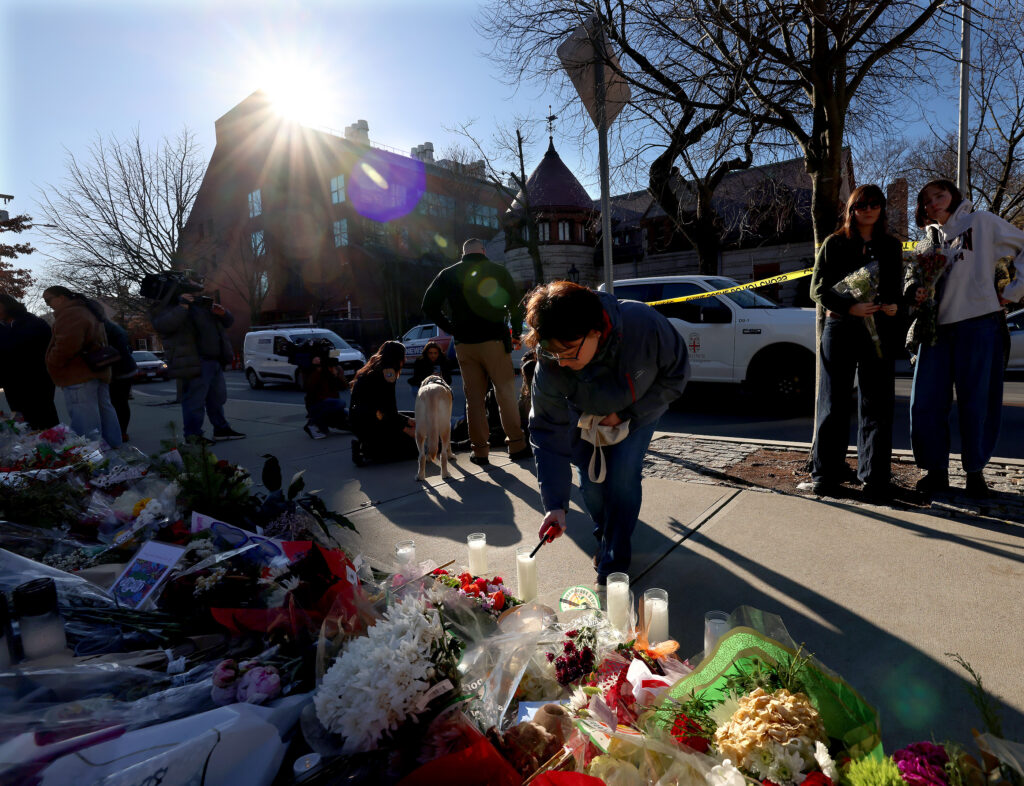
Most high-profile shooting suspects in the United States are killed or captured shortly after the attacks. While police searched for Valente, Providence, Rhode Island, remained on edge, bracing for more violence as it reeled from the shooting that killed two students and injured nine others studying for an economics exam.
Ella Cook, a sophomore, studied math and French; Mukhammad Aziz Umurzokov, a freshman, hoped to become a brain surgeon.
In the absence of a suspect and in a climate of fear, theories of the case snowballed online about who and what was responsible for the violence. Multiple Republican officials suggested without evidence that the gunman had targeted Cook, of Alabama, who was the vice president of the college Republican Club and one of relatively few conservatives on the mostly liberal campus.
“She was a Republican leader in the Republican Party at Brown University,” Sen. Tommy Tuberville (R-Alabama) said Tuesday during an appearance on conservative influencer Benny Johnson’s podcast. “You can’t tell me she wasn’t targeted. I would hate to miss that opportunity to say that because the consequences here are very, very fishy. But at the end of the day … nobody really pays a price for this.”
A House Republican whose aggressive questioning of university leaders in 2023 contributed to the resignation of two Ivy League presidents said the leader of Brown should be called to testify before Congress.
“It seems very clear to me that the president of @BrownUniversity will need to be hauled in front of Congress for a hearing under oath,” Rep. Elise Stefanik (R-New York) wrote on X.
And a top Justice Department official and members of Congress appeared to fan the flames of a theory circulating in right-wing social media circles that a Palestinian student was the gunman and had shouted “Allahu akbar” before opening fire. The baseless allegations spread so widely that university officials removed mentions of that student from the school’s website in an effort to protect him from online attacks, school officials said in a statement Tuesday.
Mustapha Kharbouch, the student, is a junior at Brown studying international and public affairs, and sociocultural anthropology. His legal team said law enforcement had asked them about his whereabouts on the day of the shooting before the suspected shooter was identified and found. The legal team said Brown took down references to Kharbouch as “a standard precautionary measure, to ensure the personal safety of any individual who has been doxxed.”
“Suss,” Harmeet K. Dhillon, head of the Justice Department’s civil rights division, said of those deletions in a social media post.
“I find it very suspicious that information has been removed from Brown University’s website following the tragic shooting,” Rep. Anna Paulina Luna, a Republican from Florida, wrote on X.
“The past few days have been an unimaginable nightmare,” Kharbouch said in a statement. “I woke up on Tuesday morning to unfounded, vile, Islamophobic, and anti-Palestinian accusations being directed toward me online.”
“I refuse to be silenced by anyone who comes after me for my identity and advocacy for Palestinians — a people I happen to owe my entire existence to,” said Kharbouch, who has engaged in student-led advocacy for Palestinians, including occasionally attending pro-Palestinian protests.
Neither Dhillon nor the Justice Department responded to requests for comment to explain her remarks. The division she leads was not directly involved in the manhunt, but Dhillon’s office was part of a Trump administration investigation into alleged antisemitism at Brown earlier this year.
The White House struck a deal with the university in July as part of a wide-reaching effort to stamp out DEI from academic institutions it views as hotbeds of liberal ideology and corrosive to American culture.
Brown’s agreement was not as restrictive as some of the deals the Trump administration reached with other schools, and it avoided a large payment to the federal government. As part of the agreement to resolve three federal investigations of compliance with nondiscrimination laws and restore federal research funding, the university agreed to spend $50 million over the next decade to workforce development organizations in Rhode Island.
The Trump administration said little about the Ivy League university after reaching a compromise in July, but the shooting appeared to reignite interest in Brown’s compliance with the agreement. On Wednesday, Laura Loomer, a Trump ally, said on social media that administration officials were telling her Brown had potentially violated the terms of the deal.
“The White House signed a very strong deal with Brown and we plan to vigorously enforce it,” a White House official said in response to Loomer’s claim.
Brian Clark, a spokesman for Brown, said Wednesday that the school is complying with the terms of the deal.
Trump, too, grew more critical of Brown as days passed without an arrest. After initially offering condolences to the victims and describing Brown as “one of the greatest schools anywhere in the world,” he told reporters on Monday that identifying the shooter had been so difficult because “this was a school problem.”
On Wednesday, he wrote on Truth Social, “Why did Brown University have so few Security Cameras? There can be no excuse for that. In the modern age, it just doesn’t get worse!!!”
That evening, Fox News host Jesse Watters characterized Brown on his show as “the most liberal Ivy League school,” and criticized Providence, where the school is located.
“They take DEI more seriously than safety,” he said. “It’s not just Brown, the whole city is a DEI mess.”
After authorities on Thursday identified the suspect, Loomer continued to name a Palestinian student and claim Brown’s moves to erase his profile was proof that the school had violated its agreement with the White House.
Meanwhile, Trump administration officials moved quickly to their immigration agenda, focusing in public statements on the alleged gunman’s background as a Portuguese national living legally in the country since 2017.
Hours after Valente died by suicide, Trump directed U.S. Citizenship and Immigration Services to suspend the green-card lottery program that had granted him legal status. The program allows about 50,000 people a year from low-immigration countries to apply to come to the United States.
The State Department signaled changes to the visa program’s entry process in November, suggesting the shift was in motion before the recent violence.
“This heinous individual should never have been allowed in our country,” Homeland Security Secretary Kristi L. Noem said in a statement on social media.
A department spokesperson did not respond to questions about why Noem believed that Valente, who authorities said Thursday appears to have no prior criminal record, should have been denied admission to the United States.
Under the timeline provided by authorities, his green card was approved during Trump’s first term.
Todd Wallack, Maria Paul and Maria Sacchetti contributed to this report.
The post Trump allies amplified unfounded online theories in wake of Brown shooting appeared first on Washington Post.