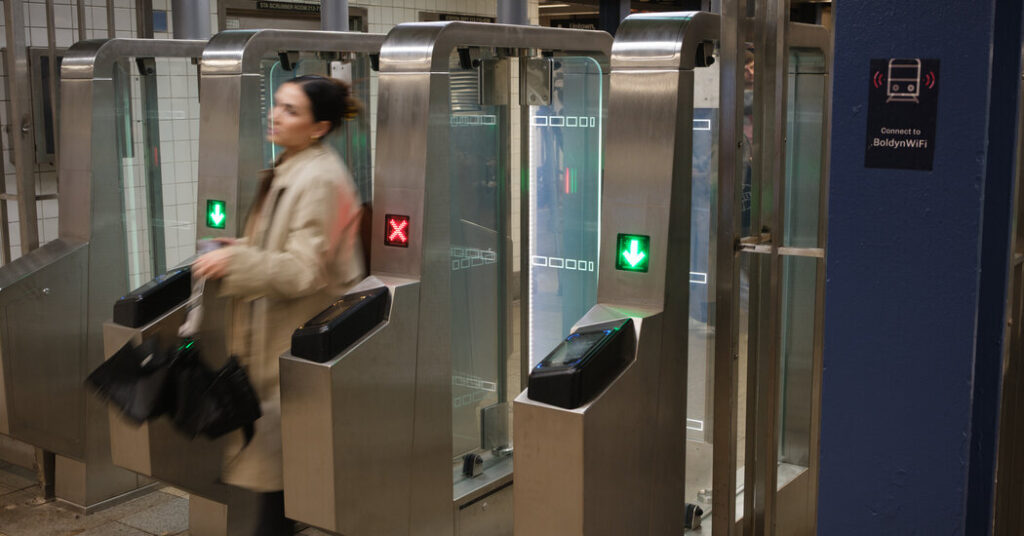
In a damp corridor of the Broadway-Lafayette Street subway station in Lower Manhattan, commuters stared quizzically at the gleaming, whooshing, glass-and-metal doors in front of them.
“What is that?” one rider said, adding a vulgarity for emphasis.
On Friday morning, the Metropolitan Transportation Authority presented one of its boldest answers yet to the stubborn problem of subway-fare evasion: 21st century fare gates.
The high-tech entries with saloon-style glass doors are part of a pilot program to be conducted in 20 stations in 2026, as transit leaders consider which company, or companies, will provide the new gates.
Over the next five years, the authority, which operates New York City’s subway, will spend more than $1.1 billion to install this type of fare gate at 150 stations, about a third of the system.
The goal is to take a bigger bite out of the M.T.A.’s $1 billion a year fare-evasion problem, after years of retrofitting and reworking the system’s decades-old turnstiles. By replacing those turnstiles with unobstructed entryways, the new gates are also expected to make going in and out easier for people with disabilities, as well as for riders with strollers, suitcases or the occasional futon.
“This is a look into the future,” Quemuel Arroyo, the authority’s chief accessibility officer said at a news conference at the station.
In the next few days, the three companies vying for a fare-gate contract will unveil their versions at stations that include Atlantic Avenue-Barclays Center in Brooklyn, 42nd Street-Port Authority in Manhattan and Third Avenue-138th Street in the Bronx. The companies are paying for the equipment used in the pilot program and its installation, said Jamie Torres-Springer, the president of the authority’s construction a development division.
Between them, the companies — Cubic, Conduent and STraffic — have produced similar gates for transit systems in Paris, London and Los Angeles.
Mr. Torres-Springer acknowledged that New York’s system is different. The city’s subway is the biggest and most complex in the United States, carrying more than four million riders a day. That, he said, meant paying close attention to safety and security measures.
The Conduent model on display on Friday has multiple sensors that detect when someone who has not paid ekes their way through — and blasts a loud siren when that happens. Artificial intelligence technology will also be used to analyze where and how riders avoid paying the fare, allowing transit officials to adust accordingly, Mr. Torres-Springer said.
The new models vary, but the Conduent gates have glass paddle-doors that are about 66 inches tall. That is roughly twice as tall as the current turnstiles, which date to the 1990s.
Riders seeing the fare gates for the first time expressed bemusement and skepticism.
Nelson Auguste, who works in security, offered a matter-of-fact assessment.
“It looks secure,” he said, while adding that he thought the M.T.A. should focus on improving service.
Maria Bianchi, who works for a nonprofit organization, said she appreciated how much easier the barriers would be to go through with a stroller. And the sirens, taller doors, narrower gap from the station floor should help reduce fare evasion.
“With this gate, someone really has to want it,” Ms. Bianchi said of would-be turnstile jumpers.
It did not take long for someone to try.
As the news conference was being set up, a man approached the swinging glass doors at one gates and then pushed through the gap.
“It don’t work!” the man yelled.
There were other issues as well.
As a line of riders left through one of the gates, the glass doors swung closed on a young woman’s neck, trapping her for several seconds before the police stepped in to help.
The woman, who declined to comment because she was rushing to work, was visibly upset.
Contacted for comment, a Conduent spokesman said: “The gates are currently configured to how our client has requested.”
Mitch Schwartz, an authority spokesman, said the M.T.A. would be monitoring the equipment closely.
“It’s the first morning of the first day of the pilot and this is the sort of thing we’re keeping an eye on,” he said.
Mr. Torres-Springer said that the authority would select one or more model for broader installation next year. In the meantime, the M.T.A. continues to fortify existing turnstiles at many stations.
Every station could soon be equipped with “sleeves,” 4-inch hurdles above the turnstile arms, and “fins,” the pointy metal partitions between gates that are already in place at over 300 of the system’s 472 stations.
About 190 stations also have devices on emergency doors that delay exiting for 15 seconds, to reduce the time that the doors are open to fare evaders. A patrol of about 1,000 unarmed guards have been deployed at stations to deter fare beating, but the M.T.A. hopes to rely less on them as new gates and other modifications are introduced.
The efforts appear to be having an effect. The Citizens Budget Commission, a fiscal watchdog group, projects that the authority will lose about $100 million less to fare evasion in 2025, which would be the first such decrease in five years.
Stefanos Chen is a Times reporter covering New York City’s transit system.
The post Bumpy Rollout for New Gates Meant to Stop Subway Fare Evasion appeared first on New York Times.