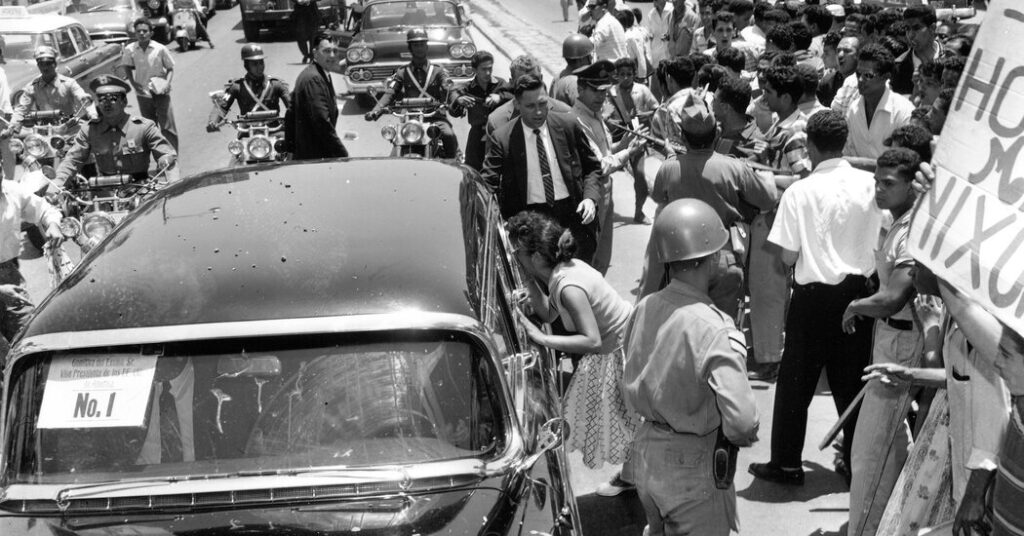
Vice President Richard M. Nixon feared for his life. A mob, angry that the United States had granted asylum to a just-deposed and brutal Venezuelan dictator, had ambushed his motorcade in the capital city of Caracas, shouting “Death to Nixon!”
People attacked the gridlocked vehicles with fists, rocks, pipes and so much spit that Mr. Nixon’s driver turned on his windshield wipers. “For an instant, the realization passed through my mind — we might be killed,” Mr. Nixon later wrote.
After several terrifying minutes the cars managed to speed away, and the vice president carried on with his visit. But back in Washington, the White House was taking no chances: An aircraft carrier task force was soon steaming toward Venezuela in case Mr. Nixon needed to be rescued.
That proved unnecessary. Mr. Nixon departed Venezuela the next day without incident. (Horrified by the riot, Venezuelan officials pleaded with Mr. Nixon not to cut his trip short and deployed troops to secure his departure route.) And while the May 1958 crisis in Caracas sullied Mr. Nixon’s good-will tour of Latin America, it had a strangely positive effect on U.S. relations with Venezuela.
Venezuela was beginning a transition to democracy. Blaming the ambush on communist agitators and the fledgling government’s weakness, Mr. Nixon called the episode “a much-needed shock treatment which jolted us out of dangerous complacency” and focused Washington’s attention on the country.
Thus began an alliance between the United States and Venezuela that would last for four decades, until dramatic political change in Caracas brought it to a screeching halt roughly 25 years ago.
Now, with President Trump massing military forces in the region and threatening to attack Venezuela if its leftist strongman, Nicolás Maduro, does not relinquish power, the onetime friends may be at the brink of all-out war, bringing the relationship full cycle.
“There was a tremendous alignment” between the United States and Venezuela during the 20th century, said Brian Fonseca, an adjunct professor at Florida International University and an expert on Venezuela. That relationship, Mr. Fonseca said, was rooted in America’s Cold War competition with the Soviet Union — and Venezuela’s vast oil reserves.
As Venezuela’s new government found its footing, it quickly emerged as an ideal U.S. partner: stable, democratic and awash in oil. It was also staunchly anti-communist, which was especially appealing in the years following the 1959 triumph of Fidel Castro’s revolution in Cuba.
By 1963, President John F. Kennedy — fresh from confrontation with Havana in the Cuban Missile Crisis — would host a state dinner for Venezuela’s president, Rómulo Betancourt, whom he called “America’s best friend” in South America.
Washington was soon selling arms to Caracas while American energy companies extracted Venezuelan oil. The two were sometimes linked: As President Nixon considered selling F-4 Phantom II jets to the country in 1971, a White House aide warned him that the decision could affect legislation in Venezuela’s Congress that “may adversely affect U.S. oil interests.”
Mr. Nixon wound up selling Venezuela an even more advanced plane, but U.S. oil interests suffered regardless when Caracas nationalized its oil industry a few years later. Still, the U.S. reaction was muted. Venezuela was one among many developing nations to nationalize their resources around that time, and Caracas paid U.S. oil companies more than $1 billion in compensation.
It was also in America’s interest to have good relations with a key member of the OPEC oil cartel like Venezuela.
And there were still the Soviets to worry about. President Ronald Reagan publicly hailed Caracas as a democratic “inspiration to the hemisphere” at a time when he was battling communist movements in the region — a cause that Venezuela’s government supported in El Salvador especially.
Trump Administration: Live Updates
Updated
- U.S. attacks another boat believed to be trafficking drugs, killing 5.
- The Justice Department will not meet the Friday deadline to release all its Epstein files.
- Trump signs a law repealing tough sanctions on Syria.
Mr. Reagan rewarded the backing with the 1981 sale of 24 F-16 fighter jets to Venezuela, for the equivalent of about $1.75 billion in 2025 dollars. It was the most significant U.S. arms sale to the region in more than a decade.
American rhetoric about Venezuela’s model democracy often glossed over the country’s many political and economic flaws, Mr. Fonseca noted, in the name of strategic interests. “The Americans were far less concerned about things like corruption and human rights and far more about political affinity.”
America’s interest drifted from Latin America after the fall of the Soviet Union. Venezuela remained a crucial oil supplier, having quietly allowed private companies, including large American ones, to sign lucrative operating agreements and profit-sharing deals. By the late 1990s, Venezuela had surpassed Saudi Arabia as America’s top oil provider.
But few in Washington were closely attuned to the rise of a leftist revolutionary named Hugo Chávez, who won Venezuela’s December 1998 presidential election. A firebrand who emulated Castro, Mr. Chávez harnessed popular anger over rampant corruption and poverty, which persisted despite the country’s massive oil resources, and promised major constitutional and economic reforms.
The United States reacted cautiously at first, hoping that Mr. Chávez would mellow once in office. President Bill Clinton even hosted him at the White House in early 1999, where Mr. Chávez assured officials that he wanted to maintain good relations and signaled that he did not have radical plans.
An April 2002 attempt to overthrow Mr. Chávez changed everything for good. As the Venezuelan leader pressed his leftist agenda, an alliance of politicians, generals and business leaders had him arrested amid mass street protests against his rule.
But the coup failed after even larger crowds gathered to demand Mr. Chávez’s return, and he was reinstated within two days. He returned with a vengeance, cracking down on political rivals and morphing his model democracy into an authoritarian state.
Mr. Chávez turned his ire against the United States, accusing President George W. Bush’s administration of trying to overthrow him. White House officials denied the charge, but documents declassified in 2004 revealed that U.S. officials had been aware of the plot in advance. (The documents also showed that the Americans warned opposition leaders against removing Mr. Chávez by unconstitutional means.)
From there on, Mr. Bush would prove a highly useful foil for Mr. Chávez — especially as Mr. Bush angered much of the world with his 2003 invasion of Iraq and ruthless pursuit of terrorists. Mr. Chávez attacked the American president with relish, including during his infamous 2006 address at the United Nations General Assembly, delivered from the same lectern at which Mr. Bush had spoken a day before.
“The devil came here yesterday, and it smells of sulfur still today,” Mr. Chávez told the assembled delegates.
The next year, Mr. Chávez’s government reasserted state control over Venezuela’s oil industry, rolling back the country’s previous steps toward privatization and forcing foreign companies to accept minority stakes in new joint ventures dominated by the state oil firm. When the U.S. oil giants Exxon Mobil and ConocoPhillips refused, Mr. Chávez seized their assets.
Mr. Chávez’s moves were politically popular at home, helping to entrench his power. After his death in March 2013, his protégé, Mr. Maduro, continued his policies, setting the stage for years of mounting isolation and punishment by the United States.
In response, Venezuela has grown increasingly reliant on some of America’s chief rivals, including Russia and China, as well as Cuba.
Tension is now peaking under Mr. Trump, who says that Venezuela’s role in migration and drug smuggling into the United States has made it a national security threat, one that justifies the use of military force. Some of Mr. Trump’s key advisers, including Secretary of State Marco Rubio, are pushing for Mr. Maduro’s removal as a means of adding to pressure on the communist government of Cuba.
Earlier this year, Mr. Trump deployed an aircraft carrier into Caribbean waters near Venezuela, positioning it for a possible military attack. The move came roughly 50 years after President Dwight D. Eisenhower did the same, for the potential mission to rescue Mr. Nixon that proved unnecessary. The big question now is whether the outcome will be so uneventful this time.
Michael Crowley covers the State Department and U.S. foreign policy for The Times. He has reported from nearly three dozen countries and often travels with the secretary of state.
The post Spit and Sulfur: How Venezuela Went From U.S. Ally to Trump Target appeared first on New York Times.