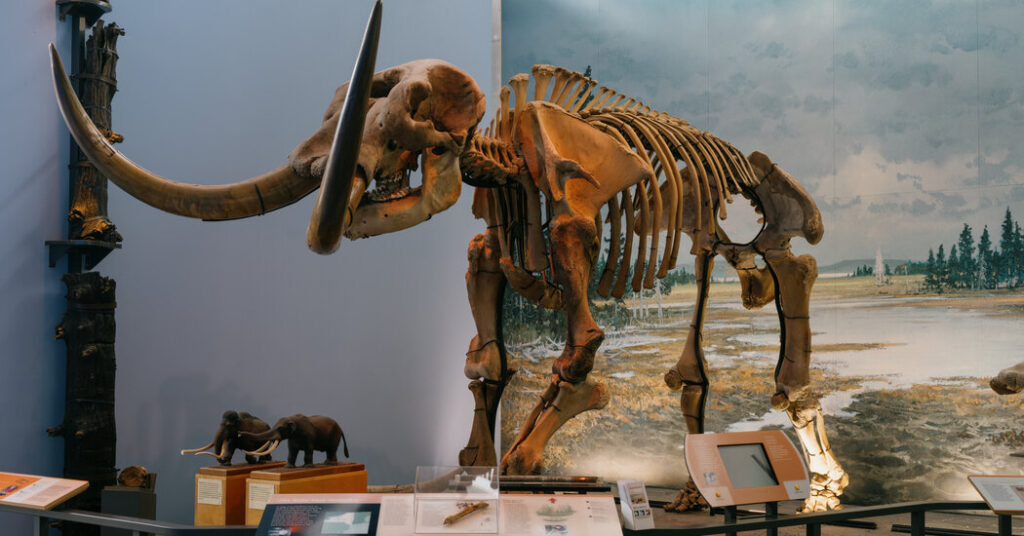
At the Museum of the Earth in Ithaca, N.Y., visitors wander through extinct ecosystems that start at the dawn of complex life on Earth and then run to the steppes of ice age mastodons.
But the museum now faces a battle for its survival as a financial crisis threatens to permanently shutter it. The Paleontological Research Institution, a hub for paleontologists all over the world that established the museum in 2003, is also at risk.
Since it was formed nearly a century ago, the institution has amassed more than seven million fossils, one of the largest troves in North America. The collection will be broken up and scattered to new owners if P.R.I. cannot cover its debts.
“No one has ever experienced trying to rehouse a collection like this,” said Warren Allmon, the director of the institution and a professor of paleontology at Cornell University. “If we had to close, there would be no one institution that could take all the collection.”
For decades, the museum has relied on a single, anonymous donor who provided $20 million, and pledged $30 million in the future, to pay its mortgage and establish an endowment. But in 2022, the promised payments dried up as the benefactor experienced financial struggles.
In response to the sudden shortfall, the institution halved its budget and staff in 2024. Later that year, fearing imminent closure, Dr. Allmon publicized the institution’s woes. The news inspired an avalanche of donations, including a $1 million gift from an unnamed Cornell alum.
“That changed our whole perspective on what was possible,” Dr. Allmon said. “We were literally staring at closing the entire institution in January of 2025 had that not happened.”
Seizing the momentum, the institution started a fund-raising campaign to pay down its mortgage, which had been sold to debt collectors, by the end of this year. With weeks to go, the appeal remains about $400,000 short of its $4 million goal. The funds would stave off foreclosure on the museum’s building and enable the institution to continue its scientific and educational outreach activities for the near future, albeit with its new shoestring budget and staff.
“Our future is not guaranteed, but we’re working really hard to provide the value and the resources that we think are most important,” said Robert Ross, the institution’s associate director for outreach.
Even if the museum perseveres, the financial struggles it faces are a hint of the precarious position of many public scientific and cultural institutions around the United States.
“Museums are being forced to cancel programs and defer critical repairs,” said Natanya Khashan, a spokesperson for the American Alliance of Museums, a nonprofit member association that advocates on behalf of museums. “Meanwhile they’re continuing to serve their community’s needs and preserve our cultural heritage.”
The Paleontological Research Institution was established in 1932 by Gilbert Harris, an invertebrate paleontologist who worked for decades at Cornell. After several spats with Cornell over his fossil collection, he left the university and formed the institution as an independent hot spot for paleontologists worldwide.
In addition to his collection, Dr. Harris had the institution take over publication of the Bulletins of American Paleontology, the oldest continuous paleontological periodical in the Western Hemisphere, which he started in 1895. Dr. Harris was also an advocate and mentor to many female paleontologists at a time when women had few opportunities in the field.
One of his protégées, Katherine Palmer, succeeded him as director in 1952. She moved the institution from Cornell’s shadow across Cayuga Lake to a converted former orphanage on Ithaca’s West Hill, where the Museum of the Earth remains. Dr. Palmer, the first woman ever to win the prestigious Paleontological Society Medal, spent decades welcoming the public and researchers alike to the institution’s evolving collection.
“This was one of the first institutions to actually believe in the importance of diversifying paleontology,” said Rowan Lockwood, a professor of geology at William & Mary in Virginia and president of the Paleontological Society. “The thought of losing that history, and losing these incredible collections, is pretty horrifying.”
By the time Dr. Allmon took the reins at the institution in 1992, the collection was known internationally for its wealth of invertebrates from the Cenozoic Era, and assemblages from the Devonian Period in New York, which offer a glimpse of the state when it was under shallow seas some 400 million years ago.
The institution’s Brett and Baird collection, a vast Devonian record gathered over more than 40 years by the paleontologists Gordon Baird and Carlton Brett, inspired the influential hypothesis of coordinated stasis, which states that the fossil record has a recurring pattern in which ecosystems remain stable for long periods of time, and then are shaken up by abrupt change.
During his tenure, Dr. Allmon has re-established ties with Cornell and expanded P.R.I.’s collection, particularly with the addition of rare Antarctic fossils. Now, it may all be on the verge of dispersal.
Though the staff members at the Paleontological Research Institution hope to weather the current storm, they are making contingency plans for the collection in the event of closure. Gregory Dietl, the curator of Cenozoic invertebrates, said that the fossils would be accounted for but noted that dividing them among new owners, or shelving them in storage indefinitely, would exact a great cost to researchers.
“Some of this material won’t be available, probably, to the research community for years,” he said, adding, “That’s where it’s really a lost opportunity in many cases that I worry about.”
When a collection is separated from its curator, he warned, “you lose that knowledge as well — the decades of curation that we’ve done in trying to make this collection accessible to the communities that we serve.”
Many of the specimens came from fossil beds that are no longer available to paleontologists because they have been paved over and developed.
“What they have amassed is a collection that you could never collect today,” Dr. Lockwood said.
Dr. Allmon’s signature effort was creating the Museum of the Earth, an 18,000-square-foot building designed to share the institution’s holdings and heritage with the public. It is home to the Hyde Park Mastodon, a nearly complete skeleton found in the Hudson Valley, as well as the bony remains of a North Atlantic right whale, which is suspended over an atrium that features new exhibitions.
The museum welcomes about 30,000 visitors a year and manages online resources. The Paleontological Research Institution also runs public outreach and educational programs, including events in the museum, fossil digs, professional development for teachers, online content and webinars, and partnerships with local communities, including the Seneca Nation.
Carlie Pietsch, an associate professor of paleontology at San Jose State University, first heard of the museum as a college freshman. After interning and working at the institution as a Cornell undergraduate, Dr. Pietsch returned to collaborate on projects as a postdoctoral researcher.
“I would not be a paleontologist without P.R.I.,” she said.
After years of uncertainty, the institution is now in the final throes of its campaign. If successful, it will be able to continue operating into 2026, and beyond. But its staff is cleareyed about the inevitable future headwinds, including further cuts to federal funding for museums and other scientific institutions.
Ms. Khashan, of the American Alliance of Museums, said institutions would need more than just donations to weather changes on the horizon.
“The most powerful thing you can do is contact your elected officials with your personal story about why your local museum matters,” she said.
Alex Howard, 14, of Horseheads, N.Y., helped raise $2,400 for the institution at a recent event, along with a donation from his family. Alex, who wants to become a paleontologist, has been a fan of the museum since his first visit a few years ago, and has volunteered there for the past year.
“I have just always been so interested in paleontology, and it gave me a place to go and learn about it,” he said. “I used to only focus on dinosaurs, and now I know about trilobites and the Devonian, which got me interested in New York State fossils.”
“Almost every kid has a dream of loving dinosaurs when they’re little, but this museum starts making that into careers,” Alex added.
The post An Engine of Fossil Discovery Fights Its Own Extinction appeared first on New York Times.