Responding to a deadly terrorist attack, the authorities in the Australian state of New South Wales promised on Friday to introduce a law that would give officials enormous powers to restrict speech and assembly.
Chris Minns, the state’s premier, said the attack, which killed 15 people at a Hanukkah celebration at Bondi Beach in Sydney on Sunday, had created a “combustible” situation and a need for greater control. The law would allow the authorities to ban protests for up to three months during periods of high tension and emotions.
The proposed law joins a series of restrictions that have been floated at the federal and state levels in recent days: to further tighten gun laws, to crack down harder on hate speech, to adopt new measures against antisemitism and to expand deportation as a tool of punishment.
Since the mass shooting, Australian institutions have moved rapidly to prioritize such preventive measures. Legal scholars say the moves are prompting a debate about whether the actions go too far in curtailing democratic rights — and whether new laws are what Australia actually needs to reduce hate.
Mr. Minns said the law in New South Wales, which is expected to pass easily in the state Parliament, was extraordinary but necessary as emotions have risen after the tragedy.
“I’m firmly of the view that when we get to the point where you see passions enlivened to the point that it can unleash violence in our community, we have to take action,” he said on Friday at a news conference.
The police have also been quicker to act, and on less evidence, since the mass shooting. The suspects are a father and son who Prime Minister Anthony Albanese said harbored “Islamic State ideology.”
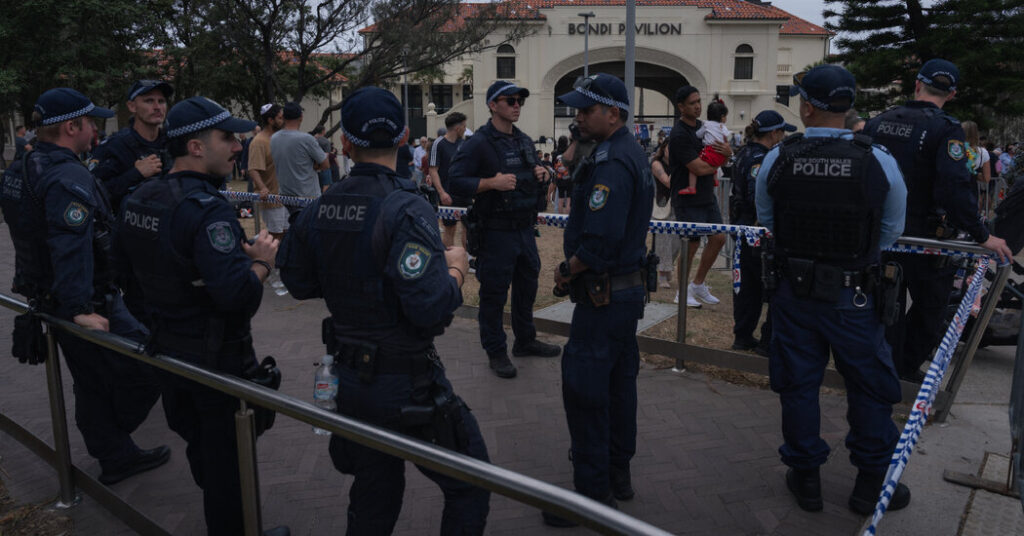
On Thursday, the police arrested seven men on a street in western Sydney after ramming into their car. The police said the men were suspected of having ties to Islamic extremism and had arrived from a different state, possibly with an intention of visiting Bondi Beach, the site of Sunday’s attack.
But on Friday, the men were released without charges. The police commissioner of New South Wales, Mal Lanyon, said their arrest was nonetheless justified.
“The potential of a violent offense being committed was such that we were not prepared to tolerate the risk,” he told reporters.
Legal scholars and security analysts saw in the police operation, and in the rush to pass new laws, an understandable urge to be seen doing something.
Matteo Vergani, director of the Tackling Hate Lab at Deakin University in Melbourne, said that “overcorrections” were common in the first weeks after a terrorizing attack.
“But there are risks,” said Mr. Vergani, who leads research in how to prevent and respond to violent extremism. “The reforms need to be done carefully. If a new law does not clearly define what counts as hate, future governments can stretch the rules for political purposes.”
“We don’t need to lower the threshold for what is hate,” he added. “We need to clarify what hate is.”
Mr. Minns and the authors of New South Wales’s proposed law had yet to clarify what would lead them to decide when state officials could ban protests.
Likewise, the prime minister and his Labor Party have not defined the new threshold for hate speech — or for a new category of aggravated hate speech — that they have promised to include in laws that they are drafting. Some Jewish leaders have called for outlawing slogans like “globalize the Intifada” and “from the river to the sea.”
Many Jews in Australia have complained for more than a year that officials allowed protests that included threatening banners and language since Israel’s war in Gaza after the Hamas-led attack in 2023.
The Palestine Action Group, which has organized several large demonstrations, issued a statement Friday that said New South Wales’s proposed law “poses a serious danger to our democratic rights.”
Among terrorism experts in Australia, however, there tends to be agreement that while tougher enforcement against threatening speech is vital, new laws may not be the best solution. They stress that the country already has some of strongest and most far-reaching laws to prevent terrorism in the democratic world.
Simon Bronitt, a criminal law professor and expert in violent extremism at the University of Sydney, noted that the Australian authorities also had “social order” laws giving them wide powers against offensive conduct and language.
However, they have not used these laws regularly, if at all, during the recent protests, including a pro-Palestinian demonstration in front of the Sydney Opera House two days after Hamas attacked Israel on Oct. 7, 2023. While there has been disagreement about what the protesters there actually shouted — some say it was “Gas the Jews,” others “Where are the Jews?” — Mr. Bronitt said any version should have been enough to prompt the police to act.
“We need to do more,” Mr. Bronitt said. “But the idea is not to create another set of new laws.”
Instead, he said, enforcement should be more common and consistent, perhaps with stiffer punishment for violators to establish new norms. Even more important, he said, was stopping problems at early stages with education and community outreach.
“It’s not just preventive policing,” he said. “What are the conditions that drive extremism, and how we can work with the Muslim community and the Jewish community to prevent radicalization?”
Mr. Vergani of the Tackling Hate Lab said that Australia now had an opportunity to to fight hate, to create more unified enforcement across states with different legal standards and to bring the country together. But if the authorities put too much emphasis on making laws without trying to get at the root causes, the whole process could backfire.
“It’s tricky,” he said. “Sometimes politicians legislate but there are no resources or it’s not feasible to enforce the legislation. If that happens, communities just get more frustrated.”
Damien Cave leads The Times’s new bureau in Ho Chi Minh City, Vietnam, covering shifts in power across Asia and the wider world.
The post Australia Debates New Laws to Restrict Hate and Suspend Protests appeared first on New York Times.