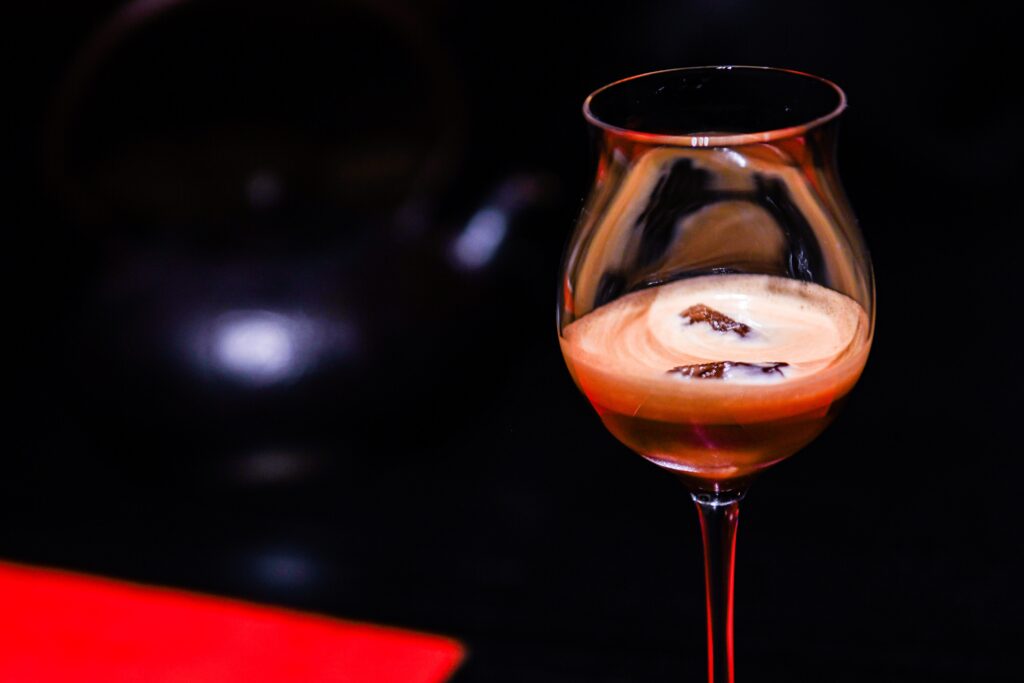
TOKYO — Walking in the quiet neighborhood, you begin to wonder whether you’re in the right place. The building isn’t marked, and the address is gatekept unless you’ve secured a reservation.
Inside, a barista wears a crisp black jacket and a broad smile, and birds are chirping on the sound system. A giant black ball fills most of the room, containing seating for four. For the next 90 minutes, you will be treated to a six-course coffee menu with an extravagance that is almost impossible to overstate.
I am definitely in the right place.
Italy brought us cappuccinos. Australia introduced the flat white. Cuba created the cafecito, and the Middle East, the qahwa.
Japan is bringing us coffee omakase.
In a coffee culture that has grown more elaborate, meticulous — and, yes, at times more than a little pretentious — this is next level. Treats and sweets are served between courses, meant to evoke seasonal themes. World-champion baristas prepare drinks with the banter of a friendly bartender.
In Japan, there are a number of cafes specializing in coffee omakase. Over the course of three days, I sampled four of them in a highly caffeinated journey through Tokyo and Kyoto. It evoked the dining experience associated with high-end sushi, placing you in the hands of an expert to curate and overwhelm your senses. (Omakase translates to “I’ll leave it up to you.”)
Some come to Japan for the sushi or wagyu, or the viral trends of soufflé pancakes and udon carbonara. I sampled some of those, too, but my primary interest was in this delicate treatment of the world’s most common beverage.
A regular joe, this is not.
Quest for the perfect cup
Benjamin Brewer, director of quality control for Blue Bottle, said people across the continent are embracing coffee omakase, “not only Japan, but South Korea and Hong Kong. India, Vietnam and Singapore are all seeing major growth.”
Brewer’s employer, based in Oakland, California, has one of the most exquisite programs in Kyoto.
“This is a big shift” in the coffee world, Brewer said.
Japanese culture is known for seeking perfection, and the art of extracting coffee — with the right pH levels in the water, the perfect temperature, the best grind settings — has set a high standard among baristas.
Japan has always had a rich coffee history, and some of the older cafes, called kissatens, still exist. There’s Cafe de l’ambre (“coffee only,” the sign proclaims) in Ginza, or Chatei Hatou in Shibuya. Walking into them can feel like walking back in time, with dark wooden rooms and coffee served in small porcelain cups.
In her book “Coffee Life in Japan,” Merry White wrote that coffee was once used as medicine and as a stimulant for 17th-century prostitutes in Nagasaki. In the early 20th century, it became a commonplace beverage.
“The expansion of the world’s coffee industries, I will argue, was in its early days closely related to the rise of coffee drinking in Japan,” White writes.
Japan manufactures much of the elegant glassware and intricate designs used for pour-overs. Coffee is in the ubiquitous vending machines, well-stocked in the 7-Eleven, FamilyMart and Lawson convenience stores.
Europe is a price-sensitive market, where protests erupt when espresso costs go up. But Japan is used to expensive coffee. The prices for a multicourse omakase experience don’t run cheap, ranging from $55 to $120.
“There’s a legacy,” Brewer said. “I mean, it’s coffee, right? It’s something that we’re all interacting with on a daily basis, but there’s, like, a very specific way of interacting with it, which is: Can we make this better? Can we make this more personal? Can we make this more hospitable?”
Mad science meets ‘happy’ cows
Deliberately hiding the location of the tasting added a bit of mystery to the experience, but that’s part of the appeal of Cokuun, the unmarked coffee house where I tried my first omakase.
At a time when most stores are courting influencers and trying to showcase themselves on TikTok, Cokuun has a basic website and little more.
It is the work of Hidenori Izaki, who in 2014 became the first Asian competitor to win the World Barista Championship. Growing out of experimenting he did during covid, he opened Cokuun to the public a couple of years ago. He deliberately chose to describe it as coffee omakase to evoke a phrase that refers to a luxury.
Inside is a large black bubble that contains four seats around a bar. The design is based on a traditional teahouse, where a small entrance required samurai to leave their swords outside. Everyone inside is equal, Izaki explained.
Water is shipped several times a week from mountain springs in southern Japan. Glassware and porcelain cups have been made specially for this experience. In some courses, a dropper is used to inject small doses of espresso.
Izaki puts on black plastic gloves to grate a pear, creating juice that needs to be consumed within 15 minutes to best appreciate the delicate flavors. It is combined with water that has been infused with a cherry blossom branch from deep inside the mountains of Japan.
Another course includes Umami Milk, gathered from a farm he chose because each cow had a name and the owner remembers all of them.
“The cows looked very happy,” he said, and, to prove it, he provided a photo book titled, “Happy cow, Delicious milk.”
He likes a coffee from Costa Rica, from an area where fog makes the trees take longer to grow, leading to more complexities in the bean. It’s naturally processed, giving it a fruitier flavor.
“We try to find a rare coffee, with a story,” he said.
Walking out, it feels as though I’ve attended a theater production, with coffee as the main character and the barista as chief narrator.
Steeped in ceremony
I’ve often used my coffee obsession as a way to guide my travel. Finding the best local coffee shops, whether in Bali or in Birmingham, often leads me off the beaten path. How different countries consume coffee can provide deeper clues into their culture.
But the spread of specialized coffee can make a coffee shop in Brooklyn feel almost identical to one in Paris. That’s part of what makes the Japanese experience feel like a new twist.
At Lonich, a shop with baristas who have backgrounds in whisky and wine, a signature cocktail is shaken in a metal mixer like a martini.
Another drink has nonalcoholic gin from Japan, flower extract syrup from France and a coffee from Panama, all served in a martini glass, resulting in a floral explosion in your sip.
In some cases, the multicourse, sit-down coffee experiences were enough to provide a caffeine jolt. But they often took place over 90 minutes with cups only large enough for a taste. In some instances, still fighting jet lag, I still went for another cup of coffee afterward.
Baristas in bow ties
Earlier in his 20-year career in the Japanese coffee industry, Eiichi Kunimoto attempted to emulate Italy with espresso-style drinks and fast-paced service. But, eventually, he made the style more Japanese, culminating in Koffee Mameya Kakeru. East of the Sumida River in a quiet and walkable neighborhood outside of the city’s bright lights and busy streets, there’s a well-lit room and comfy blond wooden chairs lining a U-shaped table.
A performance takes place in the middle, with three islands filled with coffee equipment. Six baristas in bow ties and white coats work together to craft different drinks.
“Coffee is something that ties people and time together,” Kunimoto said. “We get that inspiration from the ancient Japanese tea ceremony. We know many people think of coffee as an energy drink booster. I think we’re thinking carefully now how we can tell that story and can have that experience.”
On my visit, we try oolong tea brewed with cascara, the fruity husk removed from coffee beans.
We drink coffee at 140 degrees and 46 degrees, noting how the taste changes with the temperature.
We have coffee flower tea, made from a flower that grows on the coffee plant but only blooms for one week.
Food pairings included fresh grilled corn with uni on top that had been infused with coffee and soy sauce.
Stimulating all the senses
Blue Bottle has played a big role in expanding the specialty coffee culture in Japan, and its shop in Kyoto is a shrine to some of that work. It’s located in a 100-year-old traditional Japanese townhouse, and it offers special tastings during certain times of the year.
Brewer has crafted a menu that looks at the future of coffee. He tries to celebrate coffee from Vietnam, which is the world’s second-largest coffee producer but can be overlooked in the specialty coffee market.
Climate change is affecting current coffee regions, and there’s not enough diversity in arabica — the bean most often used for specialty coffee — to sustain.
“Coffee as we know it is expected to go extinct by 2050,” he says.
Sitting down in a wooden room with jazz music playing from a vinyl record player, barista Kurumi Hisakawa starts by saying she will aim to stimulate all five senses over nine courses. Her instructions take a Zen-like approach.
“All of us have different experiences. We’re all individuals,” she says. “Take time. Let loose. Use senses.”
The menu here is, in some ways, simple. It’s focused mainly on black coffee prepared different ways. But it also showcases the complexity in a small bean.
Some of the coffees smell like perfume. Some are potent and strong. Others have a delicate, tealike quality.
Walking out of Blue Bottle’s cafe, the last of my four coffee omakase experiences, I feel refreshed — and more than a little caffeinated.
I am definitely in the right place.
The post Coffee omakase is Japan’s love letter to caffeine appeared first on Washington Post.