Monica-Grace Mukendi has two vivid memories from her first year in the United States. She remembers blowing out candles on her sixth birthday, the first that she celebrated in New York after emigrating from the Democratic Republic of Congo. She also remembers crying in class because she couldn’t express herself in English.
With help from her family, Monica-Grace learned quickly. Her cousin quizzed her using English flashcards on the subway to her school in East Harlem, and her uncle took her and her brothers to the library on weekends. Her English skills improved so quickly that her teacher moved her to an honors class.
She continued to thrive over the years and packed her high school schedule with extracurriculars. She was a stage manager and a member of the poetry club. She learned how to code on weekends. Her activities were those of a typical ambitious, college-bound teenager. Yet as an immigrant, Ms. Mukendi wasn’t sure how to apply to college or decide what to study. “I didn’t have that strong pull,” she said.
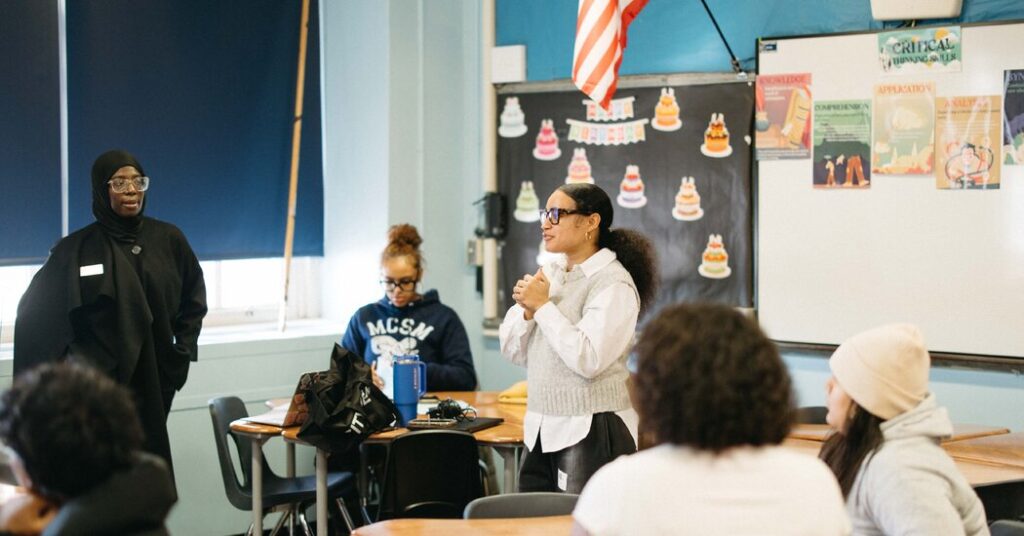
Her mind-set began to change before her junior year of high school, when Ms. Mukendi received her schedule and saw a class she didn’t recognize, called OneGoal.
An organization based in Chicago, OneGoal brings a multiyear class to high schools across the country. Its curriculum is designed to help students reflect on their career goals, write college essays, apply for financial aid and submit applications.
Americans’ belief in the importance of college has dropped sharply over the last 15 years, but college remains a powerful driver of upward mobility. A typical college graduate earns 75 percent more than they would if they had only a high school diploma. Even so, only half of low-income students attend college, compared with 90 percent of their wealthier peers.
OneGoal is trying to close that gap, and its model works. Its classes have served more than 30,000 students, and 80 percent of its graduates enroll in college or vocational school. To help students stay enrolled, OneGoal offers support throughout the first year of college.
During her junior year of high school, Ms. Mukendi realized that she did not have legal immigration status, which she soon learned would make her ineligible for state or federal financial aid. Her school’s guidance counselors were not sure how to handle the situation, and Ms. Mukendi thought she might not make it to college after all. OneGoal stepped in, helping her secure a grant that allowed her to attend college. Later, OneGoal also provided funding to renew her legal status under DACA, a program for people who entered the country as children.
Ms. Mukendi eventually transferred to Binghamton University, graduated with a bachelor’s degree in human development and worked as an analyst at McKinsey for two years. Today, she works in alumni engagement at Syracuse University, where she is also pursuing a master’s degree in marriage and family therapy. Someday, she hopes to start an educational and career consulting practice.
Her aspirations demonstrate the lasting effects of the mentorship she received through OneGoal. “In the end, it’s all going to make sense,” she said. “I’m just here for the journey.”
A $1,500 donation to OneGoal provides a young person with a full year of instruction, advising and support. You can learn more about the beneficiary organizations and donate at nytcommunitiesfund.org. To donate by check, please make your check payable to The New York Times Communities Fund and send it to P.O. Box 5193, New York, N.Y. 10087.
The Times is committed to publishing a diversity of letters to the editor. We’d like to hear what you think about this or any of our articles. Here are some tips. And here’s our email: [email protected].
Follow the New York Times Opinion section on Facebook, Instagram, TikTok, WhatsApp, X and Threads.
The post College Is Still Worthwhile. This Organization Proves It. appeared first on New York Times.