When Claudia Sheinbaum was elected president of Mexico last year, some cartels might have celebrated.
She is a climate scientist, not a cop. More important, she was the handpicked successor of Andrés Manuel López Obrador, the leftist leader whose “hugs not bullets” security strategy led to one of the worst waves of violence Mexico has ever seen.
But Ms. Sheinbaum had a pocket ace.
When she was Mexico City’s mayor, she picked a federal police official named Omar García Harfuch to lead security. Homicides fell by roughly 40 percent under their watch.
As president, she again picked Mr. Harfuch, this time to combat violent crime nationwide.
That is a far taller task. Mexico is home to some of the world’s most powerful criminal groups, and they have outlasted every previous effort to defeat them.
But Ms. Sheinbaum and Mr. Harfuch have overseen one of the most aggressive campaigns against the cartels in more than a decade, and it has shown early signs of success. According to government figures, homicides and violent robberies are down — though disappearances, kidnappings and extortion are on the rise.
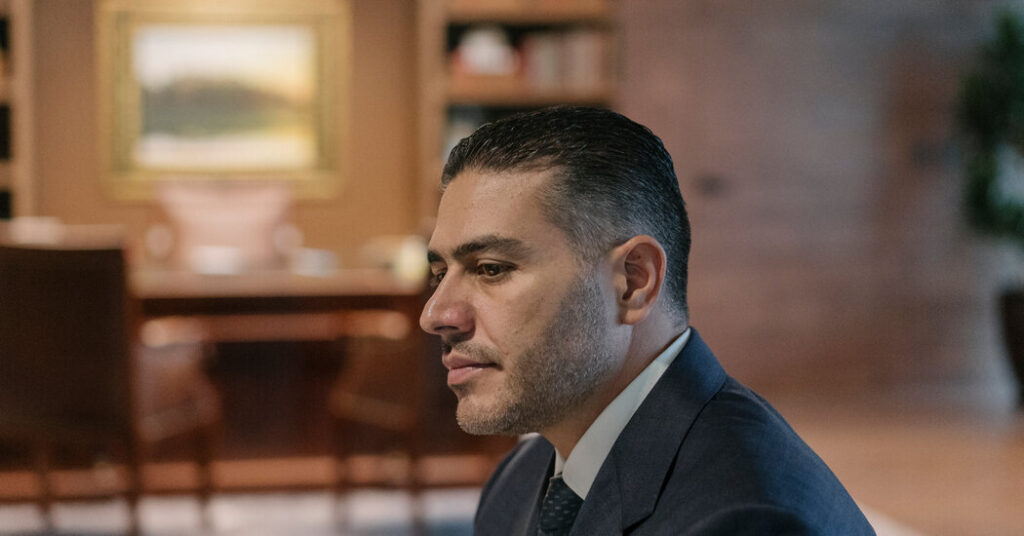
The New York Times spoke with Mr. Harfuch in his first on-the-record interview with international media since taking over Mexico’s security strategy last year.
Here are edited excerpts from our conversation.
What’s working?
The fact that the president leads the security cabinet meeting every day makes a tremendous difference. For many years, we have experienced a lack of coordination between security institutions, and that has a huge impact.
The security cabinet starts at 6 a.m. sharp, and on that board you see all the homicides.
If there has been a change, we immediately go to the municipalities. And that’s done by the president herself. She issues instructions right there. It makes coordination much easier.
Yet despite declines in violent crime, some Mexicans believe the nation is less safe. Why?
I’m convinced it will be like in Mexico City. Once homicides and robberies started to go down, it took a long time for perceptions to change. But they did change.
When we say 37,000 arrests, 300 tons of drugs seized and 1,600 laboratories destroyed, sometimes it’s difficult for the public to understand what that means. It translates into billions of pesos and billions of doses of drugs that are no longer being produced.
You’ve said you need to strengthen the security forces to do that. How?
Claudia Sheinbaum raised the salary of the Mexico City police by more than 60 percent. She also sent an initiative to Congress to give the Mexico City police the power to investigate. That is the same thing she did with us now at the federal level.
More legal capabilities. More manpower. Better conditions.
It’s better to have 1,000 well-equipped and trained police officers than 4,000 or 3,000 who are poorly paid and poorly trained.
How is your relationship with the White House?
When President Trump arrived, there was concern about how we were going to work. We began to explain our method. We showed them the results.
We also explained that it was very important to align priorities. For many years, Mexico and the United States targeted only one drug trafficker. That was to say, “Oh, we’ve arrested him.” And what changed? Nothing.
Having isolated cases against isolated individuals, no matter how important they may be, does not change anything. What we’re doing is hitting the criminal structure at the bottom, in the middle and at the top.
President Trump has said he would like to strike Mexico’s cartels. Ms. Sheinbaum has said that would be unacceptable. Are you concerned?
I’m not because we have very good coordination. We are presenting more and more detainees, arresting more and more targets, seizing more drugs, destroying more laboratories. They themselves have said that less fentanyl is entering their country. So we would be concerned if it were the other way around.
Would Mexico and the United States carry out joint operations?
I don’t see why they would be needed. What we need is information. So the exchange is more than welcome, but if I’m going to arrest a target —
(A phone rings — he says it’s Ms. Sheinbaum — and he leaves the room.)
What happened?
She called to say, “Hey, we need to reduce extortion.” She’s receiving medium-size business owners, the ones who suffer, the little guys. There’s an obligation to deliver results.
You’ve been successful in weakening the Sinaloa Cartel. But there are signs that has contributed to the strengthening of its rival, the Jalisco New Generation Cartel.
This fight is not going to be sustainable for the Sinaloa Cartel. In Culiacán, when we arrived, there were convoys of trucks. But today homicides are committed in a very different way. It’s a small car with two or three guys in it.
We’re there, and this obviously weakens them. But other cartels will always want to take over where another cartel is weak.
Miriam Castillo contributed reporting.
Jack Nicas is The Times’s Mexico City bureau chief, leading coverage of Mexico, Central America and the Caribbean.
The post Mexico’s Security Chief on His Fight Against the Cartels appeared first on New York Times.