Matthew Fleming has spent the last 25 years as a chaplain, counseling people through grief and trauma, including after disasters like Sept. 11 and Hurricane Katrina. Yet despite all of his experience and training, he was blindsided when his father died.
When Dr. Fleming, a psychologist and former naval officer, was steeped in grief, he found that the best support he received was from people who stayed steadily by his side.
In chaplaincy training, Dr. Fleming said, he was taught that “ours is a ministry of presence.” His father’s death helped him realize how true that was.
“Presence matters,” he said. “Sitting with the bereaved. Not even talking. Just soaking in the loss together.”
“I try to remember that even more whenever I enter the house of grief,” he added.
A few months ago, I wrote a column on anticipatory grief, the sorrow we sometimes feel when we’re expecting a loss, and I asked you to tell me something a person did or said that helped ease your grief.
I received hundreds of replies. Here are some of my favorites, edited and condensed.
⬥
When my husband died suddenly, my friend Marilyn came over with a bucket, soap and rubber gloves and said, “I’m going to clean your bathroom.” And then she did.
No “call me if you need anything.” No asking me to figure anything out — because I couldn’t figure anything out. — Theresa Miller, Milwaukee
⬥
When my father died three and a half years ago from lung cancer, a group of friends sent me a plant — not a dinky house plant but a big, beautiful monstera that continues to overrun any window or table I put it in. It needs effort and care; when I see it and when I try to wrangle it, I think of my dad and that great group of friends. — Brittany Vegso, Strasburg, Pa.
⬥
My sisters always tell me when they make one of my late husband’s recipes (he was a gourmet cook). I am comforted that his generous spirit and love for a good meal continues on. — Erin Stimmell-Clark, West Barnstable, Mass.
⬥
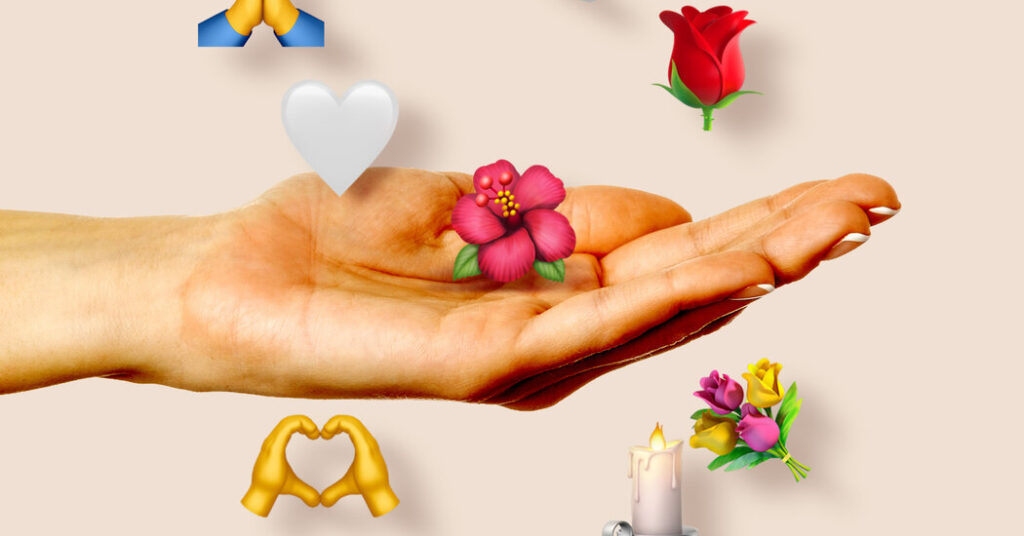
I had a friend that would text me emojis periodically — sunshine, hearts, rainbows, whatever — just letting me know she was thinking about me. Getting those emojis made me smile. And I didn’t have to respond — I could like her message or send her an emoji back. She was very helpful through the dark days. — Marianne Bloomberg, Farmington Hills, Mich.
⬥
When my mom passed, my husband would quietly put food in front of me to eat, as I was not actively looking for food like I normally would. — Cory Warden, Pagosa Springs, Colo.
⬥
The most helpful advice I’ve received was to keep an item of my loved one’s clothing. I have my grandfather’s cardigan, my stepdad’s black sweater and my aunt’s “Golden Girls” T-shirt.
It’s comforting to put them on and remember the fun times we had. I can’t stay sad for long when Sophia, Blanche, Rose and Dorothy are telling me to “stay golden.” — Amy Miles, Alexandria, Va.
⬥
The most helpful thing anyone did for me when I was grieving the loss of my husband was to initiate frequent outdoor walks. Fresh air, a little exercise and a chat got me through some very trying times. — Lucille Duguay, Bloomfield, Conn.
⬥
A friend once told me that when his father passed away, he realized he was grieving not just for his father, but also for the father he wished he’d had. That has really stuck with me over the years because it’s so applicable to many family relationships. — Catharine Gimbel, San Rafael, Calif.
⬥
What helped most was hearing that grief comes in waves, often out of the blue, and isn’t a smooth progression. You can be fine one minute and a mess the next, even after you think you “should be over it by now.”
There really isn’t a “by now,” and you can, eventually, observe the feeling and let it go by without being overwhelmed. — Jann Becker, St. Louis
Gout is an increasingly common — but misunderstood — disease.
Globally, rates of gout have climbed in recent decades; in the United States, the condition affects more than 12 million people. Yet it still carries a widespread stigma that it’s only a problem for gluttons or heavy drinkers.
Read the article: What Is Gout, and Why Is It on the Rise?
Our 5-Day Brain Health Challenge begins Jan. 5
Starting on Jan. 5, we’ll lead you through five days of activities designed to benefit your brain, and we’ll explain the science behind why they work. We’ll show you how to keep your mind sharp and resilient for years to come.
Read the article: Want a Healthier Brain in 2026?
The Week in Well
Here are some stories you don’t want to miss:
-
Rosacea tends to worsen in midlife. Here’s how to manage it.
-
In new trials, Ozempic failed to slow the progression of early Alzheimer’s. Learn the details.
-
Ask the Therapist: My parents are divorced. How do I navigate my mother’s anger during the holidays? Read the response.
-
Controlling blood sugar may cut a person’s heart disease risk in half, according to new research. Here is what the study says.
Let’s keep the conversation going. Follow Well on Instagram, or write to us at [email protected]. And check out last week’s newsletter about how to make a holiday visit with difficult in-laws easier.
Jancee Dunn, who writes the weekly Well newsletter for The Times, has covered health and science for more than 20 years.
The post The Small Gestures That Help Us Navigate Grief appeared first on New York Times.